• HOME
  • NEWS
  • EXPLORE
    • CAREER
      • Companies
      • Jobs
    • EVENTS
    • iGEM
      • News
      • Team
    • PHOTOS
    • VIDEO
    • WIKI
  • BLOG
  • COMMUNITY
    • FACEBOOK
    • INSTAGRAM
    • TWITTER
Thursday, September 24, 2026
BIOENGINEER.ORG
No Result
View All Result
  • Login
  • HOME
  • NEWS
  • EXPLORE
    • CAREER
      • Companies
      • Jobs
        • Lecturer
        • PhD Studentship
        • Postdoc
        • Research Assistant
    • EVENTS
    • iGEM
      • News
      • Team
    • PHOTOS
    • VIDEO
    • WIKI
  • BLOG
  • COMMUNITY
    • FACEBOOK
    • INSTAGRAM
    • TWITTER
  • HOME
  • NEWS
  • EXPLORE
    • CAREER
      • Companies
      • Jobs
        • Lecturer
        • PhD Studentship
        • Postdoc
        • Research Assistant
    • EVENTS
    • iGEM
      • News
      • Team
    • PHOTOS
    • VIDEO
    • WIKI
  • BLOG
  • COMMUNITY
    • FACEBOOK
    • INSTAGRAM
    • TWITTER
No Result
View All Result
Bioengineer.org
No Result
View All Result
Home NEWS Science News Chemistry

Planets around a black hole?

Bioengineer by Bioengineer
November 25, 2019
in Chemistry
Reading Time: 2 mins read
0
IMAGE
Share on FacebookShare on TwitterShare on LinkedinShare on RedditShare on Telegram

Calculations show possibility of bizarre worlds
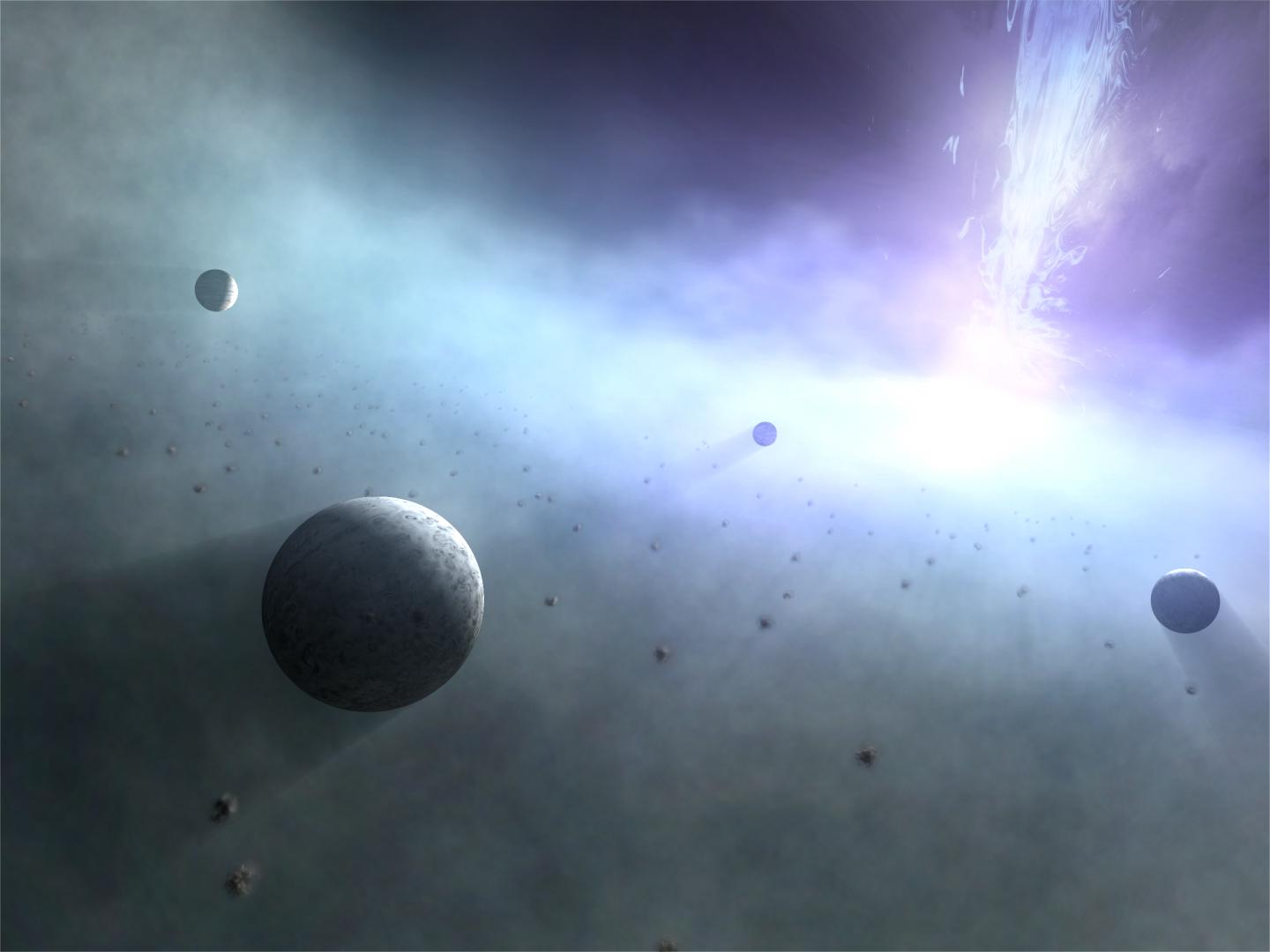
IMAGE

Credit: Kagoshima University


Theoreticians in two different fields defied the common knowledge that planets orbit stars like the Sun. They proposed the possibility of thousands of planets around a supermassive black hole.

“With the right conditions, planets could be formed even in harsh environments, such as around a black hole,” says Keiichi Wada, a professor at Kagoshima University researching active galactic nuclei which are luminous objects energized by black holes.

According to the latest theories, planets are formed from fluffy dust aggregates in a protoplanetary disk around a young star. But young stars are not the only objects that possess dust disks. In a novel approach, the researchers focused on heavy disks around supermassive black holes in the nuclei of galaxies.

“Our calculations show that tens of thousands of planets with 10 times the mass of the Earth could be formed around 10 light-years from a black hole,” says Eiichiro Kokubo, a professor at the National Astronomical Observatory of Japan who studies planet formation. “Around black holes there might exist planetary systems of astonishing scale.”

Some supermassive black holes have large amounts of matter around them in the form of a heavy, dense disk. A disk can contain as much as a hundred thousand times the mass of the Sun worth of dust. This is a billion times the dust mass of a protoplanetary disk.

In a low temperature region of a protoplanetary disk, dust grains with ice mantles stick together and evolve into fluffy aggregates. A dust disk around a black hole is so dense that the intense radiation from the central region is blocked and low temperature regions are formed. The researchers applied the planet formation theory to circumnuclear disks and found that planets could be formed in several hundred million years.

Currently there are no techniques to detect these planets around black holes. However, the researchers expect this study to open a new field of astronomy.

###

Media Contact
Hinako Fukushi
[email protected]

Original Source

https://www.cfca.nao.ac.jp/en/pr/20191125

Tags: AstronomyAstrophysicsPlanets/MoonsSpace/Planetary ScienceStars/The Sun
Share12Tweet8Share2ShareShareShare2

Related Posts

Ball-Milled and CVD Silicon Anodes Face Off in All-Solid-State Batteries

Ball-Milled and CVD Silicon Anodes Face Off in All-Solid-State Batteries

September 24, 2026
Induction-Heating PCR Chip Cracks Worm Genes in 30 Minutes

Induction-Heating PCR Chip Cracks Worm Genes in 30 Minutes

September 24, 2026

Chiral 2D Framework Turns Rhodium Catalyst Into a Recycling Champion

September 24, 2026

Tiny creases in soft materials act as rewritable gates that steer and sort droplets

September 24, 2026
Please login to join discussion

POPULAR NEWS

  • Nearly All Childhood Shigella Infections in Tehran Now Resist Multiple Antibiotics

    29 shares
    Share 12 Tweet 7
  • AI Learns to Read the Skies: Language Models Predict Air Traffic Complexity

    29 shares
    Share 12 Tweet 7
  • Why First-Generation Farmers Keep Farming Despite the Odds

    29 shares
    Share 12 Tweet 7
  • Immune Cells Cluster, Not Crowd, in Melanoma That Spreads to the Brain

    29 shares
    Share 12 Tweet 7

About

We bring you the latest biotechnology news from best research centers and universities around the world. Check our website.

Follow us

Recent News

Nearly All Childhood Shigella Infections in Tehran Now Resist Multiple Antibiotics

AI Learns to Read the Skies: Language Models Predict Air Traffic Complexity

Why First-Generation Farmers Keep Farming Despite the Odds

Subscribe to Blog via Email

Enter your email address to subscribe to this blog and receive notifications of new posts by email.

Join 85 other subscribers
  • Contact Us

Bioengineer.org © Copyright 2023 All Rights Reserved.

Welcome Back!

Login to your account below

Forgotten Password?

Retrieve your password

Please enter your username or email address to reset your password.

Log In
No Result
View All Result
  • Homepages
    • Home Page 1
    • Home Page 2
  • News
  • National
  • Business
  • Health
  • Lifestyle
  • Science

Bioengineer.org © Copyright 2023 All Rights Reserved.