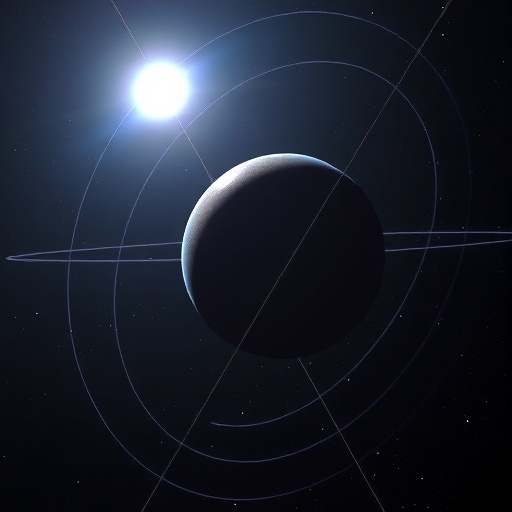
Brown dwarfs bridge the gap between planets and stars, occupying a mass range that challenges both definitions and expectations. In star–substellar systems, a third body orbiting the companion has been dubbed an “exosatellite,” but the term’s boundaries—especially whether it truly qualifies as an exomoon—remain unsettled. With more than 6,000 exoplanets discovered, the absence of any confidently detected exomoon has stood out as a major observational puzzle. Some candidates have been proposed, yet they remain controversial and unconfirmed.
The new study reports evidence for an exosatellite around CD-35 2722 B, a brown dwarf companion directly imaged around its host star. Researchers turned to a method familiar from exoplanet discovery: radial velocity analysis. Instead of monitoring a bright star’s wobble, they analyzed high-resolution VLT/CRIRES+ spectra of the brown dwarf itself, searching for periodic Doppler shifts that could betray the gravitational tug of an orbiting companion.
In exoplanet science, radial velocity works by detecting oscillations in spectral lines caused by an object’s orbital motion. Here, the same logic is applied to a much more difficult target: a substellar body whose spectral behavior can be complex. The team nevertheless finds what appears to be a periodic signal consistent with at least one satellite orbit.
The best-fitting orbital model suggests a satellite with a minimum mass near 0.9 Jupiter masses and an orbital period of roughly 170 days. A key point is that this inference depends on statistical modeling of the radial-velocity variations and the quality of the spectroscopic data. Consequently, while the signal is compelling, the existence of the companion remains to be tested more decisively.
What makes the result especially notable is that it represents, to the authors’ knowledge, the first time this radial-velocity technique has produced evidence for satellites around a companion brown dwarf. If confirmed, such a detection would provide a new pathway to study “moon-like” systems in the substellar regime.
Whether the object will meet any formal, community-agreed criteria for an exomoon is still uncertain. Still, the work is portrayed as a meaningful step toward an eventual first uncontroversial exomoon detection, aided by advancing instruments and improved spectroscopic sensitivity.
Subject of Research: Exosatellite formation and detection around a brown dwarf companion
Article Title: Planetary-mass exosatellite detected around the substellar companion of a star.
Article References: Hoy, K., Zurlo, A., Peña R, P.A. et al. Nature 655, 865–869 (2026). https://doi.org/10.1038/s41586-026-10751-w
Image Credits: AI Generated
DOI: 10.1038/s41586-026-10751-w
Keywords: Brown dwarfs; exosatellites; radial velocity; direct imaging; substellar companions
Tags: brown dwarf companionsdirect imaging of brown dwarf exosatellitesexomoon identification challengesexosatellite detectiongravitational tug in brown dwarf systemshigh-resolution spectroscopy in exoplanet researchobservational methods for exosatellite detectionorbit characterization of planetary-mass satellitesradial velocity analysis of substellar objectsspectral analysis of exoplanetary bodiesstar–substellar system dynamicssubstellar companion system architecture