• HOME
  • NEWS
  • EXPLORE
    • CAREER
      • Companies
      • Jobs
    • EVENTS
    • iGEM
      • News
      • Team
    • PHOTOS
    • VIDEO
    • WIKI
  • BLOG
  • COMMUNITY
    • FACEBOOK
    • INSTAGRAM
    • TWITTER
Thursday, July 2, 2026
BIOENGINEER.ORG
No Result
View All Result
  • Login
  • HOME
  • NEWS
  • EXPLORE
    • CAREER
      • Companies
      • Jobs
        • Lecturer
        • PhD Studentship
        • Postdoc
        • Research Assistant
    • EVENTS
    • iGEM
      • News
      • Team
    • PHOTOS
    • VIDEO
    • WIKI
  • BLOG
  • COMMUNITY
    • FACEBOOK
    • INSTAGRAM
    • TWITTER
  • HOME
  • NEWS
  • EXPLORE
    • CAREER
      • Companies
      • Jobs
        • Lecturer
        • PhD Studentship
        • Postdoc
        • Research Assistant
    • EVENTS
    • iGEM
      • News
      • Team
    • PHOTOS
    • VIDEO
    • WIKI
  • BLOG
  • COMMUNITY
    • FACEBOOK
    • INSTAGRAM
    • TWITTER
No Result
View All Result
Bioengineer.org
No Result
View All Result
Home NEWS Science News Chemistry

Pioneering technique paves way for fast and cheap fabrication of rapid medical diagnostic tools

Bioengineer by Bioengineer
February 3, 2021
in Chemistry
Reading Time: 2 mins read
0
IMAGE
Share on FacebookShare on TwitterShare on LinkedinShare on RedditShare on Telegram

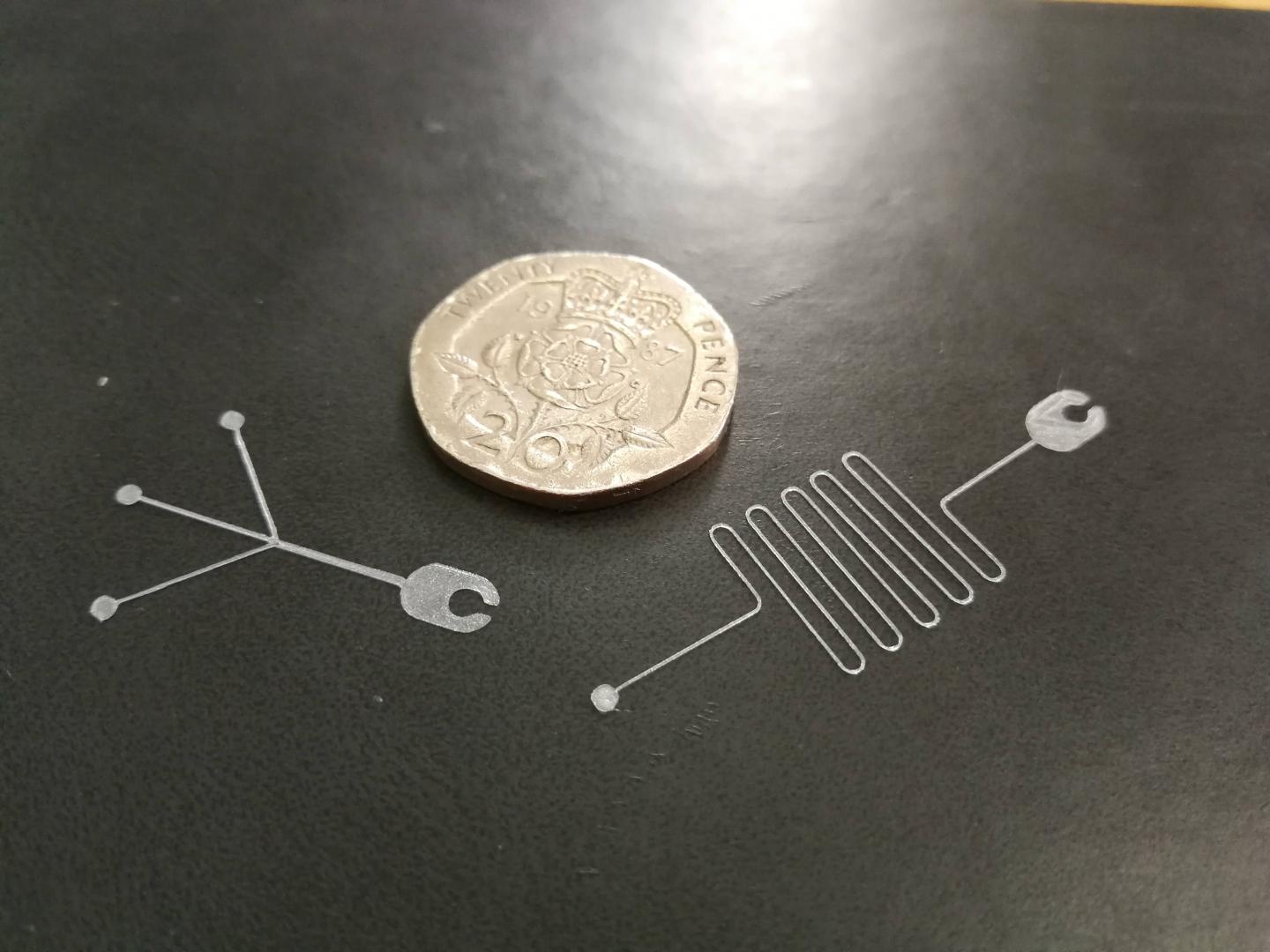
Breakthrough promises to democratise microfluidics and lab-on-a-chip technology, benefiting resource-poor countries and settings
IMAGE

Credit: University of Bristol

New technology developed by the University of Bristol has the potential to accelerate uptake and development of on-chip diagnostic techniques in parts of the world where rapid diagnoses are desperately needed to improve public health, mortality and morbidity.

Microfluidic devices underpin lab-on-a-chip (LOC) technologies which are developed to provide the rapid diagnoses at that are needed at point of care (POC) for the swift and effective treatment of many diseases.

Researchers at Bristol have developed a fast, reliable and cost-effective alternative for producing the soft-lithographic moulds used for fabricating microfluidic devices, published in the journal PLOS ONE. This discovery means fabrication of microfluidic devices (with channel dimensions ~width of a human hair) is now both accessible and affordable using simple, low-cost 3D-printing techniques and the open-source resources developed by the team.

“Previously, techniques for producing the soft-lithographic scaffolds/moulds (microfluidic channel patterns) were time-consuming and extremely expensive, while other low-cost alternatives were prone to unfavourable properties. This development could put LOC prototyping into the hands of researchers and clinicians who know the challenges best, in particular those in resource-limited settings, where rapid diagnostics may often have the greatest impact,” said lead author of the study, Dr Robert Hughes.

“This technique is so simple, quick & cheap that devices can be fabricated using only everyday domestic or educational appliances and at a negligible cost (~0.05% of cost of materials for a single microfluidic device). This means researchers and clinicians could use our technique and resources to help fabricate rapid medical diagnostic tools, quickly and cheaply, with minimal additional expertise or resources required,” said co-author, Mr Harry Felton.

“The simplicity and minimal cost of this technique, as well as the playful click-and-connect approach developed, also makes it suitable for hobbyists and educational use, to teach about microfluidics and the applications of lab-on-a-chip technology,” said co-author Ms Andrea Diaz Gaxiola.

“It is our hope that this will democratise microfluidics and lab-on-a-chip technology, help to advance the development of point-of-care diagnostics, and inspire the next generation of researchers and clinicians in the field,” said Dr Hughes.

The next step for the team is to identify potential collaborators in both research and education to help demonstrate the impact this technology could have in both settings by developing and supporting outreach activities and applications for on-chip diagnostic testing.

###

Paper: ‘Negligible-cost microfluidic device fabrication using 3D-printed interconnecting channel scaffolds,’ by Felton, H., Hughes, R., & Diaz-Gaxiola, A., in PLOS ONE.

Media Contact
Shona East
[email protected]

Related Journal Article

http://dx.doi.org/10.1371/journal.pone.0245206

Tags: Biomedical/Environmental/Chemical EngineeringDiagnosticsElectrical Engineering/ElectronicsNanotechnology/MicromachinesTechnology/Engineering/Computer Science
Share12Tweet8Share2ShareShareShare2

Related Posts

Graz University of Technology Deciphers the Structural Secrets of MOF Thin Films — Chemistry

Graz University of Technology Deciphers the Structural Secrets of MOF Thin Films

July 2, 2026
Breaking Thermodynamic Limits: Wavelength-Driven Catalysis Advances Ammonia Synthesis — Chemistry

Breaking Thermodynamic Limits: Wavelength-Driven Catalysis Advances Ammonia Synthesis

July 2, 2026

From Quantum Mechanics to AI-Powered Materials Discovery: MARVEL Marks 12 Years of Transforming Computational Science

July 2, 2026

Djire Recognized with National Award for Outstanding Contributions in Research and Teaching

July 2, 2026
Please login to join discussion

POPULAR NEWS

  • Detection of EDCs in Breast Milk and Infant Urine Up to Six Months Highlights Early Exposure Risks

    77 shares
    Share 31 Tweet 19
  • Saying Goodbye to PGY-6: Pediatric Fellowship Realities

    103 shares
    Share 41 Tweet 26
  • New Drug Candidate Developed at McMaster Shows Potential for Treating Brain Cancer

    58 shares
    Share 23 Tweet 15
  • KTU Researchers Explore Ultrasound’s Role in Enhancing Blood Flow Beyond Diagnostics

    53 shares
    Share 21 Tweet 13

About

BIOENGINEER.ORG

We bring you the latest biotechnology news from best research centers and universities around the world. Check our website.

Follow us

Recent News

Steatosis Drives Liver Metastasis Diversity in CRC

Unlocking the Mysteries of Alzheimer’s Disease

Pensoft Introduces New Peer-Reviewed Journal of Regeneration to Advance Restorative Biology Across Species

Subscribe to Blog via Email

Enter your email address to subscribe to this blog and receive notifications of new posts by email.

Join 83 other subscribers
  • Contact Us

Bioengineer.org © Copyright 2023 All Rights Reserved.

Welcome Back!

Login to your account below

Forgotten Password?

Retrieve your password

Please enter your username or email address to reset your password.

Log In
No Result
View All Result
  • Homepages
    • Home Page 1
    • Home Page 2
  • News
  • National
  • Business
  • Health
  • Lifestyle
  • Science

Bioengineer.org © Copyright 2023 All Rights Reserved.