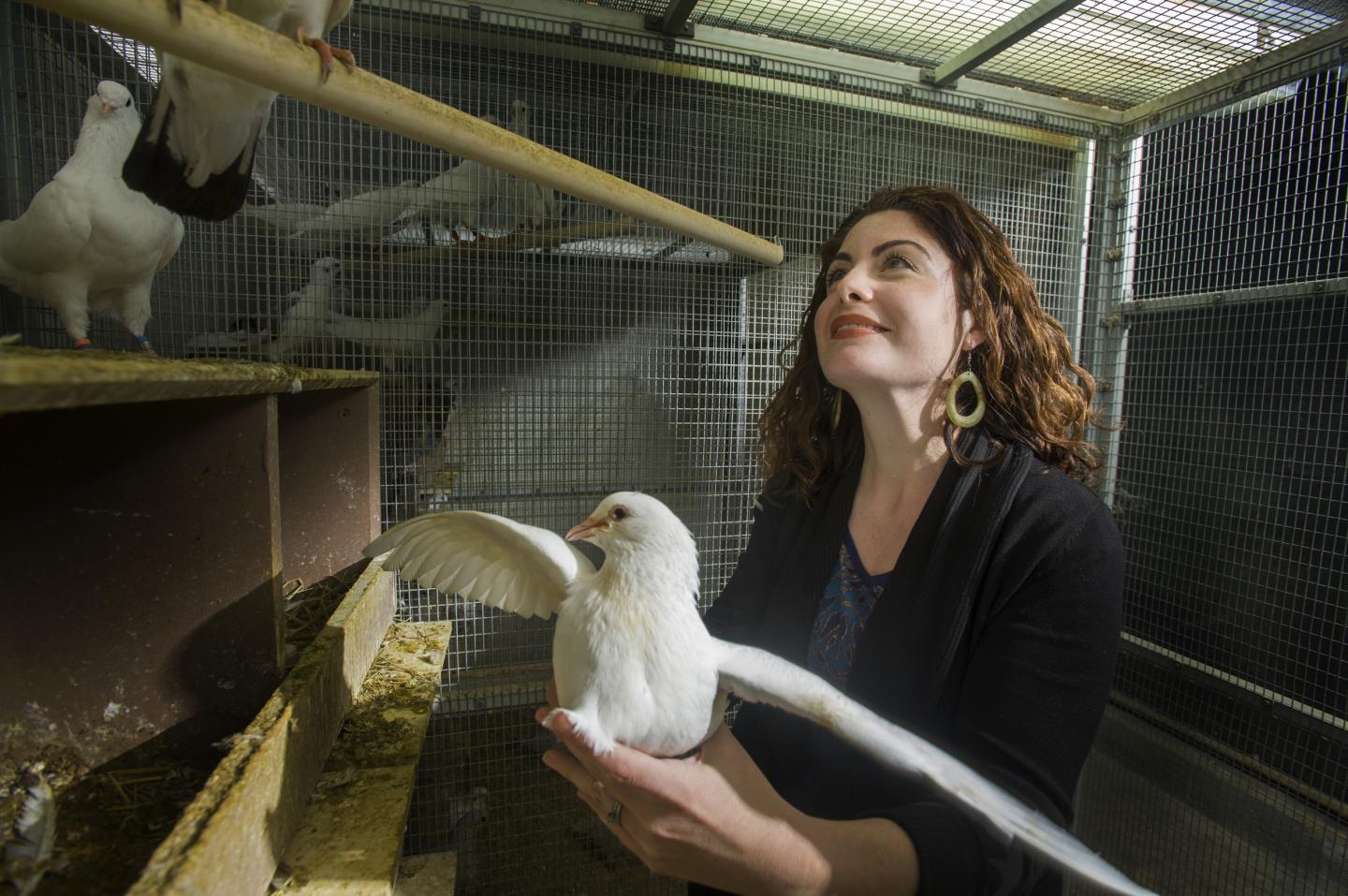
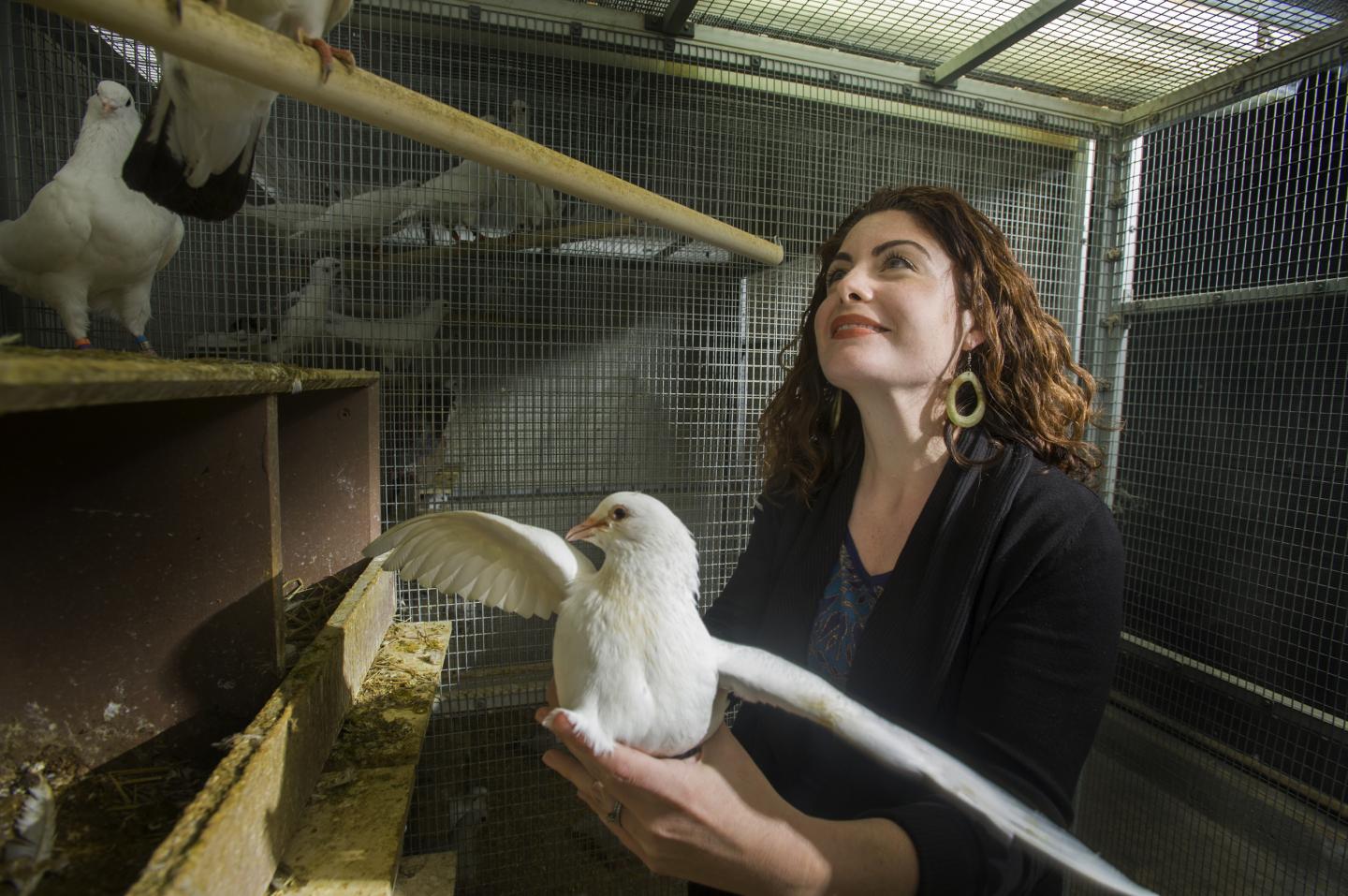
Credit: Gregory Urquiaga/UC Davis
In experimental research, scientists tend to assume that — unless they are looking specifically at reproduction or sexual behavior — male and female animals are alike, and mostly use males. But a new study by researchers at the University of California, Davis and the University of New Hampshire, published April 18 in Scientific Reports, shows surprisingly big differences in tissue gene expression between male and female rock doves. The work is part of an attempt to make science more gender-inclusive and aware of physiological and other differences between the sexes.
"There's a problem of sex and gender inclusion at all levels of science from faculty to the animals we use," said Rebecca Calisi, assistant professor of neurobiology, physiology and behavior at UC Davis and senior author on the paper. "We're trying to ameliorate that, at least in reproductive biology."
The problem for experimental science, Calisi said, is that males and females can react very differently to different treatments, even when these don't seem to be sex-related. For example, drugs as well-known as aspirin have different effects in men and women, and women report a higher rate of adverse reactions to drugs than do men.
Hundreds of Differences in Gene Activity
Calisi and co-author Matthew MacManes at the University of New Hampshire are exploring this problem using the reproductive system of the "rock dove," or common pigeon, as C. Samuel Craiga model. Scientists back to Charles Darwin have worked with pigeons, and their physiology is well-studied. Like all other vertebrates, the gonads (testes and ovaries) are influenced by hormones produced by the pituitary gland, which itself is controlled by hormones from the hypothalamus, a structure in the brain. Sex hormones produced by the gonads (testosterone and estradiol) in turn feed back to the hypothalamus. This "hypothalamus-pituitary-gonad" axis is found in animals from fish and lizards to birds and people.
Calisi's team looked at the baseline "transcriptome," capturing all the genes expressed in the hypothalamus, pituitary and gonads in male and female pigeons when they were not engaged in reproductive behavior. They found hundreds of differences in gene activity between males and females.
"There are incredible differences in gene expression, especially in the pituitary," Calisi said. The results show that there are far more sex-based differences in the pituitary than previously thought, she said.
The team has created a publicly accessible database for researchers of all the patterns of gene activation that differ between male and female pigeons. The results should generate new leads for investigating male and female reproduction, and encourage researchers to look harder at the effect of sex bias in physiological studies.
Having established baseline genomic data for the hypothalamus-pituitary-gonad axis in the pigeon model, Calisi and MacManes plan to use it to look at the influence of sex on other conditions, such as stress and parental care.
###
Additional coauthors on the paper are, at UC Davis, Suzanne Austin, April Booth and Victoria Farrar, and Andrew Lang at the University of New Hampshire.
The work is supported by a grant from the National Science Foundation.
Media Contact
Andy Fell
[email protected]
530-752-4533
@ucdavisnews
http://www.ucdavis.edu