

• HOME
  • NEWS
  • EXPLORE
    • CAREER
      • Companies
      • Jobs
    • EVENTS
    • iGEM
      • News
      • Team
    • PHOTOS
    • VIDEO
    • WIKI
  • BLOG
  • COMMUNITY
    • FACEBOOK
    • INSTAGRAM
    • TWITTER
Wednesday, May 6, 2026
BIOENGINEER.ORG
No Result
View All Result
  • Login
  • HOME
  • NEWS
  • EXPLORE
    • CAREER
      • Companies
      • Jobs
        • Lecturer
        • PhD Studentship
        • Postdoc
        • Research Assistant
    • EVENTS
    • iGEM
      • News
      • Team
    • PHOTOS
    • VIDEO
    • WIKI
  • BLOG
  • COMMUNITY
    • FACEBOOK
    • INSTAGRAM
    • TWITTER
  • HOME
  • NEWS
  • EXPLORE
    • CAREER
      • Companies
      • Jobs
        • Lecturer
        • PhD Studentship
        • Postdoc
        • Research Assistant
    • EVENTS
    • iGEM
      • News
      • Team
    • PHOTOS
    • VIDEO
    • WIKI
  • BLOG
  • COMMUNITY
    • FACEBOOK
    • INSTAGRAM
    • TWITTER
No Result
View All Result
Bioengineer.org
No Result
View All Result
Home NEWS Science News Chemistry

Physiological features of Japanese black cattle with high methane production

Bioengineer by Bioengineer
July 21, 2022
in Chemistry
Reading Time: 2 mins read
0
Figure 1
Share on FacebookShare on TwitterShare on LinkedinShare on RedditShare on Telegram

Japan’s agricultural sector produced 32.3 million tons of greenhouse gas emissions in 2022, accounting for 2.8% of the country’s total emissions. Nearly a quarter of that stems from enteric fermentation within livestock. Ruminants – grazing animals such as cattle, sheep and goats that acquire nutrients from plant-based diets – give off enteric methane as they decompose and ferment plant materials.
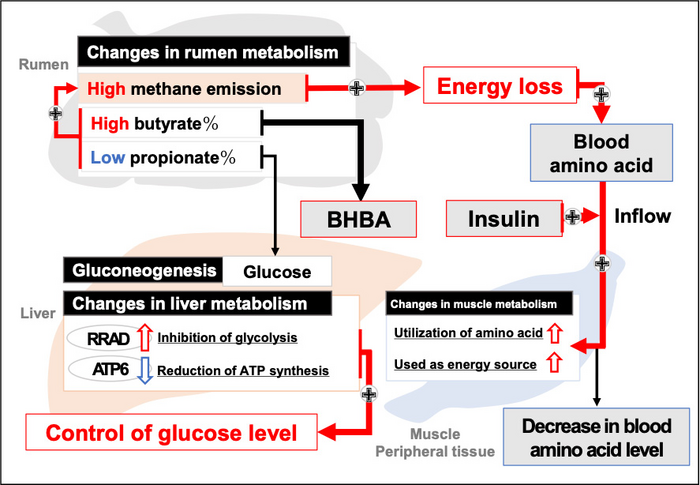
Figure 1

Credit: Tohoku University

Japan’s agricultural sector produced 32.3 million tons of greenhouse gas emissions in 2022, accounting for 2.8% of the country’s total emissions. Nearly a quarter of that stems from enteric fermentation within livestock. Ruminants – grazing animals such as cattle, sheep and goats that acquire nutrients from plant-based diets – give off enteric methane as they decompose and ferment plant materials.

To combat this, researchers have been exploring feed additives and feeding management systems that reduce methane emissions. But this remains limited to certain breeds and feeding environments.

Now, a collaborative project has employed biomarkers to tell us more about the metabolic and nutritional characteristics linked to enteric methane emissions in Japanese Black cattle. The research findings may open up new pathways for researchers exploring methane reduction.

Professor Sanggun Roh from Tohoku University’s Graduate School of Agricultural Science, working alongside the Hyogo Prefectural Technology Center of Agriculture, Forestry and Fisheries, used physiological parameters such as blood metabolites, hormones, amino acids, rumen fermentation, and liver transcriptomes to assess the relationship between methane emissions and metabolic and nutritional features.

“We found cattle exhibiting high enteric methane to have a higher butyrate and lower propionate ratio,” Roh said.

Examining the blood metabolites of steers, Roh and his team also discovered that the concentration of amino acids decreased, while ketone bodies and insulin increased in cattle with significant concentrations of methane. Meanwhile, differentially expressed genes in the liver related to amino acid and glucose metabolism, such as SERPINI2, RRAD, SLC7A5 and APT6, were upregulated or downregulated during the late fattening phase of feeding.

Cattle with high methane emissions actively utilized amino acids to replenish the energy lost during methane production, thereby decreasing blood amino acid levels and increasing blood insulin concentration. This was done without changing the growth and quality of the cattle’s muscle.

“Our results suggest that physiological differences and liver transcriptomes could be applied to monitor the levels of methane emissions from Japanese Black steers,” Roh added. “We are hopeful the relationship in this study leads to new perspectives.”

Details of the research were published in the journal Scientific Reports on July, 1, 2022.


Journal

Scientific Reports

DOI

10.1038/s41598-022-15146-1

Article Title

Physiological responses and adaptations to high methane production in Japanese Black cattle

Article Publication Date

1-Jul-2022

Share12Tweet8Share2ShareShareShare2

Related Posts

Step Aside Cassette Tapes, Adhesive Tape Holds Memory Too — Chemistry

Step Aside Cassette Tapes, Adhesive Tape Holds Memory Too

May 5, 2026
Astronomers Trace the Origins of a Peculiar Planetary Pair — Chemistry

Astronomers Trace the Origins of a Peculiar Planetary Pair

May 5, 2026

How Small Talk Drives Big Trends: Physics Unlocks the Spread of Language Patterns

May 5, 2026

New Unified Framework Unveils Complete Hierarchy of Topological Boundary States in Floquet Crystals

May 5, 2026

POPULAR NEWS

  • Research Indicates Potential Connection Between Prenatal Medication Exposure and Elevated Autism Risk

    835 shares
    Share 334 Tweet 209
  • New Study Reveals Plants Can Detect the Sound of Rain

    721 shares
    Share 288 Tweet 180
  • Scientists Investigate Possible Connection Between COVID-19 and Increased Lung Cancer Risk

    68 shares
    Share 27 Tweet 17
  • Salmonella Haem Blocks Macrophages, Boosts Infection

    61 shares
    Share 24 Tweet 15

About

We bring you the latest biotechnology news from best research centers and universities around the world. Check our website.

Follow us

Recent News

Single-Cell RNA Tags Reveal Early Heart Regeneration

Cruise Ship Hantavirus Outbreak Underscores Persistent Zoonotic Threat and Importance of Vigilance

Medical-Grade Glues Inspired by Protein from Freshwater Mussels

Subscribe to Blog via Email

Enter your email address to subscribe to this blog and receive notifications of new posts by email.

Join 82 other subscribers
  • Contact Us

Bioengineer.org © Copyright 2023 All Rights Reserved.

Welcome Back!

Login to your account below

Forgotten Password?

Retrieve your password

Please enter your username or email address to reset your password.

Log In
No Result
View All Result
  • Homepages
    • Home Page 1
    • Home Page 2
  • News
  • National
  • Business
  • Health
  • Lifestyle
  • Science

Bioengineer.org © Copyright 2023 All Rights Reserved.