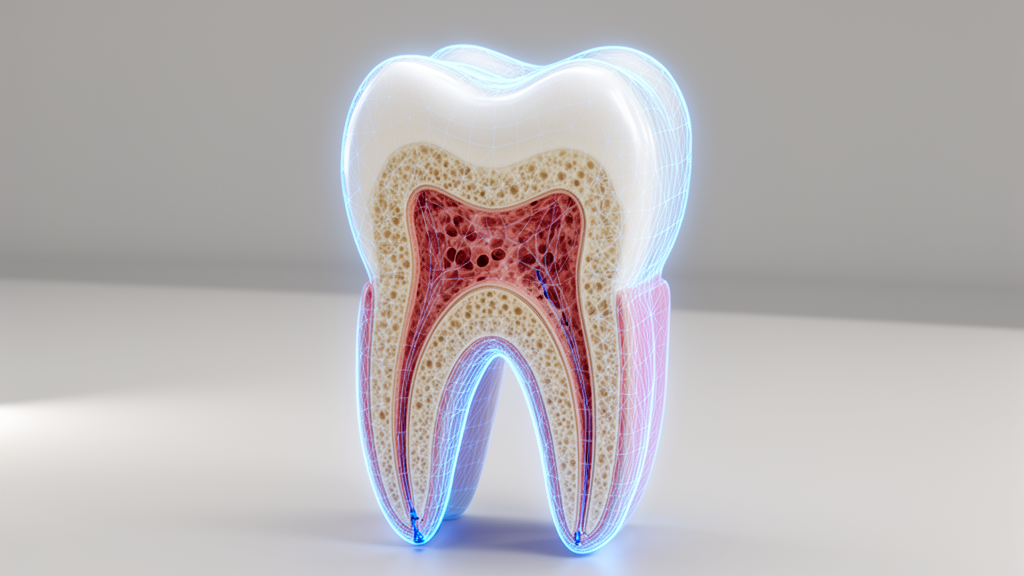
Researchers have developed an integrated computational framework combining physics-informed deep learning and biochemical modeling to track dental caries progression and map mineral loss from tooth photographs. The framework merges data-driven image processing with physicochemical equations to simulate how tooth decay develops over time, demonstrating that physical priors enable accurate pattern recognition even under limited sample sizes.
The system operates across three interconnected layers designed to evaluate and predict structural changes in teeth. In the initial recognition layer, convolutional neural networks conduct automated data pre-screening and annotation support.
To capture the biological and chemical processes underpinning decay, the framework incorporates a dedicated mechanism layer based on reaction-diffusion modeling. The investigators initially derived a system of ordinary differential equations tracking dynamic interactions among cariogenic bacteria, salivary antibacterial agents, and tooth minerals within the oral cavity.
The research team subsequently extended these equations into a system of partial differential equations that includes spatial diffusion terms. By adding spatial diffusion, the model accounts for the physical transport of substances across the uneven tooth surface and accurately represents the heterogeneous spatial distribution of caries lesions.
Determining the specific biological rates governing this reaction-diffusion system required an inverse modeling strategy. Using the adjoint method, the authors inverted key operational parameters, such as the demineralization rate, from mineral distribution images of the same tooth recorded at different time points.
The researchers also applied Turing pattern theory to examine structural instability conditions within the differential equations. By deriving system instability criteria, they established a formal connection between caries morphology and classic Turing patterns.
In the final prediction layer, a deep learning architecture fuses reaction-diffusion physical priors with visual inputs to generate direct mineral loss heatmaps from dental images. The neural network incorporates a physical prior layer alongside a liquid ordinary differential equation module.
While highlighting the complementary strengths of physical principles and neural networks for early warning and personalized intervention, the team emphasized that broader validation across larger prospective patient cohorts remains necessary prior to clinical deployment.
Subject of Research: Physics-informed deep learning for dental caries analysis and prediction
Article Title: Physics-informed deep learning for dental caries analysis and its potential application in clinical screening
Article References: Shen, S., Yang, T., Zhu, L., & Yang, X. (2026). Physics-informed deep learning for dental caries analysis and its potential application in clinical screening. BMC Oral Health. https://doi.org/10.1186/s12903-026-10502-3
Image Credits: AI Generated
DOI: 10.1186/s12903-026-10502-3
Keywords: dental caries, physics-informed deep learning, reaction-diffusion modeling, convolutional neural networks, mineral loss heatmaps, tooth demineralization, cariogenic bacteria, salivary antibacterial agents, adjoint parameter inversion, Turing patterns, liquid ordinary differential equations, partial differential equations, caries morphology, small-sample learning, dental image classification, early caries detection, oral health screening
News Source: Cassandra Pierce. (November 26, 2026). Physics-Informed Neural Model Maps Tooth Mineral Loss and Caries Progression. Scienmag.