


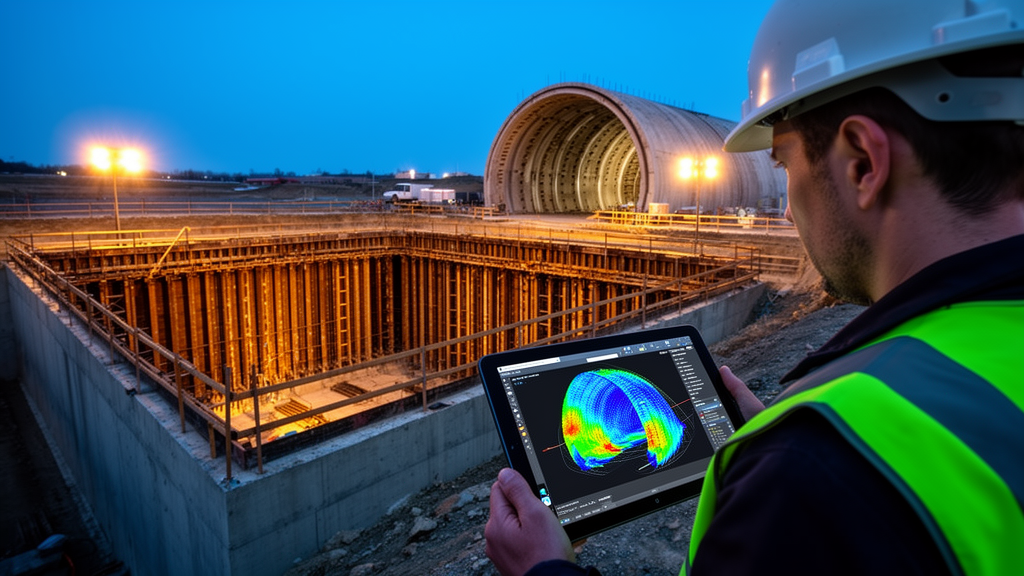
When engineers dig a deep foundation pit next to an underground rail tunnel, the ground above the tunnel unloads and the structure can slowly bulge upward, a movement that threatens the safety of busy urban transit lines. Predicting how much a tunnel will heave has long been a awkward trade-off: analytical formulas capture the physics but miss site-specific complexity, while machine learning models fit the data well yet behave as inscrutable black boxes that falter when only a handful of case histories are available. A study published in AI in Civil Engineering on 1 July 2026 proposes a way to have both, embedding a physics-based formula inside a gradient boosting regression tree so that the algorithm learns only what the physics cannot explain.
The new framework, called PG-GBRT, is built in two hierarchical layers. The first layer is an empirical formula that captures the fundamental geometric relationships governing tunnel heave. It draws on three theoretical foundations: Gaussian settlement trough theory, the established link between excavation depth and volume loss, and three-dimensional geometric effects that describe how the tunnel’s orientation and crossing length influence deformation. The second layer is a residual machine learning model, a gradient boosting regression tree, whose sole job is to learn the systematic deviations between the physical formula’s predictions and the measured deformations.
The empirical formula adopts a multiplicative structure with four key geometric parameters: excavation depth, vertical clear distance between the tunnel crown and the excavation bottom, the length of tunnel crossing beneath the pit, and the intersection angle between the tunnel axis and the pit edge. The multiplicative form is not arbitrary. It guarantees physical consistency, so that when any primary controlling factor approaches zero, such as excavation depth or crossing length, the predicted heave naturally tends to zero. It also preserves dimensional homogeneity, with a base quantity multiplied by dimensionless correction factors, and it can be linearized through a logarithmic transformation for straightforward calibration.
Each term in the formula traces back to a specific physical argument. The exponential decay term, exp[-b(C/Hp)^2], comes from the classical Gaussian settlement trough, with the horizontal distance normalized by excavation depth to form a dimensionless ratio. The power-law term Hp^a reflects observations that volume loss and maximum settlement grow with excavation depth, because deeper excavations release more overburden stress. Two dimensionless correction terms handle three-dimensional effects: (l1/Hp)^c for the crossing length and |sin α|^d for the angle, ensuring the predicted effect is maximal when the tunnel runs perpendicular to the pit edge and minimal when it runs parallel.
To train and validate the framework, the researchers compiled 154 engineering cases of foundation pit excavation above existing tunnels from major Chinese cities including Shanghai, Beijing, Shenzhen, Guangzhou and Nanjing, gathered through an extensive literature survey. The coefficient k and the exponents a, b, c and d were fitted by nonlinear least squares using the Levenberg–Marquardt algorithm, calibrated only on the training set after the data had been split to avoid leakage. The physical prediction was then fed into the residual model as an additional feature, alongside the four raw geometric parameters, allowing the tree ensemble to learn how reality systematically departs from the idealized formula.
The hyperparameters of the gradient boosting model were tuned with the Tree-structured Parzen Estimator algorithm implemented in Optuna, minimizing validation root-mean-square error over five-fold cross-validation. The dataset was randomly divided into training and test sets at an 8:2 ratio with a fixed random seed. Three baseline models, a standalone GBRT, XGBoost and LightGBM, were optimized with the same procedure and predicted tunnel heave directly from the original features, without any physical guidance.
The results show a clear advantage for the hybrid approach. On the training set, PG-GBRT achieved an R2 of 0.9023, an RMSE of 0.6123 mm, an MAE of 0.4567 mm and a MAPE of 8.23%. Relative to the best performing baseline, the pure GBRT, the hybrid model improved R2 by 7.1%, reduced RMSE by 37.9%, lowered MAE by 36.9% and cut MAPE by 33.3%. On the test set, PG-GBRT reached an R2 of 0.8738, an RMSE of 0.7814 mm, an MAE of 0.5982 mm and a MAPE of 9.36%, a small degradation from training that the authors interpret as a reasonable generalization gap rather than overfitting. The empirical formula alone, by contrast, managed only an R2 of 0.1456 with an RMSE of 4.2027 mm on the training data, confirming that the simplified physics captures the first-order trend but little else.
The interpretability analysis is where the framework’s design philosophy becomes visible. Feature importance rankings show that the physical prediction dominates within PG-GBRT, while the individual geometric parameters retain reduced but still notable importance, whereas the pure GBRT distributes importance relatively evenly across the raw features because it must learn every relationship from scratch. The lower importance of the intersection angle suggests the |sin α|^d term already captures the angular effect well, while the crossing length keeps relatively high importance, hinting that its influence involves interactions with soil properties or construction sequences beyond the simple power law. Residual statistics tell a similar story: the empirical formula is nearly unbiased, with mean residuals of −0.084 mm on training and 0.181 mm on test data, but highly scattered, with residual RMSE around 4 mm and maximum residuals above 14 mm. After residual learning, the training residual RMSE fell to 0.477 mm and the maximum training residual to 2.06 mm, a compression of variance from roughly 4.08 mm to 0.48 mm.
Parameter sensitivity analysis further reinforces the physical coherence of the model. Varying the coefficient k by ±10% changed the predicted displacement linearly, from 3.84 mm to 8.22 mm, with relative changes of 38.00% and 32.43%, exactly what a multiplicative scaling factor should do. The exponent a showed a nonlinear, exponential-tinged sensitivity, with predictions moving from 3.83 mm to 8.14 mm over the same range and slightly asymmetric relative changes of 38.28% versus 31.24%, reflecting the power-law structure. The decay parameter b behaved differently, staying remarkably stable, with relative changes below 0.13%, for variations within −10% to +5%, then dropping the prediction sharply to 5.56 mm, a 10.36% change, at +10%, a threshold pattern tied to the exponential decay term’s localized role.
The authors are candid about the limits of the work. The framework’s robustness under different training sample sizes and across unseen geological conditions still requires further validation, and performance may suffer when training data become extremely limited or when geological conditions differ markedly from those in the current database of Chinese case histories. Raw monitoring data cannot be shared publicly for confidentiality reasons, though aggregated statistical information is available from the corresponding author for academic purposes. Future work will systematically evaluate sensitivity to training set size and expand the dataset to improve generalization. Even with those caveats, the study offers a practical template for data-scarce geotechnical prediction: let physics carry the structure, and let machine learning carry the remainder.
Subject of Research: A physics-guided machine learning framework for predicting upward deformation of existing tunnels caused by nearby foundation pit excavation.
Article Title: Physics-guided gradient boosting regression tree for predicting tunnel deformation induced by foundation pit excavation
Article References: Mu, L., Li, Y., Ma, Z., & Liu, K. (2026). Physics-guided gradient boosting regression tree for predicting tunnel deformation induced by foundation pit excavation. AI in Civil Engineering, 5(1), Article 18. https://doi.org/10.1007/s43503-026-00101-0
Image Credits: AI Generated
DOI: 10.1007/s43503-026-00101-0
Keywords: tunnel deformation, foundation pit excavation, gradient boosting regression tree, physics-guided machine learning, geotechnical engineering, urban rail transit, residual learning, Gaussian settlement trough, feature importance, parameter sensitivity, small-sample prediction, excavation-tunnel interaction
News Source: Katie Riggs. (October 29, 2026). Physics-guided AI predicts tunnel deformation from nearby foundation pit excavation. Scienmag.



