• HOME
  • NEWS
  • EXPLORE
    • CAREER
      • Companies
      • Jobs
    • EVENTS
    • iGEM
      • News
      • Team
    • PHOTOS
    • VIDEO
    • WIKI
  • BLOG
  • COMMUNITY
    • FACEBOOK
    • INSTAGRAM
    • TWITTER
Thursday, May 14, 2026
BIOENGINEER.ORG
No Result
View All Result
  • Login
  • HOME
  • NEWS
  • EXPLORE
    • CAREER
      • Companies
      • Jobs
        • Lecturer
        • PhD Studentship
        • Postdoc
        • Research Assistant
    • EVENTS
    • iGEM
      • News
      • Team
    • PHOTOS
    • VIDEO
    • WIKI
  • BLOG
  • COMMUNITY
    • FACEBOOK
    • INSTAGRAM
    • TWITTER
  • HOME
  • NEWS
  • EXPLORE
    • CAREER
      • Companies
      • Jobs
        • Lecturer
        • PhD Studentship
        • Postdoc
        • Research Assistant
    • EVENTS
    • iGEM
      • News
      • Team
    • PHOTOS
    • VIDEO
    • WIKI
  • BLOG
  • COMMUNITY
    • FACEBOOK
    • INSTAGRAM
    • TWITTER
No Result
View All Result
Bioengineer.org
No Result
View All Result
Home NEWS Science News Chemistry

Physicists take the temperature of fluid flows and discover new role for turbulence

Bioengineer by Bioengineer
May 15, 2023
in Chemistry
Reading Time: 2 mins read
0
Cylindrical container
Share on FacebookShare on TwitterShare on LinkedinShare on RedditShare on Telegram

A team of physicists has discovered a new role for a specific type of turbulence—a finding that sheds light on fluid flows ranging from the Earth’s liquid core to boiling water. 
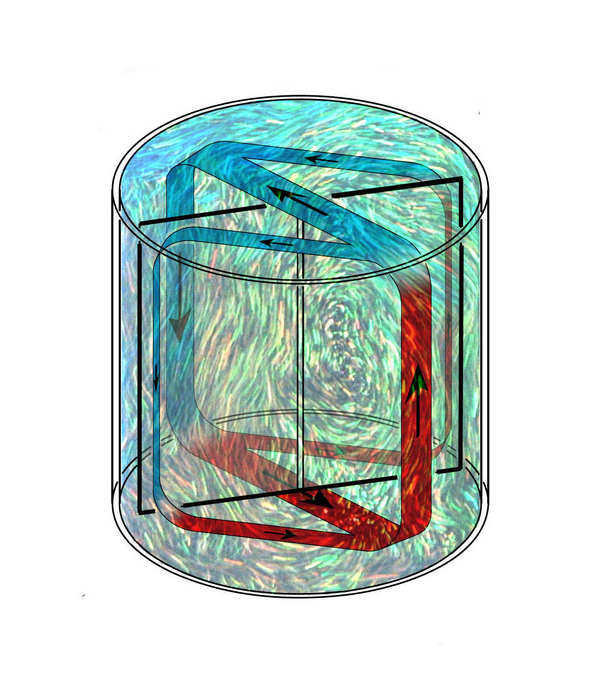
Cylindrical container

Credit: Image by Kaizhe Wang and Jun Zhang.

A team of physicists has discovered a new role for a specific type of turbulence—a finding that sheds light on fluid flows ranging from the Earth’s liquid core to boiling water. 

The research, which appears in the journal Proceedings of the National Academy of Sciences, centered on turbulent convection—the movement of fluid when heated from below.

“Our experiments reveal intricate movements between a free-moving body and thermal convective flows,” says Jun Zhang, a professor of mathematics and physics at New York University and NYU Shanghai, the paper’s senior author.

The study, which also included Kaizhe Wang, a researcher in NYU’s Department of Physics, focused specifically on Rayleigh–Bénard convection—a type of convection driven by temperature differences. 

In their experiments, conducted in the Joint Research Institute of NYU Shanghai, the paper’s authors used a cylindrical container filled with water, then heated it from the bottom, creating convective flows. The resulting turbulent flows interacted with a suspended solid (a rectangular panel) that moved freely inside the container—a setting that allowed the researchers to better study how turbulent flows interact with solid structures within.

“Surprisingly, the system becomes somewhat well-behaved,” notes Zhang. “We observed a smooth rotation of the flows and the free solid.”

Their results showed that turbulent convection powered flows, together with the solid, can move in two directions—one clockwise and the other counterclockwise—with the co-rotational speed increasing with the intensity of the convection. More than that, their rotation can sometimes switch directions, caused by the turbulence. 

“The research, inspired by the rotation of Earth’s inner core as it interacts with the convective liquid core, captures the interaction between a turbulent flow and a freely moving body within the flow,” explains Zhang. “The findings confirm that turbulence can be tamed by interacting with solids. It also reminds us that the power of thermal convection might play more important roles inside our planet Earth.”

# # #


Journal

Proceedings of the National Academy of Sciences

Method of Research

Experimental study

Article Title

Persistent Co-Rotation of the Large-Scale Flow of Thermal Convection and an Immersed Free Body

Article Publication Date

15-May-2023

Share12Tweet8Share2ShareShareShare2

Related Posts

Researchers Develop High-Efficiency Hydrogen Separation Membranes Using Innovative ‘Mortar-and-Brick’ Design — Chemistry

Researchers Develop High-Efficiency Hydrogen Separation Membranes Using Innovative ‘Mortar-and-Brick’ Design

May 13, 2026
Green Electrosynthesis Paves the Way for Direct Amines Production from Atmospheric Nitrogen — Chemistry

Green Electrosynthesis Paves the Way for Direct Amines Production from Atmospheric Nitrogen

May 13, 2026

Decoding Life’s Chemistry: A Revolutionary Search Engine from Molecules to Meaning

May 13, 2026

How Olympic Weightlifting Harnesses the Barbell’s ‘Whip’ for Peak Performance #ASA190

May 13, 2026

POPULAR NEWS

  • Research Indicates Potential Connection Between Prenatal Medication Exposure and Elevated Autism Risk

    842 shares
    Share 337 Tweet 211
  • New Study Reveals Plants Can Detect the Sound of Rain

    729 shares
    Share 291 Tweet 182
  • Salmonella Haem Blocks Macrophages, Boosts Infection

    62 shares
    Share 25 Tweet 16
  • Breastmilk Balances E. coli and Beneficial Bacteria in Infant Gut Microbiomes

    57 shares
    Share 23 Tweet 14

About

We bring you the latest biotechnology news from best research centers and universities around the world. Check our website.

Follow us

Recent News

UVR8 Variations Influence Plant Heat Tolerance and Yield

Lineage and Organ Signals Forge Intrinsic Nerves

Functional Ability and Heat Vulnerability in Older Adults

Subscribe to Blog via Email

Enter your email address to subscribe to this blog and receive notifications of new posts by email.

Join 82 other subscribers
  • Contact Us

Bioengineer.org © Copyright 2023 All Rights Reserved.

Welcome Back!

Login to your account below

Forgotten Password?

Retrieve your password

Please enter your username or email address to reset your password.

Log In
No Result
View All Result
  • Homepages
    • Home Page 1
    • Home Page 2
  • News
  • National
  • Business
  • Health
  • Lifestyle
  • Science

Bioengineer.org © Copyright 2023 All Rights Reserved.