• HOME
  • NEWS
  • EXPLORE
    • CAREER
      • Companies
      • Jobs
    • EVENTS
    • iGEM
      • News
      • Team
    • PHOTOS
    • VIDEO
    • WIKI
  • BLOG
  • COMMUNITY
    • FACEBOOK
    • INSTAGRAM
    • TWITTER
Tuesday, May 12, 2026
BIOENGINEER.ORG
No Result
View All Result
  • Login
  • HOME
  • NEWS
  • EXPLORE
    • CAREER
      • Companies
      • Jobs
        • Lecturer
        • PhD Studentship
        • Postdoc
        • Research Assistant
    • EVENTS
    • iGEM
      • News
      • Team
    • PHOTOS
    • VIDEO
    • WIKI
  • BLOG
  • COMMUNITY
    • FACEBOOK
    • INSTAGRAM
    • TWITTER
  • HOME
  • NEWS
  • EXPLORE
    • CAREER
      • Companies
      • Jobs
        • Lecturer
        • PhD Studentship
        • Postdoc
        • Research Assistant
    • EVENTS
    • iGEM
      • News
      • Team
    • PHOTOS
    • VIDEO
    • WIKI
  • BLOG
  • COMMUNITY
    • FACEBOOK
    • INSTAGRAM
    • TWITTER
No Result
View All Result
Bioengineer.org
No Result
View All Result
Home NEWS Science News Chemistry

Physicists extract proton mass radius from experimental data

Bioengineer by Bioengineer
May 12, 2021
in Chemistry
Reading Time: 3 mins read
0
IMAGE
Share on FacebookShare on TwitterShare on LinkedinShare on RedditShare on Telegram

IMAGE

Credit: KOU Wei

Researchers have recently extracted the proton mass radius from the experimental data.

A research group at the Institute of Modern Physics (IMP) of the Chinese Academy of Sciences (CAS) presented an analysis of the proton mass radius in Physical Review D on May 11. The proton mass radius is determined to be 0.67 ± 0.03 femtometers, which is obviously smaller than the charge radius of the proton.

In the Standard Model, the proton is a composite particle made of quarks and gluons and it has a non-zero size. The radius of the proton is a global and fundamental property of the proton. It is related to the color confinement radius — a property governed by quantum chromodynamics (QCD).

The radius of the proton is approximately 100,000 times smaller than that of the atom, and the sizes of the quark and gluon are several orders smaller than the proton radius. Scientists use various distributions to describe the shape of the proton, such as charge distribution and mass distribution.

The charge radius of the proton has been precisely measured by scientists via Lamb shift of the muonic hydrogen or the high energy electron-proton elastic scattering, with the average value of 0.8409± 0.0004 femtometers provided by the Particle Data Group. Nevertheless, knowledge of proton gravitational properties such as proton mass radius has still been very limited.

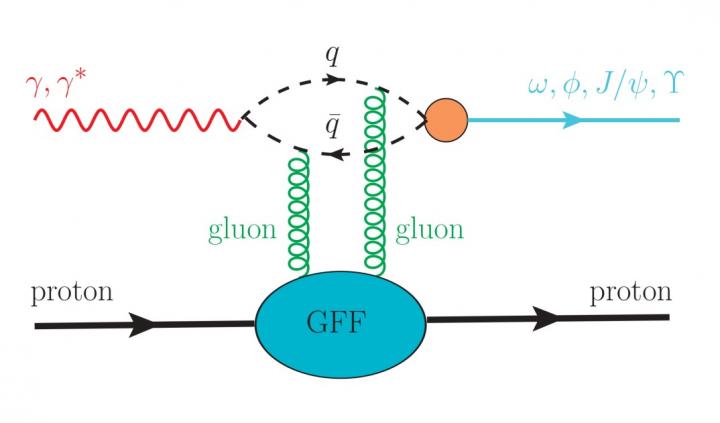
“According to recent theoretical studies by Dmitri Kharzeev, the proton mass radius is related to the scalar gravitational form factor of the proton,” said Dr. WANG Rong, first author of the paper. By investigating the vector meson photoproduction data for omega, phi and J/psi from the SAPHIR (Spectrometer Arrangement for PHoton Induced Reactions) experiment at Bonn University, the LEPS (Laser Electron Photons) experiment at SPring-8 facility, and the GlueX experiment at Jefferson Lab, the researchers determined the scalar gravitational form factor and the proton mass radius.

Meanwhile, Prof. Dmitri Kharzeev, a theoretical physicist at Stony Brook University, obtained a similar result by using GlueX J/psi data. The proton mass radius was estimated to be 0.55 ± 0.03 femtometers.

“Both results might be the first-ever values of the proton mass radius with experimental evidence,” said WANG. “The determination of the proton mass radius will improve our understanding of the origins of proton mass and the color confinement mechanism of strong interaction.”

A lot of questions still remain. “The smaller mass radius implies that the mass distribution is significantly different from the charge distribution of the proton,” said Prof. CHEN Xurong, a researcher at IMP.

Scientists are now trying to get a clearer picture of the proton mass radius and the proton structure. The GlueX experiment at Jefferson Lab will provide more data in the near future. Even more exciting, future electron-ion colliders both in the United States and in China will provide Upsilon vector meson electroproduction data for researchers to better understand these questions.

###

This work was supported by the Strategic Priority Research Program of CAS and the National Natural Science Foundation of China.

Media Contact
LIU Fang
[email protected]

Related Journal Article

http://dx.doi.org/10.1103/PhysRevD.103.L091501

Tags: Atomic/Molecular/Particle PhysicsChemistry/Physics/Materials Sciences
Share12Tweet8Share2ShareShareShare2

Related Posts

Humans and Zebra Finches Share Similar Speech Learning Techniques #ASA190 — Chemistry

Humans and Zebra Finches Share Similar Speech Learning Techniques #ASA190

May 11, 2026
Unveiling Dark Matter Through Molecular Insights — Chemistry

Unveiling Dark Matter Through Molecular Insights

May 11, 2026

From Touch to Sight: A Bioinspired Multisensory Framework Endows Robots with Human-Like Perception

May 11, 2026

Announcing the 2026 Carbon Future Young Investigator Award Winners

May 11, 2026
Please login to join discussion

POPULAR NEWS

  • Research Indicates Potential Connection Between Prenatal Medication Exposure and Elevated Autism Risk

    841 shares
    Share 336 Tweet 210
  • New Study Reveals Plants Can Detect the Sound of Rain

    728 shares
    Share 290 Tweet 182
  • Salmonella Haem Blocks Macrophages, Boosts Infection

    62 shares
    Share 25 Tweet 16
  • Breastmilk Balances E. coli and Beneficial Bacteria in Infant Gut Microbiomes

    57 shares
    Share 23 Tweet 14

About

We bring you the latest biotechnology news from best research centers and universities around the world. Check our website.

Follow us

Recent News

Humans and Zebra Finches Share Similar Speech Learning Techniques #ASA190

New Study Uncovers How Fungal Parasites Attack Strawberries and Raspberries

City of Hope Researchers to Present Groundbreaking Immunotherapy and Precision Medicine Advances Across Multiple Cancer Types at ASCO 2026

Subscribe to Blog via Email

Enter your email address to subscribe to this blog and receive notifications of new posts by email.

Join 82 other subscribers
  • Contact Us

Bioengineer.org © Copyright 2023 All Rights Reserved.

Welcome Back!

Login to your account below

Forgotten Password?

Retrieve your password

Please enter your username or email address to reset your password.

Log In
No Result
View All Result
  • Homepages
    • Home Page 1
    • Home Page 2
  • News
  • National
  • Business
  • Health
  • Lifestyle
  • Science

Bioengineer.org © Copyright 2023 All Rights Reserved.