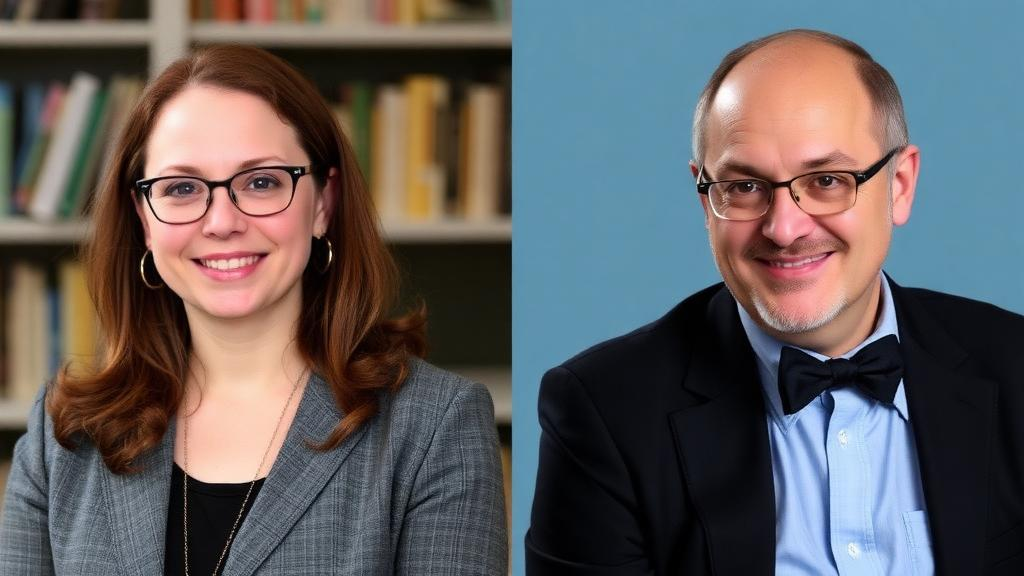
The Russian American Science Association (RASA-America) has named the 2026 laureates of the George Gamow Award, one of the most distinctive honors recognizing the achievements of the Russian-speaking scientific diaspora. The prize, established in 2015 in memory of Georgy Antonovich Gamow, the celebrated Soviet and American theoretical physicist, astrophysicist, and science popularizer who lived from 1904 to 1968, is conferred each year on researchers whose work has received wide acknowledgment from the international scientific community. For 2026, the G.A. Gamow Prize is shared by Natalia Berloff, Professor of Applied Mathematics at the University of Cambridge, and Mikhail Epstein, Samuel Candler Dobbs Professor Emeritus of Cultural Theory and Russian Literature at Emory University. The pairing of a quantum physicist and a humanities theorist underscores the award’s unusually broad intellectual remit, mirroring Gamow’s own career, which ranged from cosmology to the genetic code.
Berloff’s citation honors her groundbreaking contributions to quantum hydrodynamics and physics-inspired computing, along with what the award committee describes as an extraordinary breadth of interdisciplinary research connecting fundamental theoretical advances with experimental realizability and technological potential across the logistics, fintech, pharmaceutical, and data management sectors. The citation captures a research program that has become one of the most closely watched efforts in non-conventional computation. Rather than treating hard optimization problems as purely algorithmic challenges to be attacked by processors executing instructions, Berloff’s approach asks whether the physical world itself can be harnessed as the computer, letting natural dynamics search solution spaces that overwhelm conventional digital hardware.
In her statement following the announcement, Berloff reached back to one of Gamow’s most famous reflections on cosmic history. Gamow wrote that it took less than an hour to make the atoms, and Berloff pointed out that nature solved an enormous many-body problem in that hour without executing a single instruction: the physics was the algorithm. Physics-inspired computing takes this literally. As she described it, a hard optimization problem is written as the energy of a network of interacting spins, that network is then built out of real physics—condensates, coupled lasers, oscillators—and the system is allowed to relax toward its lowest-energy state. Reading off that final state reads off a solution: what a digital computer does by search, the hardware does by simply evolving. The remarks amount to a compact manifesto for analog computation and an invitation, in her words, to draw more physicists, mathematicians, and engineers into the question of how to make physics compute.
The technical core of that program lies in coherence in non-equilibrium quantum systems. Berloff’s research concerns superfluids and Bose-Einstein condensates of atoms, excitons, and polaritons—hybrid light-matter quasiparticles that can condense at far higher temperatures than atomic condensates. Her group was among the first to propose polariton condensates and other optical systems as physical simulators and optimizers. In such platforms, the phase and amplitude dynamics of the condensate map directly onto the variables of a mathematical problem, and the relaxation of the system toward equilibrium performs the computation. The work has since expanded into Ising and XY machines, which encode combinatorial optimization problems in networks of coupled binary or phase-based variables, and into neuromorphic architectures and analog platforms for artificial intelligence that take further inspiration from the way biological neural systems process information.
Berloff’s career traces a path through some of the leading centers of theoretical and applied physics. Born in Orenburg, she graduated from Lomonosov Moscow State University and received her Ph.D. from Florida State University. After research and faculty positions at the University of California, Los Angeles, she joined Cambridge in 2002, where she is based at the Department of Applied Mathematics and Theoretical Physics and is a Fellow of Jesus College. She served as Director of Photonics at Skoltech from 2013 to 2016 and was a visiting researcher at Microsoft from 2021 to 2023, a period that coincided with intense industry interest in analog and quantum-inspired optimization hardware. She currently leads the π-computing group, co-directs the UK Multidisciplinary Neuromorphic Center (NeuroSYNC), and chairs the American Physical Society’s Committee on International Freedom of Scientists. Her earlier honors include an NIH/NHGRI Career Development Award and the Pilkington Prize.
The co-laureate, Mikhail Epstein, receives the 2026 prize for pioneering contributions to the study of Russian postmodernism and conceptualism, significant advances in philosophy and literary theory, and the construction of alternative concepts and propositions to multiple symbolic systems and theoretical models. The committee also cites his role as a public intellectual and advocate for the humanities and their transformative potential, articulating a vision of scholarship as a creative and forward-looking process. Epstein is widely regarded as one of the founding theorists of Russian postmodernism, a body of work that mapped the late-Soviet and post-Soviet cultural landscape onto the broader currents of twentieth-century global thought.
The unifying impulse of Epstein’s scholarship, as his citation suggests, is the expansion of the thinkable. Where scholarship conventionally describes what exists, Epstein constructs alternatives to prevailing theories and sign systems: possible philosophies, new disciplines, genres, concepts, and words. From this impulse his work has given rise to the philosophy of the possible, to transculture, and to the transformative humanities—conceiving scholarship itself as a creative, world-changing force. In recent years he has turned this constructive method toward the philosophy of artificial intelligence, which he develops as a new stage in the evolution of thought, extending a career-long inquiry into how symbolic systems shape and are shaped by human imagination.
Epstein’s own trajectory parallels the diaspora history the Gamow Award commemorates. Educated at Moscow State University, he moved to the United States in 1990 and built his career at Emory University, where he holds an emeritus professorship in cultural theory and Russian literature. He is the author of fifty books and numerous articles, translated into twenty-six languages. His honors include the Andrei Bely Prize in 1991, the Liberty Prize in New York in 2000, and the Modern Language Association’s Scaglione Prize for the best book in Slavic studies in 2023. In his response to the award, he emphasized its symbolic weight across the two cultures: George Gamow, he noted, embodied the kind of intellectual daring that bridges disciplines and crosses borders, a physicist whose thought ranged from the origins of the universe to the code of life without losing the playful curiosity that makes science kin to the humanities. Epstein said he sees the award as a sign that the boundary between the sciences and the humanities is becoming ever more permeable, and that the humanities, no less than the sciences, can be a creative and world-transforming force.
The selection was made by a five-member 2026 award committee drawn from leading research universities: Tatiana Bronich of Northeastern University, Igor Efimov of Northwestern University, Mark Lipovetsky of Columbia University, Konstantin Sonin of the University of Chicago, who served as chair, and Alexandra Zhernakova of the University of Groningen. Their charge, under the Regulations of the George Gamow Award, is to identify members of the Russian-speaking scientific diaspora whose outstanding achievements have been widely acknowledged by the scientific community, a mandate that spans the natural sciences, mathematics, engineering, and the humanities. The 2025 laureates, chemist Anna Krylov and historian Mikhail Yampolsky, similarly spanned that range, and the 2026 pairing of a computational physicist and a philosophical theorist continues the pattern.
The formal ceremony will take place as part of the 17th Annual Conference of the Russian American Science Association, to be held on November 7 and 8, 2026, at the Simpson Querrey Biomedical Research Center at Northwestern University in Chicago, Illinois. The conference will honor Andrei Sakharov, the brilliant physicist, Nobel Peace Prize laureate, and enduring symbol of intellectual courage and integrity, adding a further layer of resonance to an award already steeped in the history of scientists who moved between countries and disciplines. For Berloff, the recognition arrives as physics-inspired computing moves from laboratory demonstrations toward practical optimization hardware for logistics, finance, pharmaceuticals, and data management; for Epstein, as humanistic theory confronts the rise of machine intelligence. Both laureates, in their different domains, embody the award’s founding premise: that the most consequential work happens when the boundaries between fields, and between nations, prove permeable.
Subject of Research: The 2026 George Gamow Award recognizing members of the Russian-speaking scientific diaspora
Article Title: Natalia Berloff and Mikhail Epstein are the 2026 George Gamow award laureates
Article References: Natalia Berloff and Mikhail Epstein are the 2026 George Gamow award laureates. (n.d.). Original publication
Image Credits: AI Generated
DOI: Not provided
Keywords: George Gamow Award, Natalia Berloff, Mikhail Epstein, RASA-America, physics-inspired computing, polariton condensates, quantum hydrodynamics, neuromorphic computing, Russian postmodernism, philosophy of the possible, University of Cambridge, Emory University
News Source: Katie Riggs. (October 14, 2026). Physicist Natalia Berloff and Philosopher Mikhail Epstein Win 2026 George Gamow Award. Scienmag.