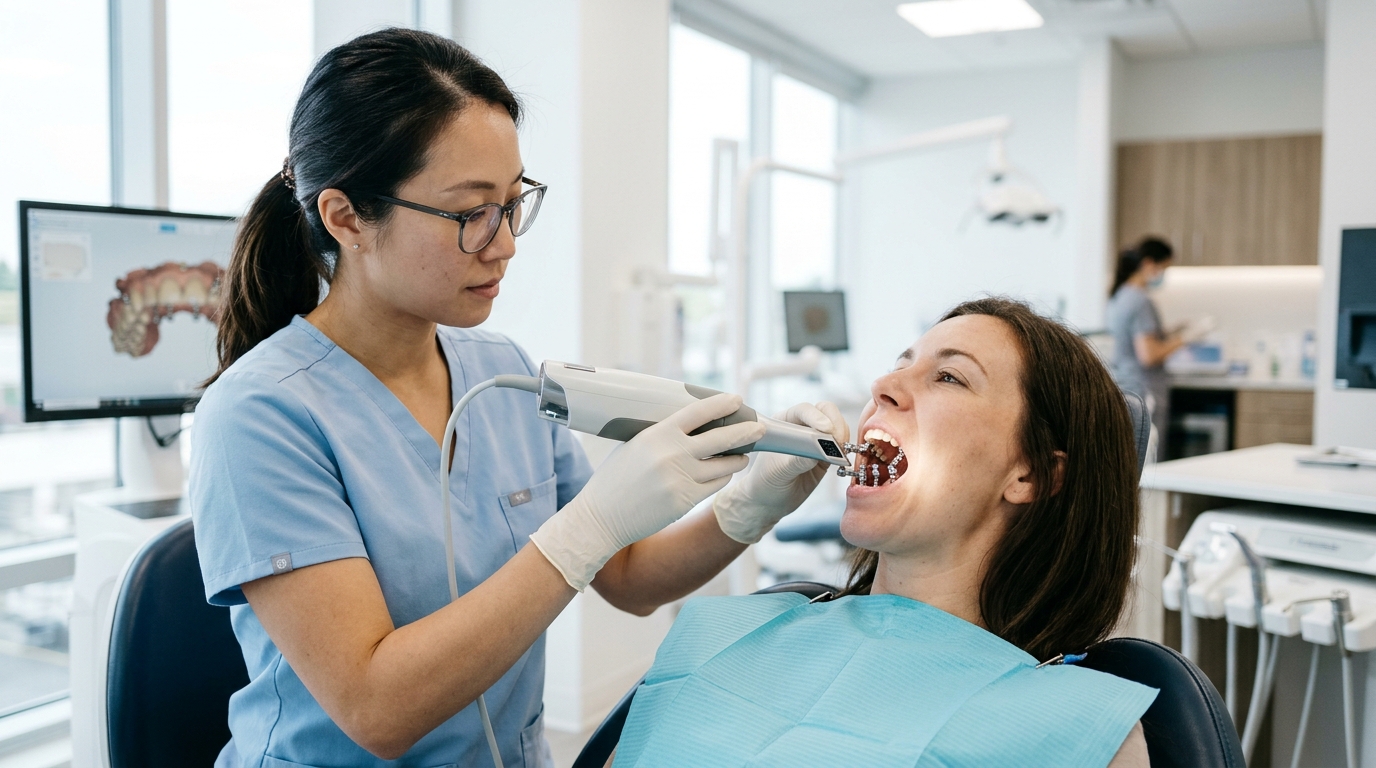
Accurate impressions represent a critical factor for the long-term clinical success of full-arch implant-supported restorations. In a recent in vitro study, researchers compared the accuracy of five distinct digital implant impression workflows for complete-arch rehabilitation, examining how different scanning techniques influence linear and angular precision. The study utilized a mandibular typodont featuring an All-on-4 implant configuration to evaluate various intraoral scanning approaches under controlled conditions.
The study assessed five specific workflows using two different intraoral scanners: the TRIOS 5 and the Aoralscan Elite. These methods included scanning with conventional vertical scanbodies, splinted scanbody scanning, and photogrammetry-assisted scanning. To ensure measurement integrity, investigators assessed deviations at the multi-unit abutment level, specifically analyzing inter-axis and inter-marker relationships while avoiding best-fit superimposition techniques. The research team focused on identifying the linear and angular discrepancies inherent in each workflow.
Regarding linear accuracy, the results revealed notable differences between the methods. The conventional scanbody workflow using the Shining 3D scanner demonstrated the lowest linear discrepancy, recording an average of 28.99 ± 12.21 μm. In contrast, the photogrammetry-assisted workflow (Intr_Ptg) showed a linear discrepancy of 36.93 ± 10.00 μm. Other methods, including the conventional TRIOS scanbody workflow, exhibited higher linear deviations, with measurements reaching 81.56 ± 41.60 μm.
Angular accuracy results highlighted the performance advantages of photogrammetry. The photogrammetry-assisted scanning technique achieved superior angular accuracy compared to the other four methods, with an overall angular discrepancy of 0.614 ± 0.045°. The conventional scanbody workflow with the Shining 3D scanner followed with an angular discrepancy of 0.748 ± 0.365°. Conversely, the remaining techniques showed larger angular discrepancies, ranging from 0.986° to 1.178°.
The study also evaluated the impact of splinting scanbodies, a common technique intended to improve impression accuracy in full-arch cases. Contrary to some clinical expectations, the data indicated that splinting did not consistently enhance the accuracy of the digital impressions. This finding suggests that the added complexity of splinting may not always yield measurable improvements in precision for the digital workflows tested in this in vitro model.
In conclusion, the research underscores that different digital implant impression workflows possess distinct accuracy profiles. Photogrammetry-assisted intraoral scanning provided the most consistent results in terms of angular accuracy and repeatability, while conventional scanbody workflows proved effective for minimizing linear deviations. The authors emphasize that clinicians should select the appropriate digital implant impression workflow based on the specific technical requirements of each individual full-arch rehabilitation case to potentially improve prosthetic fit and reduce mechanical complications.
Subject of Research: Comparative accuracy of full-arch digital implant impression workflows
Article Title: Alignment-independent analysis of full-arch digital implant impression workflows: an in vitro comparative study
Article References: Vánkos, B., Yang, S., Mühl, A., Ábrám, E., Loza, M. A., Borbély, J., Hermann, P., & Kispélyi, B. (2026). Alignment-independent analysis of full-arch digital implant impression workflows: an in vitro comparative study. BMC Oral Health. https://doi.org/10.1186/s12903-026-10444-w
Image Credits: AI Generated
DOI: 10.1186/s12903-026-10444-w
Keywords: Digital Dentistry, Dental Implants, Photogrammetry, Intraoral Scanning, All-on-4, Prosthetic Fit, Implant Rehabilitation, Workflow Accuracy, Linear Discrepancy, Angular Discrepancy, In Vitro Study, Scanbody, Dental Materials, Restorative Dentistry, Precision Dentistry
News Source: Ophelia Keating. (November 17, 2026). Photogrammetry Offers Superior Angular Accuracy for Full-Arch Digital Implant Impressions. Scienmag.