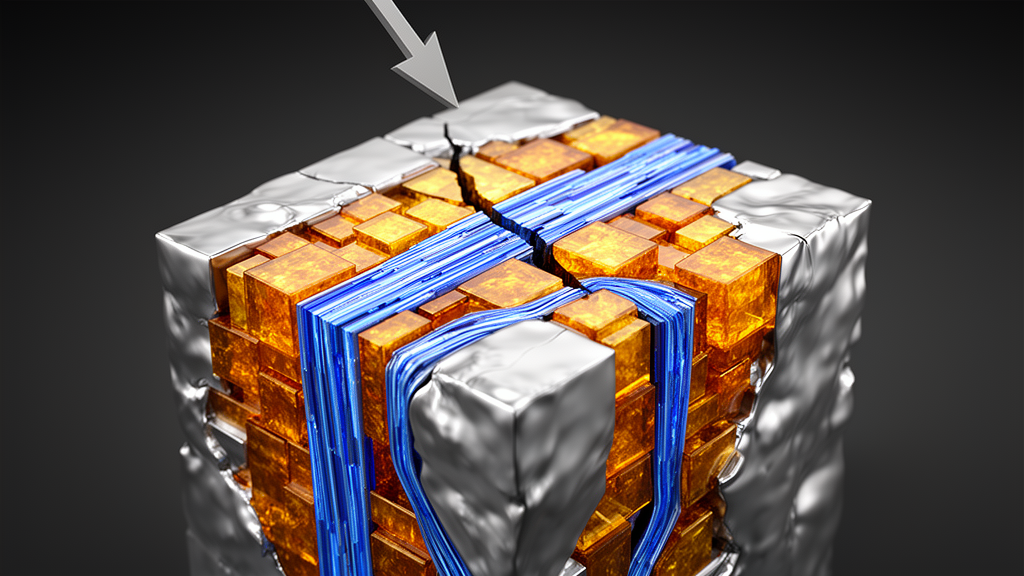
The Al0.6CoCrFeNi high-entropy alloy is unusual even by the standards of its class: depending on how it is processed, it can host not one but three coexisting crystal structures, the face-centered cubic (FCC), body-centered cubic (BCC) and ordered B2 phases.
Because the role of phase constitution in deformation stability under thermal and high-rate loading had remained insufficiently understood, Quang-Nguyen Pham, Thi-Nhai Vu, Chi-Jen Shih, Te-Hua Fang and colleagues used molecular dynamics simulations to build a direct comparison. They modeled seven representative microstructures: single-phase FCC, BCC and B2; the dual-phase combinations FCC+BCC, FCC+B2 and BCC+B2; and a multiphase BCC+FCC+B2 state.
Temperature emerged as the dominant governor of mechanical response. FCC-rich microstructures retained the highest strength as conditions changed, whereas configurations rich in BCC or B2 softened rapidly. The degradation was most severe in the BCC+B2 dual-phase combination, where the ultimate tensile strength fell to 1.11 GPa and Young’s modulus dropped from 76.24 to 31.35 GPa.
The deformation mechanisms behind these numbers proved strongly phase dependent. Structures containing FCC accommodated strain mainly through dislocation activity and FCC-to-HCP planar faulting, the classic signatures of defect-mediated plasticity. BCC- and B2-rich structures, by contrast, took a different route: they absorbed strain through lattice distortion, shear localization and structural disordering.
Above 900 K, the BCC/B2-containing structures showed a pronounced increase in highly distorted local environments. The authors are careful about what this means: the simulations indicate a loss of BCC-compatible local topology rather than a confirmed thermodynamic phase transformation, a distinction that matters for how the results should be interpreted.
Not all mixed structures behaved alike. Among the seven microstructures, FCC+B2 reached its peak tensile stress at the largest strain, approximately 0.150, indicating delayed post-peak softening and improved deformation stability in that configuration. The multiphase BCC+FCC+B2 state occupied a distinct intermediate position: its ultimate tensile strength decreased from 4.47 to 2.47 GPa, and its Young’s modulus fell from 77.52 to 26.60 GPa between 300 and 1100 K.
Strain rate added a further layer of differentiation. At 300 K, single-phase FCC showed the strongest strain-rate sensitivity of all the configurations tested. The FCC-containing dual-phase structures displayed non-monotonic, interface-sensitive responses, meaning their behavior did not scale simply with loading speed and depended on how the phase boundaries were arranged. The multiphase BCC+FCC+B2 state again remained intermediate, with its rate-dependent response governed by the competition between FCC-assisted planar-defect activity and BCC/B2-assisted disordering.
The study is a computational one, based on molecular dynamics simulations of seven idealized microstructures rather than experiments on bulk specimens, so its conclusions describe modeled deformation mechanisms at the simulated scales. Even so, the authors draw a broad lesson from the comparison: phase constitution in Al-containing high-entropy alloys controls not only strength and stiffness, but also the transition from defect-mediated plasticity to disorder-assisted strain localization.
Subject of Research: Simulation study of how FCC, BCC and B2 phase constitution controls tensile deformation of Al0.6CoCrFeNi high-entropy alloys
Article Title: Effects of phase constitution on the tensile deformation of Al0.6CoCrFeNi high-entropy alloys
Article References: Pham, Q.-N., Vu, T.-N., Shih, C.-J., & Fang, T.-H. (2026). Effects of phase constitution on the tensile deformation of Al0.6CoCrFeNi high-entropy alloys. Journal of Materials Science. https://doi.org/10.1007/s10853-026-13695-8
Image Credits: AI Generated
DOI: 10.1007/s10853-026-13695-8
Keywords: high-entropy alloys, Al0.6CoCrFeNi, molecular dynamics, tensile deformation, FCC, BCC, B2 phase, ultimate tensile strength, Young's modulus, strain rate sensitivity, dislocation, shear localization
News Source: Neil Sanderson. (October 28, 2026). Phase Mix Dictates Strength and Stability of Al0.6CoCrFeNi High-Entropy Alloy. Scienmag.