• HOME
  • NEWS
  • EXPLORE
    • CAREER
      • Companies
      • Jobs
    • EVENTS
    • iGEM
      • News
      • Team
    • PHOTOS
    • VIDEO
    • WIKI
  • BLOG
  • COMMUNITY
    • FACEBOOK
    • INSTAGRAM
    • TWITTER
Monday, May 11, 2026
BIOENGINEER.ORG
No Result
View All Result
  • Login
  • HOME
  • NEWS
  • EXPLORE
    • CAREER
      • Companies
      • Jobs
        • Lecturer
        • PhD Studentship
        • Postdoc
        • Research Assistant
    • EVENTS
    • iGEM
      • News
      • Team
    • PHOTOS
    • VIDEO
    • WIKI
  • BLOG
  • COMMUNITY
    • FACEBOOK
    • INSTAGRAM
    • TWITTER
  • HOME
  • NEWS
  • EXPLORE
    • CAREER
      • Companies
      • Jobs
        • Lecturer
        • PhD Studentship
        • Postdoc
        • Research Assistant
    • EVENTS
    • iGEM
      • News
      • Team
    • PHOTOS
    • VIDEO
    • WIKI
  • BLOG
  • COMMUNITY
    • FACEBOOK
    • INSTAGRAM
    • TWITTER
No Result
View All Result
Bioengineer.org
No Result
View All Result
Home NEWS Science News Biology

Pest-killing fungi could protect NYS grapes, apples from invasive insect

Bioengineer by Bioengineer
April 30, 2019
in Biology
Reading Time: 3 mins read
0
IMAGE
Share on FacebookShare on TwitterShare on LinkedinShare on RedditShare on Telegram

IMAGE

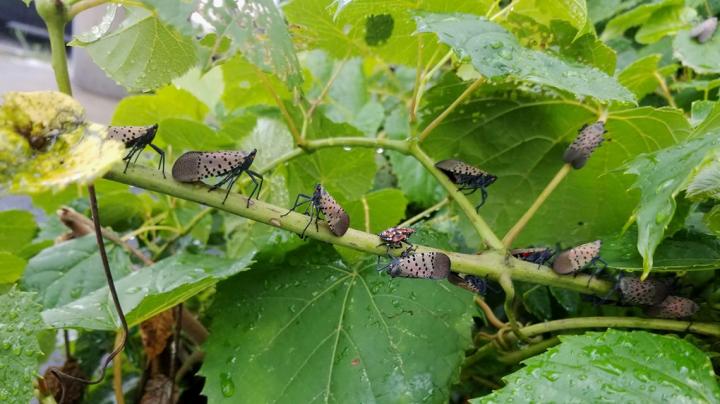
Credit: Eric H. Clifton, Cornell University

ITHACA, N.Y. – Cornell University-led research reports that two local fungal pathogens could potentially curb an invasive insect that has New York vineyard owners on edge.

The spotted lanternfly feeds on more than 70 plant species, including grape vines and apple trees.

Now, the paper, “A pair of native fungal pathogens drives decline of a new invasive herbivore,” led by Eric Clifton, a postdoctoral researcher in the lab of Cornell professor of entomology and co-author Ann Hajek, describes how two unrelated fungi – Batkoa major and Beauveria bassiana – have been decimating spotted lanternfly populations near Reading, Pennsylvania.

“The finding is important because these naturally-occurring pathogens could be used to develop methods for more environmentally-friendly control of this damaging invader,” Hajek said.

“It’s a great example of how a major new invasive herbivore can be suppressed by native pathogens,” Clifton said. “Nobody stepped in to do this; it all happened naturally.”

Native to China, Taiwan and Vietnam, the spotted lanternfly was first discovered in southeastern Pennsylvania in 2014 and has spread to seven more states. Adult insects occasionally have been sighted in New York, but there are no signs yet of large populations. Entomologists and growers believe it’s just a matter of time before spotted lanternflies settle in New York, which boasts a nearly $5 billion grape, grape juice and wine industry, and also stands as the country’s second-largest apple producing state. In Pennsylvania, spotted lanternflies damaged at least a half-dozen vineyards from 2017 to 2018. While there are no reports of spotted lanternflies infecting apple orchards in the U.S., the insects have damaged apples in Korea.

In late 2017 Clifton and Hajek began responding to reports of fungi killing the insects in Berks County, Pennsylvania. In early October 2018, they investigated a site near an apple orchard. “It was clear anywhere you walked, you’d see dozens of lanternflies killed by Beauveria on the ground, and then you’d see cadavers all over the trees killed by Batkoa,” Clifton said.

Back at the lab, the researchers used genetic techniques to identify the two fungi. They found that 97 percent of lanternflies on tree trunks were killed by B. major, while on the ground 51 percent of cadavers were killed by B. bassiana and the rest by B. major.

“If you like apples, if you like grapes and wine, if you like beer (which requires hops, another plant eaten by spotted lanternflies), spotted lanternflies can attack those, and that has growers worried,” Clifton said.

###

Louela Castrillo, an entomologist at the United States Department of Agriculture (USDA) Agricultural Research Service on Cornell’s campus, and Andrii Gryganskyi, a molecular biologist at L.F. Lambert Spawn Co., are co-authors of the study.

The study was funded by the USDA.

Cornell University has dedicated television and audio studios available for media interviews supporting full HD, ISDN and web-based platforms.

Media Contact
Lindsey Hadlock
[email protected]

Original Source

http://news.cornell.edu/stories/2019/04/destructive-plant-pest-thwarted-two-native-fungi

Related Journal Article

http://dx.doi.org/10.1073/pnas.1903579116

Tags: AgricultureBiologyEntomologyFertilizers/Pest ManagementMolecular Biology
Share14Tweet8Share2ShareShareShare2

Related Posts

Ancient Plant Populations Reveal Fresh Insights into Climate Resilience — Biology

Ancient Plant Populations Reveal Fresh Insights into Climate Resilience

May 8, 2026
Rare Brain Disorders in Children Linked to Mutations in Lesser-Known Protein Complex — Biology

Rare Brain Disorders in Children Linked to Mutations in Lesser-Known Protein Complex

May 8, 2026

From Odd Insect to Underwater Predator: The Remarkable Evolution of a Bloodthirsty Fruit Fly

May 8, 2026

SNU Professor Sangwoo Seo’s Team Develops Next-Generation CRISPR Biocontainment Technology to Control Microbial Survival Without DNA Cleavage

May 8, 2026
Please login to join discussion

POPULAR NEWS

  • Research Indicates Potential Connection Between Prenatal Medication Exposure and Elevated Autism Risk

    840 shares
    Share 336 Tweet 210
  • New Study Reveals Plants Can Detect the Sound of Rain

    727 shares
    Share 290 Tweet 181
  • Salmonella Haem Blocks Macrophages, Boosts Infection

    61 shares
    Share 24 Tweet 15
  • Breastmilk Balances E. coli and Beneficial Bacteria in Infant Gut Microbiomes

    57 shares
    Share 23 Tweet 14

About

We bring you the latest biotechnology news from best research centers and universities around the world. Check our website.

Follow us

Recent News

New Post-Hoc Analysis Explores Daily Oral Orforglipron Use in Adults Over 65 with Obesity, Regardless of Diabetes Status

Evaluating Digoxin Use in Patients with Symptomatic Rheumatic Heart Disease

Evaluating the Effectiveness and Safety of Digitalis Glycosides in Treating Heart Failure

Subscribe to Blog via Email

Enter your email address to subscribe to this blog and receive notifications of new posts by email.

Join 82 other subscribers
  • Contact Us

Bioengineer.org © Copyright 2023 All Rights Reserved.

Welcome Back!

Login to your account below

Forgotten Password?

Retrieve your password

Please enter your username or email address to reset your password.

Log In
No Result
View All Result
  • Homepages
    • Home Page 1
    • Home Page 2
  • News
  • National
  • Business
  • Health
  • Lifestyle
  • Science

Bioengineer.org © Copyright 2023 All Rights Reserved.