


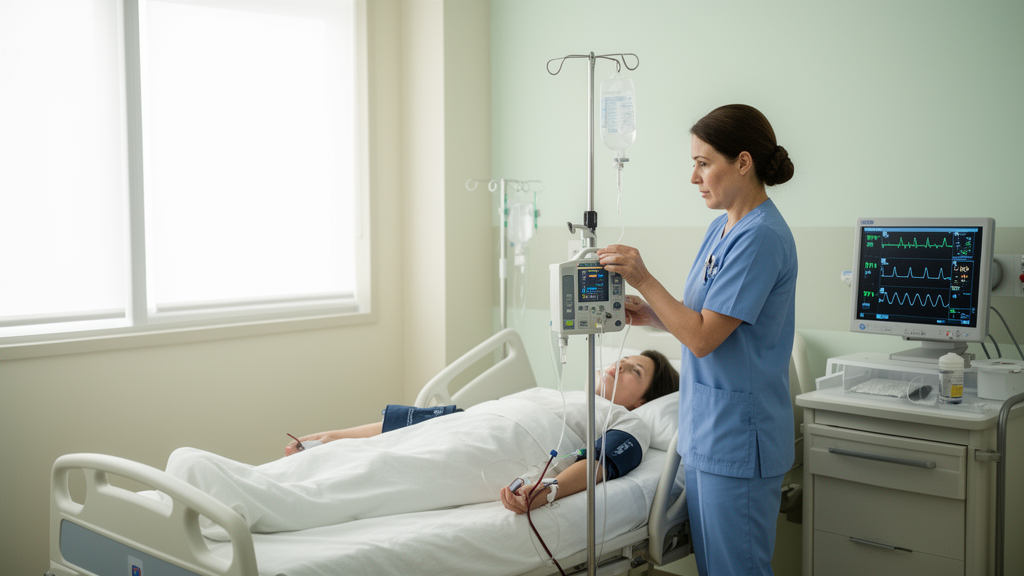
Patients with sepsis-induced hypotension can be treated with norepinephrine delivered through a simple peripheral intravenous catheter at an intermediate care unit, with a low rate of serious complications, according to a retrospective observational study conducted at Sahlgrenska University Hospital in Gothenburg, Sweden. Among 55 patients treated between January 2020 and July 2024, only one experienced extravasation, the leakage of the drug into surrounding tissue, and no patient developed tissue necrosis, the feared complication that has long kept this vasopressor confined to central lines in intensive care units.
The findings, published as a Brief Report in Critical Care: Sepsis and Severe Infection, address a growing practical problem. When intensive care beds are scarce, hospitals need less resource-intensive options for some patients with sepsis, yet data on treating sepsis-induced hypotension with peripheral norepinephrine outside the ICU have remained scarce. The Gothenburg team set out to assess whether such treatment is feasible at an intermediate care unit, a level of care sitting between a general ward and an ICU.
Norepinephrine is essential in treating sepsis-induced hypotension and is usually administered via a central venous catheter in an intensive care unit. Peripheral administration has traditionally been avoided because of the risk of extravasation and tissue necrosis. However, previous observational studies, conducted in ICU settings, reported that extravasation is uncommon when vasopressors are given through a peripheral catheter for a limited duration and under close observation. The intermediate care unit offers a cost-effective alternative that can reduce ICU admissions, but the spectrum of patients who can safely be treated at this level has been unclear.
The study was a retrospective, single-arm review of medical records at the intermediate care unit of the Department of Medicine and Emergency Care Mölndal. Eligible patients had to fulfill three criteria: a registered ICD-10 diagnosis code of sepsis or septic shock, treatment with norepinephrine through a peripheral intravenous line, and treatment at the unit between January 2020 and July 2024. Patients with more than one care episode within four weeks contributed only their first episode. The study was approved by the Swedish Ethical Review Authority.
The treatment followed a specific protocol detailing blood pressure targets, catheter size and location, norepinephrine dilution and dosage, and patient monitoring. All patients received the drug through a peripheral catheter inserted in the proximal volar forearm, using either BD Venflon Pro Safety or B. Braun Introcan Safety 3 catheters. No central venous access or midline catheters were used during the treatment period. Nurses monitored patients hourly for clinical signs of extravasation or tissue necrosis, such as coldness or pallor of the skin, and documented all findings in the medical records.
The 55 included patients had a median age of 78 years and 42 percent were female. They received norepinephrine for a median of 28 hours, reaching a median maximum dose of 0.09 micrograms per kilogram per minute, with the highest dose in the study population reaching 0.23 micrograms per kilogram per minute. Thirty-one percent of patients showed no evidence of bacteria in their blood cultures, while among positive cultures Escherichia coli was the most common organism, followed by Staphylococcus aureus and Klebsiella species. Most patients, 93 percent, were admitted from the emergency ward, with a median of 10 hours between arrival and the start of the infusion.
The hemodynamic results showed a meaningful rise in blood pressure during treatment. Mean arterial pressure averaged 61.1 millimeters of mercury at baseline and 76.2 at the time of infusion stop, a mean difference of 14.7 millimeters of mercury with a 95 percent confidence interval of 10.2 to 19.2. Median urine output also rose during treatment, from 15 milliliters per hour at baseline to 62.5 milliliters per hour at infusion stop.
Safety outcomes were the primary focus. One patient, or 2 percent, experienced extravasation during the infusion; that patient’s maximum dose of 0.17 micrograms per kilogram per minute exceeded the third quartile of maximum doses in the study, which the authors note could indicate that dose is a factor influencing extravasation risk. The event was managed successfully by stopping the infusion and applying a cream containing nitroglycerine locally. No case of tissue necrosis was reported. Six patients developed new-onset atrial fibrillation, no ventricular tachycardia was reported, and 11 patients, or 20 percent, subsequently required ICU admission. In-hospital mortality was 31 percent, and 60 percent of patients had a do-not-resuscitate decision due to frailty and comorbidity.
The authors are careful about the limits of their evidence. This was a retrospective observational study with an obvious risk of selection bias, and the researchers do not know why certain patients with sepsis-induced hypotension were selected for peripheral norepinephrine at the intermediate care unit rather than centrally administered norepinephrine in the ICU. They believe bed availability was a major factor, since clinical practice at the hospital is to start treatment at the intermediate care unit and admit to the ICU only when such a bed is unavailable. The study also did not compare peripheral administration at the intermediate care unit with ICU administration, and patients were treated according to clinical practice rather than a study protocol, although the unit’s specific protocol allows the approach to be reproduced.
Within those constraints, the report adds to a small evidence base. Previous observational studies examined peripherally administered norepinephrine either in ICUs or at intermediate care units using midline catheters, and only one earlier retrospective study has reported observational data on norepinephrine through a peripheral intravenous catheter at an intermediate care unit. The Gothenburg unit operated with a minimum nurse-to-patient ratio of 1:7, lower staffing intensity than the 1:3 ratio in that earlier report. In the absence of randomized trials, the authors conclude that treating sepsis-induced hypotension with peripherally administered norepinephrine at an intermediate care unit according to a specific protocol appears feasible, with a low incidence of complications, and highlights a potential role for intermediate care in modern sepsis management.
Subject of Research: Safety of peripherally administered norepinephrine for sepsis-induced hypotension treated at an intermediate care unit
Article Title: Sepsis-induced hypotension at an intermediate care unit: observational results on the safety of peripherally administered norepinephrine
Article References: Mårtensson Elmrud, J., & Mourtzinis, G. (2026). Sepsis-induced hypotension at an intermediate care unit: observational results on the safety of peripherally administered norepinephrine. Critical Care: Sepsis and Severe Infection, 1(1), Article 3. https://doi.org/10.1186/s44541-026-00005-7
Image Credits: AI Generated
DOI: 10.1186/s44541-026-00005-7
Keywords: sepsis, norepinephrine, hypotension, intermediate care unit, peripheral intravenous catheter, extravasation, tissue necrosis, mean arterial pressure, retrospective observational study, intensive care unit, vasopressor, patient safety
News Source: Ophelia Keating. (October 29, 2026). Peripheral Norepinephrine Shows Low Complication Rates for Sepsis Outside the ICU. Scienmag.



