Peregrine falcon populations across North America are heavily contaminated with harmful flame retardants–including those that have been phased out for years–according to a new study published in Environmental Science & Technology. Flame retardants are chemicals added to furniture, electronics, and other everyday products to meet flammability standards, though they often do not work as intended. They also migrate out of products they are added to and end up in wildlife and people and many are linked to serious health and environmental harms.
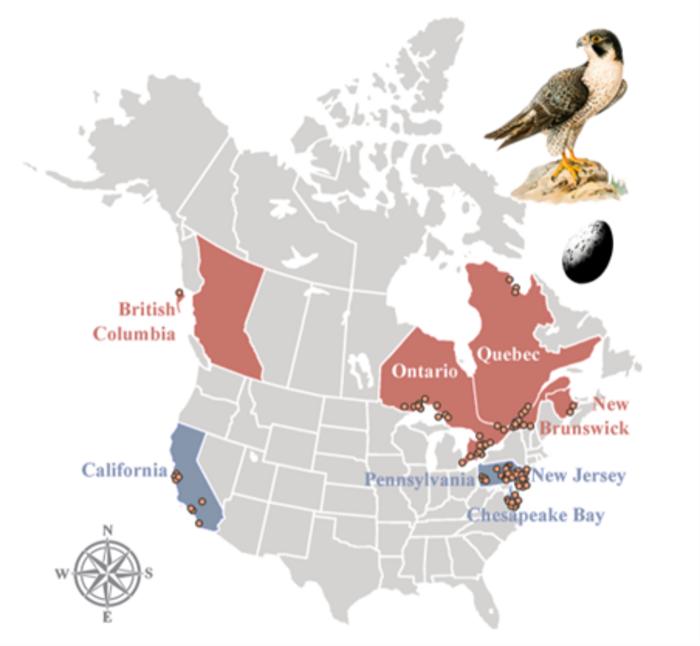
Credit: Wu et al. (2024)
Peregrine falcon populations across North America are heavily contaminated with harmful flame retardants–including those that have been phased out for years–according to a new study published in Environmental Science & Technology. Flame retardants are chemicals added to furniture, electronics, and other everyday products to meet flammability standards, though they often do not work as intended. They also migrate out of products they are added to and end up in wildlife and people and many are linked to serious health and environmental harms.
“Our results expose the long-term consequences of adding flame retardants to consumer products,” said leading author Da Chen, a scientist at Jinan University. “As globally distributed apex predators, the peregrine falcon is the ideal canary in the coal mine for monitoring flame retardant pollution in the environment. Flame retardants phased out a decade ago are still accumulating in these birds and into their eggs, which indicates that the threats of these chemicals to wildlife and people can far outlast their production.”
Researchers measured concentrations of a suite of old and newer halogenated flame retardants in peregrine falcon eggs collected from multiple locations in the U.S. (New Jersey, California, Chesapeake Bay, and Pennsylvania) and Canada (Ontario, Quebec, British Columbia, and New Brunswick) between 1984 and 2016. It is the largest investigation to date of flame retardants in peregrine falcons in terms of both time and space.
In these falcons, polybrominated diphenyl ethers (PBDEs) were the most commonly detected flame retardants and had the highest concentrations. Despite the fact that production of the major PentaBDE and DecaBDE mixtures ceased in North America by the end of 2004 and 2013, respectively, PBDE concentrations did not decline over the study period in most regions. Similarly, although hexabromocyclododecane (HBCDD) has been phased out from the North American market since 2012, it was detected in the majority of eggs and concentrations did not decrease over the study period in any of the regions.
Continued exposure to old flame retardants comes from the release of these chemicals from in-use and discarded products produced before the phase-outs. Further, many flame retardants released from products accumulate up marine and terrestrial food chains over time, making apex predators like peregrine falcons more likely to build up high concentrations in their tissues. The flame retardants also end up in their eggs through maternal transfer.
Concentrations of the unregulated halogenated flame retardants measured by the research team stayed constant or declined throughout the study period, suggesting that non-halogenated flame retardants and polymeric flame retardants are more popular as replacements. Unfortunately, those too are increasingly linked to human and wildlife health harms.
Peregrine falcons are far from the only species polluted by flame retardants. Last year the Green Science Policy Institute released a map of more than 150 species of wild animals across every continent contaminated with old and new flame retardant chemicals. Polluted wildlife included killer whales, red pandas, chimpanzees and other endangered species.
Journal
Environmental Science & Technology
DOI
10.1021/acs.est.3c10907
Article Title
Exposure of Peregrine Falcons to Halogenated Flame Retardants: A 30 Year Retrospective Biomonitoring Study across North America
Article Publication Date
9-Apr-2024