


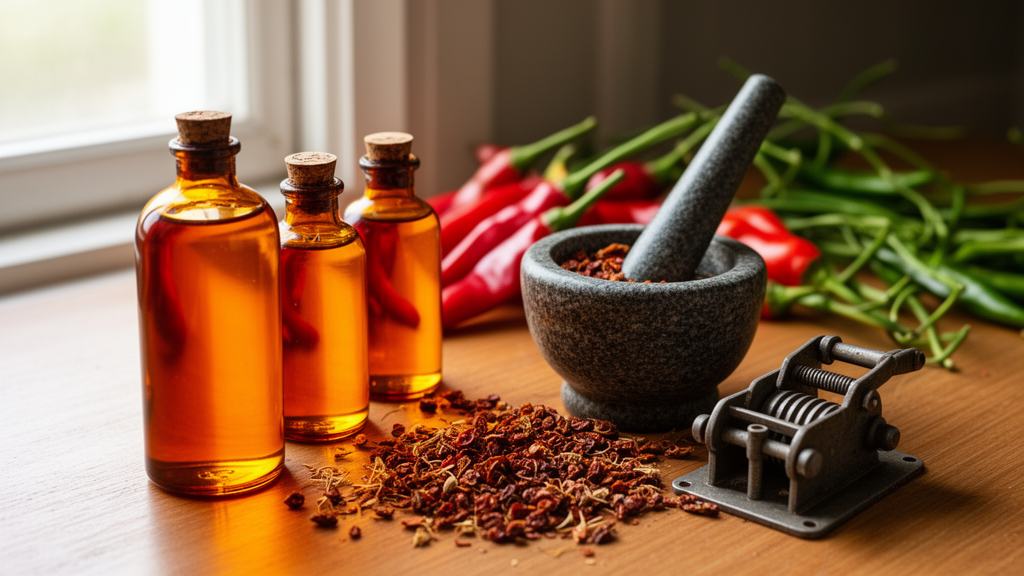
The seeds left behind when sweet and hot peppers are processed into sauces, spices and canned foods are usually thrown away, yet they carry a surprising payload of oil. A new study published in Food Production, Processing and Nutrition has cold-pressed oils from the seeds of four domesticated Capsicum species and mapped their chemistry in unusual detail, from fatty acids and capsaicinoids to tocopherols, carotenoids and oxidative stability. The results suggest that an abundant, inexpensive by-product could be turned into specialty oils with a deep orange color, a high proportion of polyunsaturated fatty acids, and in some cases a fiery kick measured in tens of thousands of Scoville units.
The research team, working with seeds supplied by the Peruvian company DANPER and varieties bought at a local market in Huancayo, Peru, examined three varieties of Capsicum annuum (California, Kapia and Piquillo) plus one variety each of C. baccatum (Ají Mirasol), C. chinense (Ají Panca) and C. pubescens (Ají Rocoto). Seeds were dried at 60 °C until moisture fell below 8 grams per 100 grams, stripped of any residual placenta or pericarp tissue, and pressed with a mechanical oil press; the recovered oil was separated by centrifugation and stored cold until analysis. Three independent batches were prepared for each sample, and the oils were characterized using high-performance liquid chromatography, gas chromatography and a Rancimat apparatus.
The seeds themselves proved to be fiber-rich and moderately oily. On a dry-matter basis they contained 19.8 to 23.5 grams of protein, 49.0 to 55.2 grams of fiber and 9.2 to 12.0 grams of lipid per 100 grams. Rocoto and Panca seeds were the largest and heaviest, while Mirasol seeds were the thinnest and lightest. Cold pressing extracted between 4.0 and 5.4 grams of oil per 100 grams of seed, a total lipid recovery of 43.1 to 45.1 percent. That yield is lower than solvent extraction could achieve, a gap the authors attribute to the seeds’ relatively low lipid and high fiber contents, but cold pressing produces flavored oils that need no refining before consumption.
Across all six oils, polyunsaturated fatty acids dominated, accounting for 67.9 to 75.6 percent of the total, with saturated fatty acids at 16.9 to 25.8 percent and monounsaturates at only 6.2 to 9.6 percent. Linoleic acid was the principal fatty acid at 67.2 to 74.9 percent, followed by palmitic acid, oleic acid and stearic acid. Rocoto oil had the highest polyunsaturated fraction and Mirasol the highest saturated fraction, with PUFA/SFA ratios ranging from 2.74 to 4.48. Computed nutritional indices pointed to a lipid profile dominated by desirable fatty acids with low predicted atherogenic and thrombogenic potential, though the authors caution that the near-absence of alpha-linolenic acid leaves the essential fatty acid balance skewed toward omega-6, and the polyunsaturated richness makes the oils inherently prone to oxidative deterioration.
The most striking differences between species lay in pungency. The three C. annuum oils contained little or no capsaicinoids: none were detected in California oil, Kapia held 7.5 milligrams per kilogram and Piquillo 17.6. The other three species were loaded with capsaicin and dihydrocapsaicin, at 440.6 to 922.2 and 223.2 to 1109.7 milligrams per kilogram respectively. Rocoto oil topped the scale with 2446.5 milligrams per kilogram of total capsaicinoids and an estimated 36,155 Scoville units, placing it in the highly pungent grade, while Panca reached 21,024 and Mirasol 11,017 Scoville units. Because capsaicinoids concentrate in the placenta rather than the seeds, the authors note that careful seed cleaning was essential to keep the measurements representative of the oil itself.
Vitamin E compounds were abundant in every sample, with total tocols between roughly 600 and 1200 milligrams per kilogram. Gamma-tocopherol made up more than 90 percent of the tocols, consistent with its status as the characteristic seed form, while alpha-tocopherol, the only homologue with established vitamin E activity, was present at lower levels and peaked in Mirasol oil at 47 milligrams per kilogram. Carotenoids ranged more widely, from 4.2 milligrams per kilogram in Piquillo to 47.1 in Kapia, with alpha- and beta-carotene the most common compounds. These pigments, recovered from residual pericarp and vein tissue attached to the seeds, gave the oils their appealing orange-red hue and tracked closely with the measured color coordinates.
Freshness indicators suggested the oils were in good condition. Acid values were in line with previously published C. annuum seed oils, peroxide values were lower than most literature reports, and p-anisidine values stayed below the threshold of 10 generally expected for edible oils, with only Rocoto approaching that limit. Specific extinction values at 232 and 268 nanometers indicated limited primary and secondary oxidation products. The authors conclude that the low oxidation indices make the oils suitable for human consumption, while noting that sweet pepper oils suit everyday use whereas the hot pepper oils, given their pungency, fit a niche market unless de-pungency treatments are applied.
Oxidative stability, tested with the Rancimat method at temperatures from 100 to 140 °C, showed a consistent pattern: induction times fell by 45 to 55 percent for every 10-degree increase, from about 12.2 to 16.0 hours at 100 °C down to 0.7 to 0.9 hours at 140 °C. Mirasol oil was the most stable at every temperature, a result the team links to its high tocol content, its intermediate carotenoid concentration and its comparatively high saturated fatty acid proportion, which correlated with stability across the tested range. Extrapolated shelf-life at 25 °C ranged from 3.2 to 4.1 months, with Mirasol at roughly four months and the others near three. The authors stress that these extrapolated values are theoretical comparative benchmarks rather than real-time storage determinations, since high-temperature oxidation kinetics may diverge from ambient behavior in oils containing natural antioxidants.
A principal component analysis of eighteen selected parameters separated the oils along axes of oxidative stability and oxidation status. Mirasol clustered with stability-related variables, Rocoto sat apart despite its antioxidant-rich capsaicinoid content because of its high polyunsaturated fraction, and the three C. annuum samples grouped together on the strength of their higher monounsaturated levels. Correlation analysis tied saturated fatty acids to peroxide value and oxidative stability, polyunsaturates to secondary oxidation markers, and capsaicinoid content to the polyunsaturated fraction, reflecting the shared biosynthetic pathway of these pungent alkaloids and fatty acids.
The study has clear limits that the authors acknowledge: only six samples across four species were tested, the sample number was too small to establish statistically significant links between oxidative stability and individual antioxidant compounds, and no sensory analysis or long-term ambient storage trial was performed. They recommend extending the work to additional Capsicum accessions and adding storage and sensory studies before commercial potential can be fully judged.
Subject of Research: Chemical characterization and oxidative stability of cold-pressed oils from seeds of four Capsicum species
Article Title: Characterization of cold-pressed oils extracted from seeds of different Capsicum species
Article References: Rodriguez, G., Cervi, A., Citti, F., Aguirre, E., Estivi, L., de Fatima Arevalo-Oliva, M., Muñoz-Agreda, J., Barco-Jara, M., Cordova-Chang, A., Muñoz-Saenz, J., Campolungo, L., Brandolini, A., & Hidalgo, A. (2026). Characterization of cold-pressed oils extracted from seeds of different Capsicum species. Food Production, Processing and Nutrition, 8(1), Article 64. https://doi.org/10.1186/s43014-026-00423-7
Image Credits: AI Generated
DOI: 10.1186/s43014-026-00423-7
Keywords: Capsicum, cold-pressed oil, pepper seeds, linoleic acid, capsaicinoids, tocopherols, carotenoids, oxidative stability, Scoville units, food by-products, Rancimat, shelf-life
News Source: Alan Morgan. (October 30, 2026). Pepper Seed Waste Yields Pungent, Antioxidant-Rich Cold-Pressed Oils. Scienmag.



