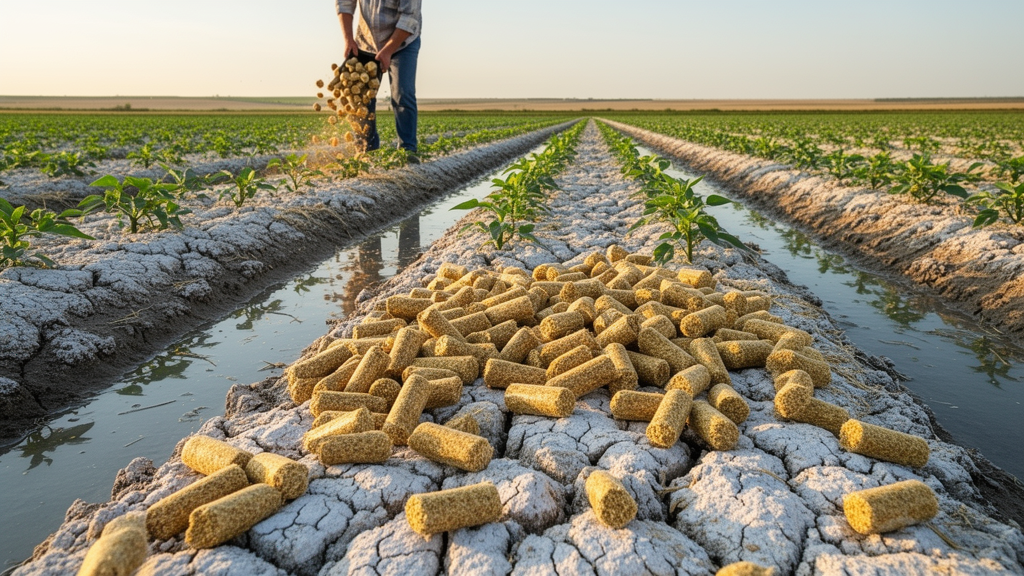
Pelletized straw reduced cumulative nitrous oxide emissions by as much as 45.7% in nitrogen-fertilized saline-alkali soil during a 90-day laboratory incubation, outperforming crushed straw, composted cattle manure derived from straw-fed livestock, and carbonized straw biochar. The treatment also lowered the abundance of a bacterial gene associated with nitrous oxide production and shifted the composition of ammonia-oxidizing bacterial communities. The findings indicate that the physical form in which crop straw is returned to soil can substantially alter its effect on a potent greenhouse gas.
Researchers from Shenyang Agricultural University and collaborating institutions collected soil from a saline-alkali land improvement demonstration site in Weifang, Shandong Province, China. They applied two nitrogen rates equivalent to 120 and 240 kilograms per hectare and compared untreated soil with four amendments: crushed straw, pelletized straw, straw-derived composted cattle manure, and carbonized straw biochar. Increasing the nitrogen application rate raised cumulative nitrous oxide emissions by an average of 41.6%, but every straw treatment reduced emissions relative to soil that received no straw. Pelletized straw consistently produced the lowest cumulative emissions, with reductions of 45.7% at the lower nitrogen rate and 43.2% at the higher rate. Carbonized straw generally had a weaker effect than the other straw-based treatments. Because the experiment lasted 90 days and used collected soil under controlled incubation conditions, the results do not establish how the same treatments would perform across growing seasons or working fields.
The amended soils also differed in when nitrous oxide emissions peaked. Without straw, emissions reached their maximum around day 30, whereas soils receiving straw showed a delayed peak around day 60. This shift suggests that incorporating straw did more than change the total quantity of emissions: it altered the timing of microbial nitrogen-cycling processes that produce and release nitrous oxide. The researchers linked the differences to ammonia-oxidizing bacteria, microorganisms that oxidize ammonia into forms used in the nitrogen cycle. Among the functional genes examined, the abundance of the bacterial amoA gene showed the strongest relationship with cumulative nitrous oxide emissions, while straw application generally reduced its abundance. The association does not alone prove that changes in this microbial group caused the emission reductions.
Straw also changed which ammonia-oxidizing bacteria predominated. The relative abundance of Nitrosovibrio increased, while that of Nitrosospira declined, indicating that management affected both the overall size of the ammonia-oxidizing community and its composition. Corresponding author Yuping Zhuge of Shandong Agricultural University said the results suggest that straw return should not be treated as a single management practice because the physical form and processing pathway can alter microbial nitrogen cycling and, in turn, the amount of nitrous oxide released from soil. The authors propose that pelletized straw may be particularly effective at suppressing nitrous oxide production associated with ammonia-oxidizing bacteria in nitrogen-fertilized saline-alkali soils. Field studies will be needed to determine whether the observed reductions and microbial shifts persist under crop production conditions.
Subject of Research: Effects of processed straw return on nitrous oxide emissions and ammonia-oxidizing bacteria in nitrogen-fertilized saline-alkali soil
Article Title: How straw is returned to soil can make a major difference in nitrous oxide emissions
Article References: How straw is returned to soil can make a major difference in nitrous oxide emissions. Original publication (Bibliographic details unavailable.)
Image Credits: AI Generated
DOI: Not provided
Keywords: nitrous oxide, saline-alkali soil, pelletized straw, crop residue management, ammonia-oxidizing bacteria, nitrogen cycling, greenhouse gas emissions, soil incubation, agricultural management, straw, returned, soil
News Source: Denise Maddox. (October 25, 2026). Pelletized straw cuts nitrous oxide emissions in saline-alkali soil. Scienmag.