Credit: ©Science China Press
Since the Materials Genome Initiative (MGI) was proposed by the United States, Chinese government has launched the Materials Genome project in 2016. By using artificial intelligence and machine learning techniques, the researchers are trying to achieve high-throughput calculation, preparation and detection for the materials database. This project aims to subvert the traditional material research methods and accelerate the development in material research field.
Feng Pan’s group from Peking University Shenzhen Graduate School has led the research project of “National R&D Plan of Materials Genome Project and Genetic Engineering Supporting Platform” for several years, and they are exploring the rule of the material inherent law of the key basic elements, which includes crystal structure, the connection and interaction of the primitive units.
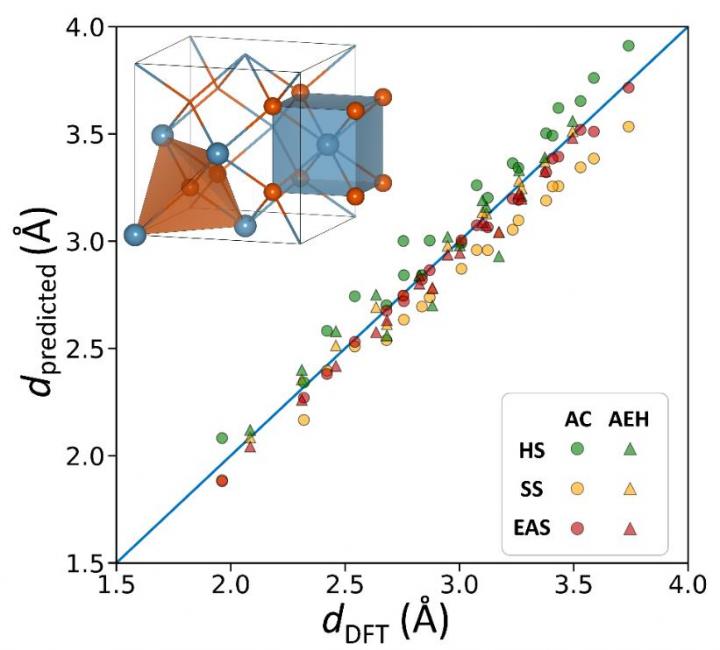
The structural elements are composed of atoms (or ions). In fact, the size of the ion is related to the environment of the structural elements. In 1927, Pauling proposed a large number of ionic radii based on the semi-empirical method according to the nuclear spacing of atoms. However, this model did not consider the interaction between central atom and the coordination atom, so in the application of complex lattice, the prediction error of the distance between adjacent atoms was obvious. Therefore, Pan’s team proposed a new model (effective atom size model, EAS), which considers the influence of the type and number of neighboring atoms on the ionic radius and the interatomic distance. Besides, EAS model can well predict the distance between adjacent atoms.
Then Pan’s group used the EAS model to predict the interatomic distance of a binary compound with a complex crystalline calcium fluoride structure, with both 4 and 8 coordination. The results show that the deviation between the predicted results and the calculated ion spacing by DFT is less than 0.1 Å, which is obviously better than the calculated results based on the current main models (Pauling ion radius, Shannon ion radius, etc.). In addition, the team verified some compounds with special stacking methods and all 148 compounds in the database composed of IA/IIA and VIA/VIIA main group elements with 8, 6 or 4 coordination, and obtained good consistency (all deviations were within 0.1 Å, and most of them were within 0.05 Å).
This work “A descriptor of ‘material genes’: Effective atomic size in structural unit of ionic crystals” has been published in Science China Technological Sciences. Tongyi Zhang, an Academician of Chinese Academy of Sciences, the editor-in-chief of this journal and the Dean of the Shanghai Institute of Materials Genomics, has commented to this work, “Pan and co-workers discovered the most fundamental problem in materials at the atom level via modifying the interatomic distance. This study has a high academic value and will speed up the development of Materials Genome project.”
###
This work was supported by the National Key R&D Program of China, the Shenzhen Science and Technology Research, and the Guangdong Key-Lab Project.
See the article: Chen D, Li S N, Jie J S, Li S B, Zheng S S, Weng M Y, Yu C C, Li S C, Chen D J, Pan F. A descriptor of “material genes”: Effective atomic size in structural unit of ionic crystals. Sci China Tech Sci, 2019, https:/
http://engine.
Media Contact
Pan Feng
[email protected]
Related Journal Article
http://dx.