Credit: Merritt Melancon/University of Georgia, used with permission
STONEVILLE, MISSISSIPPI, May 1, 2019–Improved pest resistance and drought tolerance are among potential benefits of an international effort in which Agricultural Research Service (ARS) scientists and their collaborators have produced the clearest picture yet of the complex genomic history of the cultivated peanut.
Scientists undertook this large project to better understand the molecular and cellular mechanisms that underpin the peanut plant’s growth and development, as well as the expression of desirable traits, like high seed yield, improved oil quality and resistance to costly diseases and pests such as root knot nematodes.
Cultivated peanut, Arachis hypogaea, is an important grain legume and oilseed crop, with a total global production area of approximately 59 million acres. Besides oil, peanut seed contains protein, vitamins and other nutrients. United States peanut production, valued at $2 billion annually, extends from Virginia south to Florida and westward to New Mexico.
The story of the cultivated peanut begins several thousand years ago in South America, where the genomes of two wild ancestors, A. duranensis and A. ipaensis, merged in a rare genetic event. The result, in modern-day peanuts, is a complex genomic blend that’s nearly as big as the human genome, which is about 3 billion DNA base pairs.
Initially, scientists sequenced the genomes of the two wild ancestors separately, using DNA taken from the two species rather than from cultivated peanut. This made it easier to identify structural features of the genomes and the genes residing on them. The team reported that progress in a 2016 issue of the journal Nature Genetics. Now, using advanced DNA sequencing equipment, the researchers have sequenced the two merged genomes in a single commercially grown peanut, namely ‘Tifrunner,’ filling in knowledge gaps that the previous effort missed.
This latest advance, reported in the May issue of Nature Genetics, has already generated interesting leads, including the geographic origin of A. duranensis, one of the two “parents” of cultivated peanut. The team’s genomic analysis of populations of plants that make up the wild peanut species pointed to a region in northern Argentina known as Rio Seco. Researchers surmise that ancient farmers migrating there from Bolivia exposed A. duranensis plants to another species they had brought with them–A. ipaensis, considered the other parent of cultivated peanut.
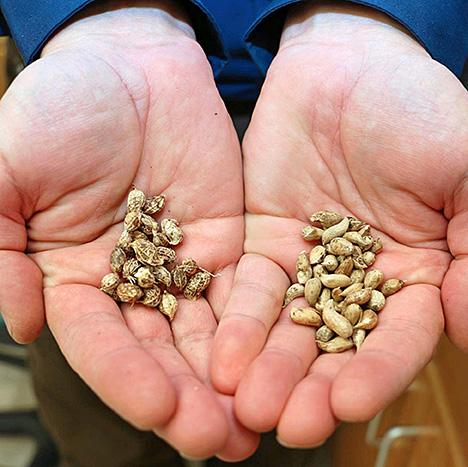
The researchers also recreated this genomic merger by crossing the two ancient peanuts species and analyzing the results in seven generations of offspring plants. This revealed an interesting pattern of DNA swapping and deletions (eliminations) taking place in the offspring plants that likely explains the diverse seed size, shape, color and other traits seen in commercial peanuts today. The DNA swapping is unusual in that it occurs between the two “subgenomes” of the two contributing wild species–something that’s possible due to their high similarity.
Led by University of Georgia researcher David Bertioli, the effort is a continuation of the “International Peanut Genome Initiative” and involves scientists from four ARS laboratories and other partner organizations in the United States, Argentina, Brazil, China and India.
###
The ARS team’s contributions included providing bioinformatics support, peanut germplasm resources and data for analysis, mapping and comparison. Brian Scheffler at Stoneville, Mississippi; Steven Cannon at Ames, Iowa; and Baozhu Guo and Corley Holbrook at Tifton, Georgia, were among ARS contributors.
The Agricultural Research Service is the U.S. Department of Agriculture’s chief scientific in-house research agency. Daily, ARS focuses on solutions to agricultural problems affecting America. Each dollar invested in agricultural research results in $20 of economic impact.
Media Contact
Jan Suszkiw
[email protected]
Original Source
https:/
Related Journal Article
http://dx.