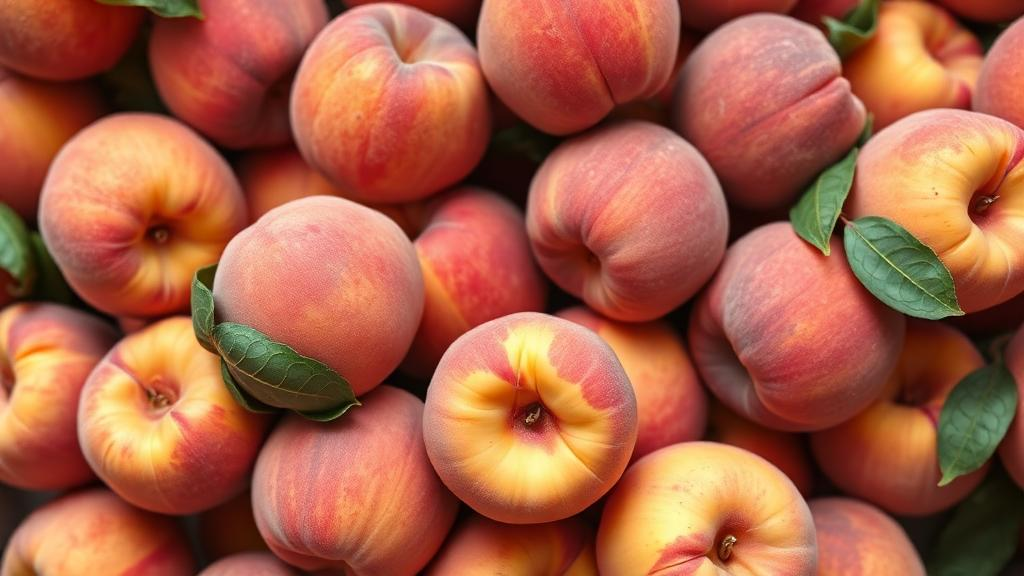
Every summer, crates of peaches and nectarines travel from orchards in northeastern Iran to wholesale markets, cold storage facilities, retail shops, and finally kitchen refrigerators. Along that journey, some fruit is bruised, rots, or is thrown away. But a new study from Razavi Khorasan Province suggests that the most damaging consequence of postharvest deterioration is not the fruit that disappears at all. It is the fruit that stays on the shelf, still technically edible and sellable, but quietly worth less than it was the day it was picked. The research, published in the Journal of Agriculture and Food Research, is among the first to track both physical loss and economic value decline side by side across every stage of a stone fruit supply chain.
The research team, led by Parvin Sharayei and colleagues at the Agricultural Engineering Research Institute in Iran, surveyed 23 orchards, 23 wholesale traders, 14 cold storage facilities, 49 retail fruit shops, and 64 households during the July to September harvest season. At the orchard stage, the researchers went beyond interviews and actually weighed harvested lots on calibrated digital platform scales, separating fruit with visible defects such as bruising, decay, pest damage, and cracking from marketable produce. At later stages, where rapid product turnover made direct weighing impractical, they relied on structured interviews and standardized observational assessments, converting all observations into percentage-based indicators so that stages could be compared on equal footing.
The headline numbers reveal a consistent and striking pattern. Physical losses were modest at every stage: 4.54 percent at orchards, 2.49 percent at the wholesale stage, 2.70 percent in cold storage, 3.35 percent at retail, and just 1.77 percent in households. Economic value decline, however, was higher than physical loss at every stage where it could be measured, reaching 7.85 percent at the orchard, 4.23 percent at wholesale, 3.70 percent during storage, and 4.60 percent at retail. In other words, fruit was losing commercial value faster than it was physically disappearing, a distinction that conventional food loss assessments, which typically count only discarded mass, systematically miss.
The study defines the two measures carefully. Physical loss is the proportion of fruit that becomes non-marketable and is removed from the supply because of bruising, decay, pest damage, or cracking. Economic value decline is the relative reduction in the commercial value of fruit that remains present but has been downgraded, whether through visual defects, softening, physiological disorders, or price markdowns. At each stage, the researchers compared the prevailing price of marketable fruit with the actual price achieved after deterioration. This operational distinction matters because a peach does not need to be thrown away to cost someone money. A soft spot, a skin blemish, or a loss of firmness can push fruit into a lower price grade while it still sits in the crate.
Statistical analysis reinforced the point. At the wholesale stage, linear regression showed a weak association between physical loss and value decline, with physical loss explaining only about nine percent of the variation in economic devaluation. At retail, the relationship was similarly weak, with an R-squared of just 0.16. The magnitude of physical loss simply did not predict how much commercial value was being destroyed. This echoes findings from Spanish persimmon production, where economic depreciation of 38.5 percent of commercialized volume exceeded physical mass loss of 29.5 percent, suggesting that the gap between what is discarded and what is devalued may be a general feature of fresh fruit supply chains rather than a quirk of peaches.
To identify which factors mattered most at each stage, the team applied TOPSIS, the Technique for Order Preference by Similarity to Ideal Solution, a multi-criteria decision-making method that ranks factors by their distance from ideal and worst-case solutions. Stakeholders at each stage rated candidate determinants on a five-point importance scale, and the researchers weighted respondents using attributes such as education, experience, and operational capacity, with orchard weights proportional to production volume. The result was a stage-specific priority ranking of loss drivers, grounded in the practical knowledge of the people who actually handle the fruit.
The rankings tell a coherent story about where the supply chain leaks value. At the orchard stage, water stress emerged as the highest-ranked factor with a priority score of 52.2 percent, followed closely by the absence of pre-cooling systems, which 73.9 percent of surveyed orchards lacked. Without rapid removal of field heat, harvested fruit continues respiring at elevated temperatures, accelerating ethylene production, moisture loss, tissue softening, and senescence. At the wholesale stage, inappropriate harvest timing ranked first at 63 percent, followed by cold chain disruption at 58 percent and harvest-to-market shipment delays at roughly 55 percent. In cold storage, where temperatures were appropriately held between 0 and 1 degrees Celsius but humidity ran slightly below the recommended 90 to 95 percent, the single most influential factor, scoring a perfect 100 percent, was low inbound fruit quality, evidence that storage losses often originate upstream rather than in the storage facility itself.
Retail and household results shifted the focus toward economics and behavior. At retail, where every shop relied on ambient storage with no cooling, high fruit prices received the highest TOPSIS priority score, plausibly because expensive fruit sells more slowly, sits longer on display, and deteriorates further under warm conditions. Failure to sell fruit on time and inadequate cooling ranked second and third. At the household level, where average waste was a remarkably low 1.77 percent, the dominant perceived drivers were low-quality fruit at purchase, buying beyond actual consumption needs, and insufficient personal concern about food waste. Nearly 97 percent of consumers refrigerated their fruit, and average storage lasted 6.8 days, suggesting that Iranian households in the study region were already handling peaches and nectarines relatively carefully.
The authors are appropriately cautious about generalizing. The study was designed as a descriptive, stage-based assessment rather than a probability survey, so the figures represent estimates for the surveyed actors rather than statistically representative values for the entire province. The stage-specific percentages cannot simply be added together into a single supply chain total, because the same fruit batches were not tracked longitudinally from orchard to table. The algebraic sum of the stage averages, 14.90 percent, is reported only as a descriptive indicator. Still, when set against regional production of roughly 9,590 tonnes of peaches and nectarines and a population of 7.1 million, the numbers hint at the scale of value quietly leaking out of the system, equivalent to a descriptive estimate of about 14 kilograms of fruit per capita across the assessed stages.
The practical implications are refreshingly concrete. Growers could benefit from improved irrigation management, better harvest scheduling, effective pest and disease control, and access to pre-cooling facilities. Wholesale distributors would gain from minimizing delays between harvest and market and maintaining cold chain continuity. Storage operators should focus on assessing fruit quality at intake, respecting recommended storage durations, and using packaging that cushions and ventilates. Retailers need cooling infrastructure, careful handling, and pricing strategies that encourage timely turnover rather than slow-moving premium displays. Because the dominant loss factors differ from stage to stage, the authors argue, interventions tailored to each node of the chain will accomplish far more than any one-size-fits-all waste reduction campaign. And perhaps most importantly, anyone measuring food loss should look beyond the bin: the truest accounting of waste in perishable fruit includes every discount, downgrade, and devaluation that happens long before anything is thrown away.
Subject of Research: Postharvest physical loss and economic value decline in peach and nectarine supply chains
Article Title: Physical loss/waste vs. value decline in peaches and nectarines: A multi-stage empirical and TOPSIS based assessment
Article References: Sharayei, P., Einafshar, S., Sabeghi, Y., Azarpazhooh, E., Gandomzadeh, D., & Hassan, H. F. (2026). Physical loss/waste vs. value decline in peaches and nectarines: A multi-stage empirical and TOPSIS based assessment. Journal of Agriculture and Food Research, 31, Article 103338. https://doi.org/10.1016/j.jafr.2026.103338
Image Credits: AI Generated
DOI: 10.1016/j.jafr.2026.103338
Keywords: peaches, nectarines, postharvest losses, food waste, economic value decline, supply chain, TOPSIS, cold chain, Iran, Razavi Khorasan, fruit quality, pre-cooling
News Source: Alan Morgan. (October 7, 2026). Peaches lose value before they are lost, Iranian supply chain study shows. Scienmag.