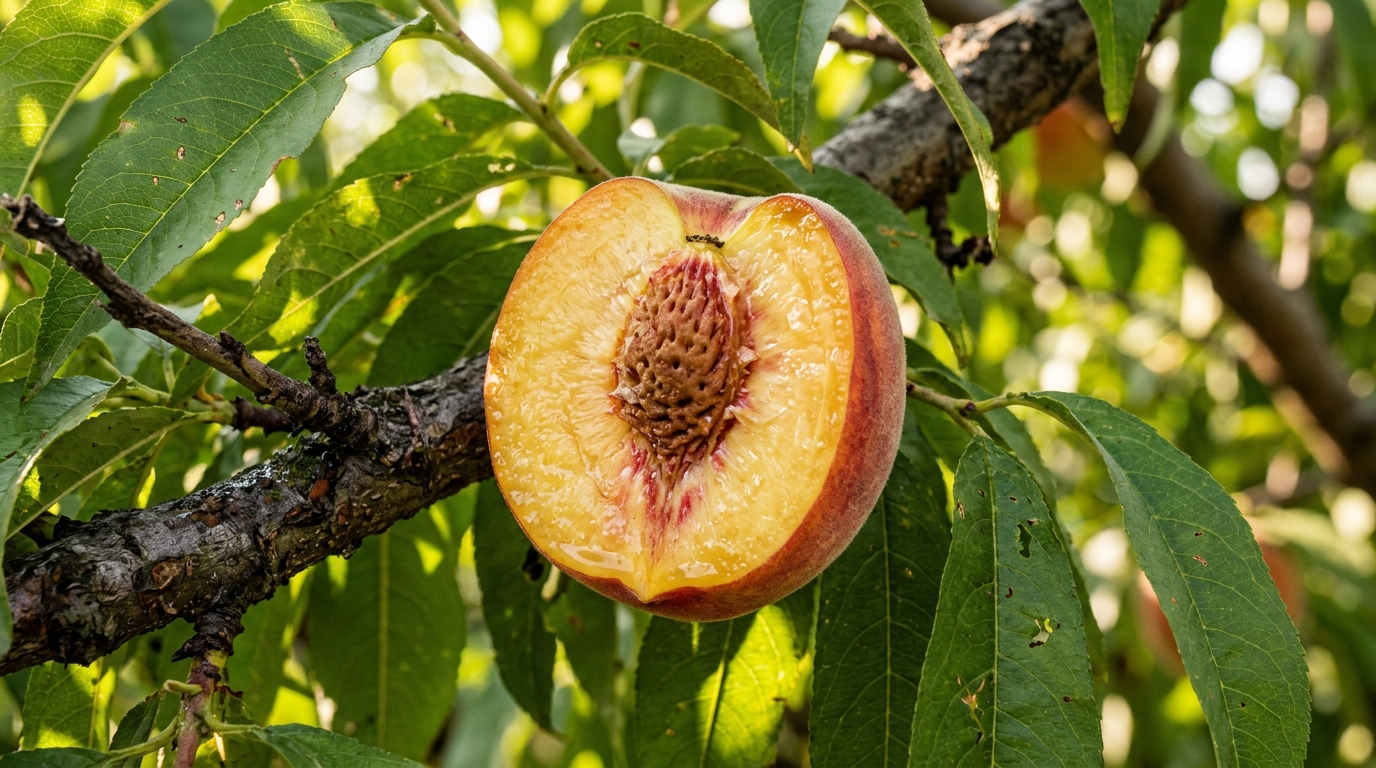
Two specific vacuolar proton pump genes, PpVHA-c1 and PpVHA-c3, function as positive regulators of malate accumulation in peach fruit, according to a study published in Horticulture Advances. The research, led by a team including Beibei Feng and Bin Tan, identifies these genes as key components in the biochemical machinery that determines fruit acidity and quality. By combining genomic analysis with functional validation in both peach and tobacco plants, the study provides a detailed framework for understanding how organic acid metabolism is controlled at the cellular level in Prunus persica.
Malate is a primary determinant of peach fruit acidity, working alongside citric acid to shape the sensory perception of flavor. Beyond its role in taste, malate performs essential physiological functions, including pH homeostasis, osmotic adjustment, and stress response. The accumulation of these organic acids is a complex process involving the balance of synthesis, degradation, and storage. While the metabolic pathways for organic acids are well-characterized, the specific role of vacuolar H⁺-ATPase (VHA) genes in peach fruit had remained poorly characterized prior to this investigation.
The study began by identifying the full complement of VHA genes in the ‘Zhongyoutao 14’ (CN14) peach genome. Using homology-based screening with Arabidopsis thaliana sequences as queries, the researchers identified 23 putative PpVHA genes encoding 25 distinct transcripts. These genes were validated through conserved domain analysis and phylogenetic reconstruction. The phylogenetic tree revealed that the VHA family is classified into 13 evolutionarily conserved groups, with each VHA subunit represented by at least one transcript in peach. This conservation suggests that the structural requirements for the proton pump are maintained across plant species.
To refine the genomic data, the team manually adjusted three gene models using transcriptome mapping data. Specifically, exon skipping was observed in PpVHA-A and PpVHA-d, generating novel transcript variants, while an erroneous annotation in PpVHA-D was corrected to prevent premature termination. These adjustments were confirmed through PCR cloning and sequencing. The encoded proteins exhibited diverse physicochemical properties, with molecular weights ranging from 7.5 to 93.6 kDa and isoelectric points between 4.90 and 9.46. Subcellular localization predictions indicated that these proteins are distributed across the vacuole, nucleus, plasma membrane, and other organelles, consistent with the multifunctional roles of V-ATPases.
Expression profiling of the 25 PpVHA transcripts was conducted across four developmental stages in two peach cultivars: ‘Huangshuimi’ (HSM) and CN14. The results showed that malate content was highest at the early S1 stage and gradually decreased throughout fruit development. The expression levels of PpVHA-c1 and PpVHA-c3 showed a general decreasing trend in both cultivars, which was positively correlated with the measured malate content. This correlation suggested that these two specific VHA genes might be involved in the regulation of malate accumulation during the maturation of the fruit.
To test this hypothesis, the researchers performed functional validation using transient transformation assays in both peach fruit and Nicotiana benthamiana leaves. In peach fruits of the ‘Chunmei’ and ‘Jin Hui’ cultivars, transient overexpression of PpVHA-c1 and PpVHA-c3 significantly increased the malate content. Conversely, transient silencing of these genes in ‘Yumeiren’ peach fruits resulted in a significant reduction in malate concentration. Similar results were observed in N. benthamiana leaves, where overexpression promoted malate accumulation. These findings provide direct evidence that PpVHA-c1 and PpVHA-c3 play crucial roles in regulating malate levels in plant tissues.
The study also investigated the transcriptional regulation of these genes by analyzing the cis-acting elements in their promoter regions. Using the PlantCARE database, the team predicted diverse regulatory elements, including photoresponsive, hormone-responsive, and stress-related motifs. To identify potential regulators, they used the PlantRegMap database to predict transcription factor binding sites. The analysis revealed 310 potential binding sites in the PpVHA-c1 promoter and 234 in the PpVHA-c3 promoter. Nine transcription factors for PpVHA-c1 and fourteen for PpVHA-c3 exhibited high Pearson correlation coefficients with their target genes, suggesting they act as positive regulators.
Among the candidate regulators for PpVHA-c1, two belong to the TCP family and two to the MYB family, with others from the bZIP, Dof, NAC, MYB-related, and WRKY families. For PpVHA-c3, the predicted regulators include three NAC transcription factors and two each from the MYB-related and HSF families. Notably, one NAC transcription factor, Ppchr02G027880, was predicted to potentially regulate both PpVHA-c1 and PpVHA-c3. RT-qPCR validation in peach fruits confirmed that three transcription factors were significantly positively correlated with PpVHA-c1 expression, while two were correlated with PpVHA-c3.
The V-ATPase complex is a highly conserved ATP-dependent proton pump consisting of a cytoplasmic V1 domain and a membrane-embedded V0 domain. The V1 domain catalyzes ATP hydrolysis, while the V0 domain is responsible for proton translocation. By establishing an electrochemical proton gradient, VHA drives the secondary active transport of organic acids into the vacuole. This process is essential for maintaining cellular pH homeostasis and is involved in various stress responses, including adaptations to salt, cold, and heavy metals. The study highlights the integrated control of proton pump activity in plant physiology and stress adaptation.
The findings contribute to a broader understanding of how fruit quality traits are genetically controlled. By identifying specific VHA genes and their regulatory networks, the research provides a foundation for dissecting the mechanisms of organic acid metabolism in peach. The conservation of VHA subunits across species suggests that similar regulatory principles may apply to other fruit crops.
The study was conducted using peach germplasms cultivated at the experimental base of Henan Agricultural University in Zhengzhou, China. Fruits were harvested at specific developmental stages for transient transformation and malate measurement. The use of multiple cultivars and the N. benthamiana system allowed for a robust assessment of gene function. The statistical analysis confirmed that the observed differences in malate content were significant, with P-values less than 0.05 determined by one-way ANOVA and Duncan’s test.
This research underscores the importance of vacuolar proton pumps in determining the sensory and physiological properties of peach fruit. By linking specific gene expression to metabolic outcomes, the study bridges the gap between genomic data and functional biology.
The physical distribution of the twenty-three identified proton pump genes reveals an uneven arrangement across the eight chromosomes of the peach genome. Chromosomes 1 and 3 harbor the highest concentration of the gene family, containing five distinct loci each. Chromosome 6 carries four genes, while chromosome 8 contains three members. In contrast, chromosomes 4 and 5 each possess two genes, and chromosomes 2 and 7 carry only a single gene apiece. Comparative phylogenetic analysis demonstrated that the peach complement mirrors the organization of model plants, systematically dividing the twenty-five transcripts into thirteen V1 domain transcripts across eight subunit groups and twelve V0 domain transcripts across five subunit groups. Bioinformatic evaluation further identified thirteen acidic proteins and twelve basic proteins, with thirteen designated as hydrophilic and twelve categorized as hydrophobic.
Beyond the specific profiles of PpVHA-c1 and PpVHA-c3, transcriptomic monitoring across the four developmental stages revealed pronounced divergence among other family members between cultivars. In the CN14 cultivar, PpVHA-a2 and PpVHA-A displayed substantial expression during the earliest developmental phases, designated CS1 and CS2, before declining sharply during later maturation stages, while remaining consistently suppressed throughout all developmental periods in HSM fruit. Conversely, PpVHA-F2, PpVHA-D, and PpVHA-G1 exhibited a gradual upward trajectory from HS1 through HS3 in HSM peaches, followed by low expression at HS4, maintaining minimal activity across all CN14 fruit stages. Furthermore, a subset comprising PpVHA-G2, PpVHA-E1, and two PpVHA-c’ transcripts exhibited stage-specific expression restricted exclusively to the HS3 developmental window in HSM fruit, reflecting complex developmental regulation.
These vacuolar proton pumps operate within a broader metabolic framework governing organic acid accumulation and storage. In plant cells, cytosolic malate and citrate exist primarily as charged anions that cannot diffuse freely across the tonoplast membrane. The vacuole can occupy up to ninety percent of total cellular volume, serving as the primary storage reservoir for these metabolites. Proton pumps, including vacuolar H⁺-ATPases and pyrophosphatases, actively translocate hydrogen ions across the tonoplast to establish the requisite electrochemical gradient that energizes secondary transport. Upstream, organic acid biosynthesis begins with carbon fixation catalyzed by phosphoenolpyruvate carboxylase in the cytoplasm, whereas degradation during fruit ripening is mediated by enzymes such as phosphoenolpyruvate carboxykinase and NADP-dependent malic enzyme, jointly defining the balance of organic acid storage.
The experimental validation also depended on rigorous molecular quantification and standardized transient transformation procedures. Agrobacterium cultures harboring either the overexpression constructs or silencing vectors were cultivated in liquid medium until reaching an optical density of approximately 0.8 at 600 nanometers, after which suspensions were introduced into at least ten healthy fruit specimens using sterile one-milliliter syringes. For quantification, malic acid was extracted from freeze-dried fruit flesh or powdered leaf tissue and evaluated photometrically with a microplate reader across three biological replicates. Expression changes were verified through reverse transcription quantitative PCR using an Actin reference gene and the comparative threshold method, with statistical significance established through analysis of variance and Duncan’s multiple range testing at a significance threshold of P less than 0.05.
Subject of Research: Genetic and functional analysis of vacuolar H⁺-ATPase genes in peach fruit malate accumulation
Article Title: Two vacuolar proton pumps, PpVHA-c1 and PpVHA-c3, contribute to malate accumulation in peach fruit
Article References: Feng, B., Liu, Q., Liu, K., Wang, D., Ding, Y., Lian, X., Wang, X., Zheng, X., Cheng, J., Wang, W., Zhang, L., Ye, X., Li, J., Zhang, H., Feng, J., & Tan, B. (2026). Two vacuolar proton pumps, PpVHA-c1 and PpVHA-c3, contribute to malate accumulation in peach fruit. Horticulture Advances, 4(1), Article 18. https://doi.org/10.1007/s44281-026-00108-8
Image Credits: AI Generated
DOI: 10.1007/s44281-026-00108-8
Keywords: PpVHA-c1, PpVHA-c3, malate accumulation, peach fruit, Prunus persica, vacuolar H⁺-ATPase, fruit acidity, transient transformation, Nicotiana benthamiana, transcription factors, organic acid metabolism, fruit quality, proton pumps, Horticulture Advances, CN14 peach genome, fruit development, pH homeostasis, gene expression, plant physiology, biochemical basis
News Source: Juliet Wilcox. (November 18, 2026). Peach Proton Pumps Drive Malate Accumulation in Fruit. Scienmag.