• HOME
  • NEWS
  • EXPLORE
    • CAREER
      • Companies
      • Jobs
    • EVENTS
    • iGEM
      • News
      • Team
    • PHOTOS
    • VIDEO
    • WIKI
  • BLOG
  • COMMUNITY
    • FACEBOOK
    • INSTAGRAM
    • TWITTER
Monday, May 18, 2026
BIOENGINEER.ORG
No Result
View All Result
  • Login
  • HOME
  • NEWS
  • EXPLORE
    • CAREER
      • Companies
      • Jobs
        • Lecturer
        • PhD Studentship
        • Postdoc
        • Research Assistant
    • EVENTS
    • iGEM
      • News
      • Team
    • PHOTOS
    • VIDEO
    • WIKI
  • BLOG
  • COMMUNITY
    • FACEBOOK
    • INSTAGRAM
    • TWITTER
  • HOME
  • NEWS
  • EXPLORE
    • CAREER
      • Companies
      • Jobs
        • Lecturer
        • PhD Studentship
        • Postdoc
        • Research Assistant
    • EVENTS
    • iGEM
      • News
      • Team
    • PHOTOS
    • VIDEO
    • WIKI
  • BLOG
  • COMMUNITY
    • FACEBOOK
    • INSTAGRAM
    • TWITTER
No Result
View All Result
Bioengineer.org
No Result
View All Result
Home NEWS Science News Health

Patients with high-risk clinical features are at high risk for acute aortic dissection

Bioengineer by Bioengineer
April 10, 2018
in Health
Reading Time: 2 mins read
0
Share on FacebookShare on TwitterShare on LinkedinShare on RedditShare on Telegram
IMAGE

Credit: Kirsty Challen, B.Sc., MBChB, MRes, Ph.D., Lancashire Teaching Hospitals, United Kingdom.

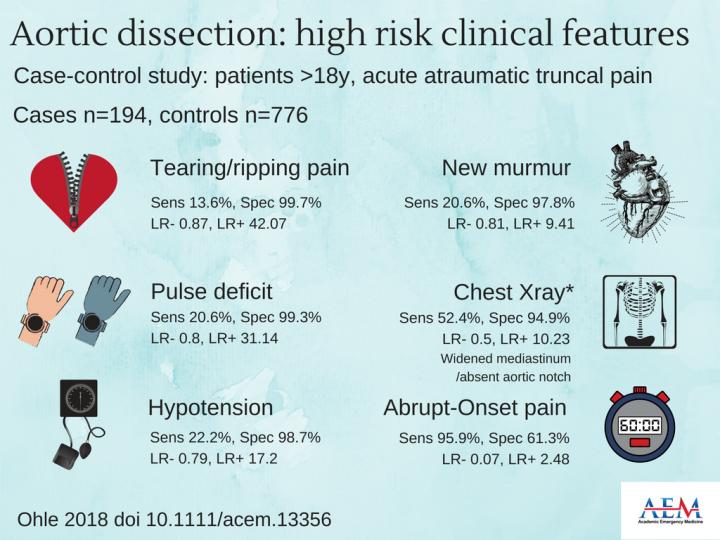
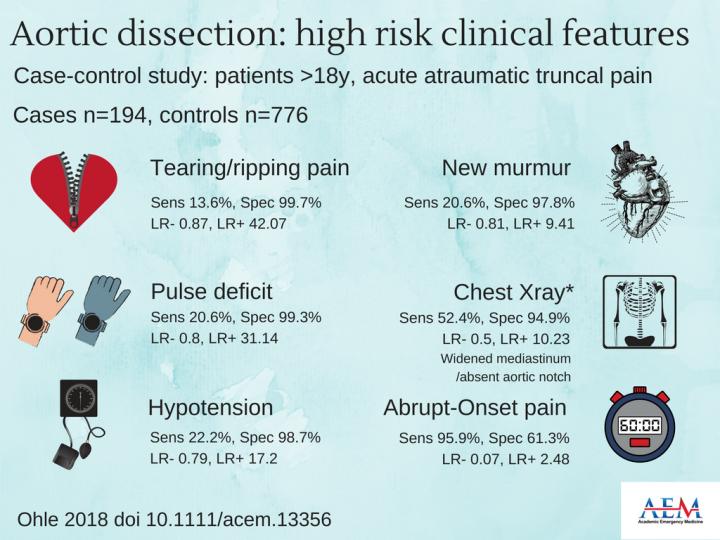
DES PLAINES, IL- Patients with one or more high-risk clinical features (tearing pain, hypotension, pulse deficit, neurologic deficit, new murmur) should be considered high risk for acute aortic dissection (AAD). That is the finding of a study to be published in the April 2018 issue of Academic Emergency Medicine (AEM), a journal of the Society for Academic Emergency Medicine (SAEM).

The lead author of the study is Dr. Robert Ohle, MSc, MA, MB, FRCPC, Department of Emergency Medicine, the Ottawa Hospital Research Institute, University of Ottawa, Ottawa, Ontario.

The study by Ohle, et al, further found that patients with no high-risk and multiple low-risk features (absence of abrupt-onset pain, history of ischemic heart disease and diabetes) are at low risk for acute aortic dissection.

A novel finding of the study was that a history of ischemic heart disease decreased the probability of AAD.

The study suggested that educational strategies focusing on disseminating the diagnostic accuracy of clinical findings could reduce time to diagnosis and that further research should focus on the ability of a combination of these factors in the assessment of a patient for AAD.

The findings support the need for prospective data collection to address the reproducibility of subjective historical features and the accuracy of D-dimer in a lower-risk population.

Lane McNeil Smith, MD, PhD, assistant professor, Lexington Emergency Medicine, Wake Forest Baptist Health, commented:

"Ohle et al have done a great job at telling us how acute aortic dissection presents to emergency departments. Are we finally on the verge of a decision rule for this disease that improves our miss rate without ballooning non-therapeutic imaging and costs? This study is a step in the right direction and the authors are in a good position to find the right balance of improved accuracy and increased cost."

###

The Society for Academic Emergency Medicine (SAEM) is a 501(c)(3) not-for-profit organization dedicated to the improvement of care of the acutely ill and injured patient by leading the advancement of academic emergency medicine through education and research, advocacy, and professional development. To learn more, visit saem.org.

Media Contact

Stacey Roseen
[email protected]
847-257-7227
@SAEMonline

http://saem.org

Related Journal Article

http://dx.doi.org/10.1111/acem.13356

Share12Tweet8Share2ShareShareShare2

Related Posts

Durvalumab and HAIC-FOLFOX Advance Liver Cancer Treatment

May 18, 2026

Social Exclusion in Midlife Caregivers Explored Through Photos

May 18, 2026

Unraveling Non-Ischaemic Dilated Cardiomyopathy Trends

May 18, 2026

New Study Reveals Potential Misinterpretations in Alzheimer’s Drug Effectiveness Analysis

May 18, 2026
Please login to join discussion

POPULAR NEWS

  • Research Indicates Potential Connection Between Prenatal Medication Exposure and Elevated Autism Risk

    845 shares
    Share 338 Tweet 211
  • New Study Reveals Plants Can Detect the Sound of Rain

    731 shares
    Share 292 Tweet 182
  • Salmonella Haem Blocks Macrophages, Boosts Infection

    62 shares
    Share 25 Tweet 16
  • Breastmilk Balances E. coli and Beneficial Bacteria in Infant Gut Microbiomes

    58 shares
    Share 23 Tweet 15

About

We bring you the latest biotechnology news from best research centers and universities around the world. Check our website.

Follow us

Recent News

Cellulose Aerogel Inspired by White Beetles Enables Passive Daytime Cooling

How Hibernation Impacts Visual Processing in Squirrels’ Brains

NUS Team Unveils Open-Access Tool to Decode DNA Mutation Patterns in Breast Cancer

Subscribe to Blog via Email

Enter your email address to subscribe to this blog and receive notifications of new posts by email.

Join 82 other subscribers
  • Contact Us

Bioengineer.org © Copyright 2023 All Rights Reserved.

Welcome Back!

Login to your account below

Forgotten Password?

Retrieve your password

Please enter your username or email address to reset your password.

Log In
No Result
View All Result
  • Homepages
    • Home Page 1
    • Home Page 2
  • News
  • National
  • Business
  • Health
  • Lifestyle
  • Science

Bioengineer.org © Copyright 2023 All Rights Reserved.