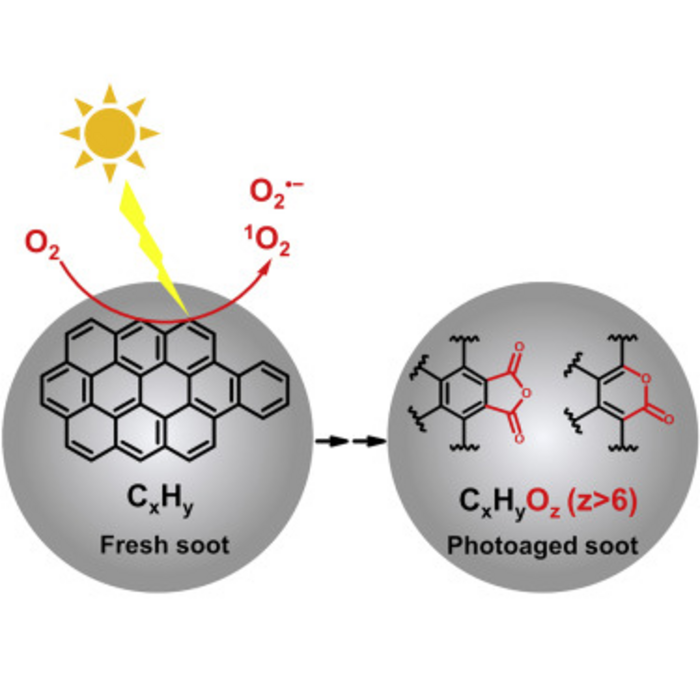
Highly oxygenated organic molecules are a key component of atmospheric secondary organic aerosol. However, the origin and formation mechanism of highly oxygenated organic molecules with high unsaturation (HU-HOMs), remain unknown. But now an international team of researchers has found that photooxidation of large polycyclic aromatic hydrocarbons (PAHs) on soot by singlet oxygen and superoxide anion radicals can be an important source of the unexplained HU-HOMs widely observed in the atmosphere. The team was led by Yafang Cheng from the Max Planck Institute for Chemistry and Chuncheng Chen from the Institute of Chemistry, Chinese Academy of Sciences. Their results are based on molecular-level investigations of the photochemical aging of soot by O2. The PAH-derived HU-HOMs exhibit lactone and anhydride functional groups and can substantially increase the hydrophilicity of soot.
Credit: https://doi.org/10.1016/j.chempr.2022.06.011
Highly oxygenated organic molecules are a key component of atmospheric secondary organic aerosol. However, the origin and formation mechanism of highly oxygenated organic molecules with high unsaturation (HU-HOMs), remain unknown. But now an international team of researchers has found that photooxidation of large polycyclic aromatic hydrocarbons (PAHs) on soot by singlet oxygen and superoxide anion radicals can be an important source of the unexplained HU-HOMs widely observed in the atmosphere. The team was led by Yafang Cheng from the Max Planck Institute for Chemistry and Chuncheng Chen from the Institute of Chemistry, Chinese Academy of Sciences. Their results are based on molecular-level investigations of the photochemical aging of soot by O2. The PAH-derived HU-HOMs exhibit lactone and anhydride functional groups and can substantially increase the hydrophilicity of soot.
The increase in the hydrophilicity of soot after photochemical aging is expected to further influence the fate and effects of soot aerosols in the atmosphere: e.g., becoming better cloud condensation nuclei, more easily being involved in aqueous phase chemistry and aging, altering its wet deposition process etc.
Deciphering the molecular formulae
The researchers characterized the evolution of molecular composition during the photoaging of soot by applying laser desorption ionization coupled with Fourier transform ion cyclotron resonance mass spectrometry (LDI FT-ICR MS), an ultrahigh-resolution mass spectrometry technique allowing confident assignment of the molecular formulae. In situ attenuated total internal reflection IR (ATR-IR) was used to investigate the evolution of functional groups during soot oxidation. They find that highly oxygenated organic molecules with high unsaturation (HU-HOMs) are formed through a multigenerational photochemical oxidation pathway, where ketones, aldehydes, and acids are produced by the photooxidation of large polycyclic aromatic hydrocarbons on soot in the initial stage, followed by the formation and accumulation of lactones and anhydrides on further oxidation.
“In this heterogeneous photochemical oxidation, O2 molecules are the initial oxidant, which is further photosensitized to form reactive oxygen species such as singlet oxygen and superoxide anion radicals,” said Meng Li, postdoc in Yafang Cheng’s group and the first author of the study. “Considering the abundance of O2 in the troposphere, this oxidation pathway should be a very important aging process for PAHs and soot particles, especially in clean and remote regions”, added Meng Li.
“This new HU-HOM formation pathway could be a characteristic evolution pathway of primary organic aerosols from various combustions, due to the widespread existence of PAHs there, thus contributing to a more comprehensive understanding of the chemical evolution of organic aerosols”, said Yafang Cheng who leads the Minerva Independent Research Group at the MPIC.
Journal
Chem
DOI
10.1016/j.chempr.2022.06.011
Method of Research
Computational simulation/modeling
Subject of Research
Not applicable
Article Title
Highly Oxygenated Organic Molecules with High Unsaturation Formed upon Photochemical Aging of Soot
Article Publication Date
15-Jul-2022