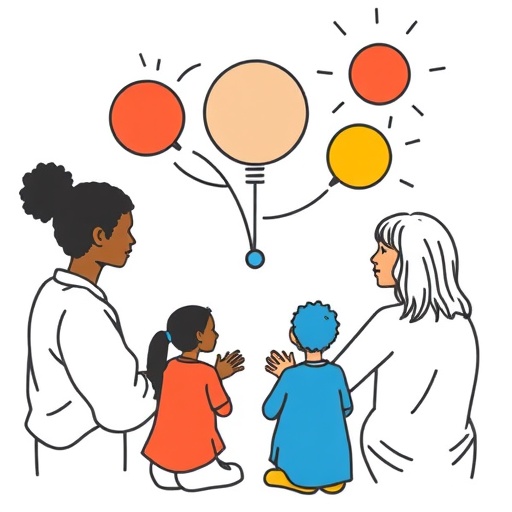
Young people who are struggling with their mental health often find help in unexpected places: a youth club down the street, a patch of green space where they can unwind, a sports programme staffed by adults they trust. These community assets, as researchers call them, can play a powerful role in supporting adolescent wellbeing, yet the pathways that lead vulnerable young people toward or away from them remain poorly understood. A new study published in the journal Health Research Policy and Systems offers a fresh way of mapping those pathways, using a participatory technique known as group model building to bring teenagers, parents and local decision-makers together around the same table to draw the system that shapes their lives.
The research, led by Harriet Fisher of the University of Bristol’s NIHR School for Public Health together with colleagues from the University of Exeter, the London School of Hygiene and Tropical Medicine, Imperial College London and the Dartington Service Design Lab, was conducted in rural towns and two urban areas in the South of England. Rather than treating young people as passive subjects of surveys, the team recruited them as active co-investigators of their own circumstances. In total, 32 young people aged 14 to 16 years, identified as at risk either by local services or through self-identification, took part alongside 31 parents and carers and 31 decision-makers and practitioners. Between May and July 2025, these 94 participants gathered for 20 workshops across the study sites, with each participant group attending two workshops per site.
Group model building is grounded in systems thinking, an analytical tradition that treats social problems not as isolated incidents with single causes, but as the emergent output of networks of interlocking causes and effects. The method asks stakeholders to articulate what they believe drives a problem, then translates those beliefs into causal loop diagrams, often called systems maps, in which variables are connected by arrows representing influence. When a chain of influence loops back on itself, it forms a feedback loop, the fundamental unit of system dynamics. Reinforcing loops amplify change in one direction, while balancing loops resist it and stabilize the system. By making these structures visible on paper, the method allows a group of people with very different vantage points to negotiate a shared picture of reality, one that is often far more complex and counterintuitive than any individual’s intuition.
In practice, the workshops worked like this: each participant group first brainstormed the factors that help or hinder at-risk young people from reaching community assets such as green spaces, youth centres and structured activities. Facilitators then guided the groups through the process of connecting these factors with arrows, specifying whether an increase in one variable pushed another up or down, and searching for the closed circuits that would make the map dynamic rather than merely descriptive. Nine group-specific systems maps were produced in total, one for each participant group at each site. The research team then synthesized these into a single merged systems map, a task that required them to identify which loops recurred across groups and which leverage points, the places in the system where a small, well-aimed intervention could ripple outward into substantial change, appeared most consistently.
Four key feedback loops emerged from the synthesis. The first describes a virtuous cycle in which increased investment in prevention and early intervention services enhances young people’s access to appropriate activities, which in turn improves their wellbeing. Better wellbeing feeds back into greater engagement and reduced need for crisis services, reinforcing the value of the initial investment. The second loop, by contrast, is a vicious one: competition for limited resources can reduce staff capacity to deliver services, which undermines the sustainability of provision, which in turn intensifies the competition for what remains. This loop captures a dynamic familiar to anyone working in underfunded public services, where the struggle to survive financially consumes precisely the staff time and energy that service delivery requires.
The third loop centres on the developmental and emotional power of community assets themselves. Access to these spaces promotes personal development and emotional support through engagement with trusted adults and structured activities, and that support in turn makes young people more likely to keep attending and to benefit further. The fourth loop is perhaps the most sobering finding of the study. Experiences of discrimination reduce young people’s sense of belonging, which limits their use of public spaces and negatively impacts their emotional wellbeing, which can deepen their isolation and make them still less visible to the services designed to help them. Discrimination, in other words, does not merely hurt individual feelings; it structurally excludes young people from the very environments that could buffer their distress.
The technical architecture of these loops matters for policy because it changes the logic of intervention. In a linear model, one might assume that simply building more youth centres would solve the access problem. The systems view complicates that assumption. A new centre staffed by burned-out workers in a neighbourhood where teenagers feel unwelcome may fail regardless of its facilities, because the balancing loops of resource competition and discrimination will drain its impact. Conversely, the map suggests that interventions targeting the reinforcing loops, such as securing sustainable funding for prevention and early intervention, increasing the presence of trusted adults in public spaces, enhancing the quality of the community asset and youth provision offer, and improving awareness of existing services, could generate compounding returns. The researchers frame these four areas as promising targets for national action to address inequalities and improve young people’s mental health.
What distinguishes this study methodologically is not only what it found but how it found it. Traditional qualitative research on youth mental health access typically interviews stakeholders separately and then integrates their perspectives analytically, leaving the participants themselves unaware of the larger picture. Group model building inverts that arrangement: the young people, the parents and the professionals built the picture together, in real time, negotiating disagreements on the spot. The merged map is thus not just a research product but a shared artefact with political force, since every stakeholder group can see its own concerns reflected in it and can trace how those concerns connect to everyone else’s. The authors present the study explicitly as a demonstration, an argument that the method deserves a wider role in health policy research, particularly for problems like youth mental health where the relevant determinants span education, housing, policing, planning and health services and no single actor controls the system.
The ethical and practical scaffolding of the study reflects the sensitivity of its population. Because participants were minors and because many were already known to services, the research received approval from three separate ethics committees: the University of Bristol’s Faculty of Health Sciences, the London School of Hygiene and Tropical Medicine’s Observational and Intervention committee, and the University of Exeter’s Sports and Health Sciences committee. For participants under 16, parental consent was obtained alongside adolescent assent, with written, electronic or verbal procedures available across the sites. The work was funded by the National Institute for Health and Care Research School for Public Health Research under grant reference NIHR 204000, and the authors declare no competing interests. Published open access under a Creative Commons Attribution licence, the study makes its systems maps and workshop materials available to other research teams through supplementary files, lowering the barrier for replication in different regions and different service contexts.
The timing of the work gives it additional resonance. Youth mental health services across the United Kingdom and much of the world are under sustained strain, with rising demand for support colliding with constrained budgets and long waiting lists. Prevention, the strategy of acting before problems become crises, is widely endorsed in principle but chronically difficult to fund in practice, precisely because the second feedback loop in the study’s map operates at the level of public finances as well as local services: money spent on prevention yields diffuse, delayed benefits, while money spent on crisis response yields visible, immediate ones. By rendering these dynamics as explicit, diagrammatic structures, group model building gives advocates for prevention a communication tool as well as an analytical one. A picture of a vicious cycle competing for staff capacity is arguably more persuasive to a budget committee than a paragraph of prose making the same point.
For the young people involved, the workshops may have had a quieter benefit beyond the data. Being asked to map the forces shaping one’s own access to support is an act of epistemic recognition, a signal that teenagers’ lived knowledge of their communities counts as evidence. The study’s merged systems map, built from the perspective of 32 at-risk adolescents, 31 carers and 31 practitioners across urban and rural England, stands as a concrete demonstration that when research treats vulnerable young people as experts on the systems that constrain them, the resulting picture of the problem, and the resulting ideas about where to intervene, look meaningfully different from those generated in offices far from the youth centres, parks and streets where those systems actually operate. The research team, whose corresponding author is Fisher at the University of Bristol, hopes the demonstration will encourage commissioners, local authorities and service designers to adopt participatory systems methods as a routine part of planning mental health support, so that the loops that trap young people in isolation can be identified early, named collectively and, ultimately, broken.
Subject of Research: Barriers and facilitators to at-risk young people’s access to community assets for mental health support, examined through participatory group model building
Subject of Research: Medicine
Article Title: Demonstration of how group model building can be used to understand barriers and facilitators to “at-risk” young people’s access to community assets for mental health support: a participatory study
Article References: Fisher, H., Er, V., Longdon, B., Gnani, S., Hartwell, G., Keenan, M., Mutanda, D., Robinson, H., Dodd, H., & Kidger, J. (2026). Demonstration of how group model building can be used to understand barriers and facilitators to “at-risk” young people’s access to community assets for mental health support: a participatory study. Health Research Policy and Systems. https://doi.org/10.1186/s12961-026-01526-w
Image Credits: AI Generated
DOI: 10.1186/s12961-026-01526-w
Keywords: young people, mental health, participatory research methods, group model building, community assets, systems thinking, prevention, inequalities, early intervention, feedback loops
Cite Scienmag News
APA
MLA
Chicago
Glenn Wilkins. (September 5, 2026). Participatory group model building reveals barriers to youth mental health support access. Scienmag. https://scienmag.com/participatory-group-model-building-reveals-barriers-to-youth-mental-health-support-access/
Glenn Wilkins. “Participatory group model building reveals barriers to youth mental health support access.” Scienmag, 5 September 2026, https://scienmag.com/participatory-group-model-building-reveals-barriers-to-youth-mental-health-support-access/. Accessed 5 September 2026.
Glenn Wilkins. “Participatory group model building reveals barriers to youth mental health support access.” Scienmag. September 5, 2026. https://scienmag.com/participatory-group-model-building-reveals-barriers-to-youth-mental-health-support-access/
Copy citation
Download RIS
Tags: adolescent mental health interventionsadolescent wellbeingbarriers to mental health accessbarriers to mental health help-seekingco-investigation in mental health researchco-investigation of mental health determinantscommunity assets for adolescent wellbeingcommunity assets for youthinvolving young people in decision-makinginvolving young people in health policylocal decision-making in youth mental healthmapping pathways to mental health supportmental health access in rural and urban areasparticipatory group model buildingqualitative research on mental health support accessrural and urban mental health disparitiessystem mapping for mental health servicesyouth engagement in researchYouth mental health support barriersYouth mental health support pathwaysyouth participation in health system design