• HOME
  • NEWS
  • EXPLORE
    • CAREER
      • Companies
      • Jobs
    • EVENTS
    • iGEM
      • News
      • Team
    • PHOTOS
    • VIDEO
    • WIKI
  • BLOG
  • COMMUNITY
    • FACEBOOK
    • INSTAGRAM
    • TWITTER
Wednesday, January 14, 2026
BIOENGINEER.ORG
No Result
View All Result
  • Login
  • HOME
  • NEWS
  • EXPLORE
    • CAREER
      • Companies
      • Jobs
        • Lecturer
        • PhD Studentship
        • Postdoc
        • Research Assistant
    • EVENTS
    • iGEM
      • News
      • Team
    • PHOTOS
    • VIDEO
    • WIKI
  • BLOG
  • COMMUNITY
    • FACEBOOK
    • INSTAGRAM
    • TWITTER
  • HOME
  • NEWS
  • EXPLORE
    • CAREER
      • Companies
      • Jobs
        • Lecturer
        • PhD Studentship
        • Postdoc
        • Research Assistant
    • EVENTS
    • iGEM
      • News
      • Team
    • PHOTOS
    • VIDEO
    • WIKI
  • BLOG
  • COMMUNITY
    • FACEBOOK
    • INSTAGRAM
    • TWITTER
No Result
View All Result
Bioengineer.org
No Result
View All Result
Home NEWS Science News Biology

Parrot talk

Bioengineer by Bioengineer
September 6, 2025
in Biology
Reading Time: 2 mins read
0
IMAGE
Share on FacebookShare on TwitterShare on LinkedinShare on RedditShare on Telegram

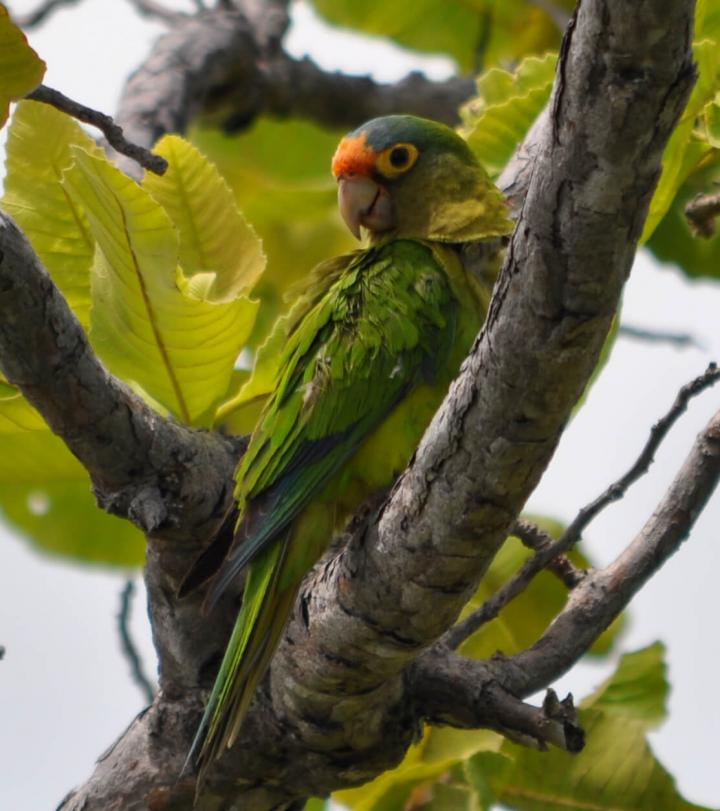
During flock encounters, a single vocal interaction seems to be sufficient for making the decision of whether to recruit an individual or flock. Parrots are known for their splendid ability to imitate, including the contact calls of other individuals during vocal interactions. Such rapid vocal matching is hypothesised to precede and mediate the formation of new flocks. But how are such interactions perceived by others?

Heidi M. Thomsen, first author and PhD student at the Department of Biology, University of Copenhagen explains:

-“By using a novel experimental design, we were able to gain valurable insights in the flock decisions of a social parrot, the orange-fronted conure (Eupsittula canicularis). We conducted a field experiment in which flocks of wild orange-fronted conures were attracted to two loudspeakers simulating two orange-fronted conures engaged in a contact call interaction. During the interaction, one simulated individual would act as the leader by calling first, followed by the other individual. We specifically tailored the playback so the contact calls of the follower would imitate those of the leader. The listening wild flocks could now decide to fly after either the leader or the follower to fuse with it”.

The results showed that flocks primarily chose to fuse with the leaders of the simulated vocal interactions. Furthermore, flocks responded with higher contact call rates and with contact calls that were more similar to the playback when they chose to fuse with a leader compared to trials where they chose a follower. Especially if the leader was a male.

-“Although we do not yet know why leaders are preferred, our findings suggest that orange-fronted conure flocks rely on eavesdropping on vocal interactions to infer the relative quality of unfamiliar individuals. While orange-fronted conures frequently engage in contact call imitation during vocal interactions with conspecifics, we here illustrate that vocal imitation also has implications for potential third party listeners”: says Heidi M. Thomsen.

These birds respond selectively to interactants, indicating that contact call imitation plays an essential role in facilitating the formation and maintenance of affiliative social interactions – and not only with the individuals they directly interact with. This is a missing key to understanding the function of vocal imitation in parrots.

###

Media Contact
Heidi M. Thomsen
[email protected]

Original Source

https://www1.bio.ku.dk/nyheder/nyheder/parrot-talk/

Related Journal Article

http://dx.doi.org/10.1371/journal.pone.0252374

Tags: BehaviorBiodiversityBiologyEcology/EnvironmentEvolutionPopulation BiologyZoology/Veterinary Science
Share13Tweet8Share2ShareShareShare2

Related Posts

Genetic Insights into Circadian Adaptation in Endangered Fish

Genetic Insights into Circadian Adaptation in Endangered Fish

January 13, 2026
blank

Blastocystis Boosts B and K2 Vitamins in Antelope Gut

January 13, 2026

New Intermediate Host Found for Fish Parasite

January 13, 2026

Hidden Parasites in Saudi Rodents: Molecular Insights

January 13, 2026
Please login to join discussion

POPULAR NEWS

  • Enhancing Spiritual Care Education in Nursing Programs

    154 shares
    Share 62 Tweet 39
  • PTSD, Depression, Anxiety in Childhood Cancer Survivors, Parents

    147 shares
    Share 59 Tweet 37
  • Robotic Ureteral Reconstruction: A Novel Approach

    73 shares
    Share 29 Tweet 18
  • Study Reveals Lipid Accumulation in ME/CFS Cells

    52 shares
    Share 21 Tweet 13

About

We bring you the latest biotechnology news from best research centers and universities around the world. Check our website.

Follow us

Recent News

G-Quadruplex Regulation: The Role of G-Loops

How Training Affects Brain Health in Overweight Teens

Refining Biomedical Engineering Immersion: Faculty Insights

Subscribe to Blog via Email

Enter your email address to subscribe to this blog and receive notifications of new posts by email.

Join 71 other subscribers
  • Contact Us

Bioengineer.org © Copyright 2023 All Rights Reserved.

Welcome Back!

Login to your account below

Forgotten Password?

Retrieve your password

Please enter your username or email address to reset your password.

Log In
No Result
View All Result
  • Homepages
    • Home Page 1
    • Home Page 2
  • News
  • National
  • Business
  • Health
  • Lifestyle
  • Science

Bioengineer.org © Copyright 2023 All Rights Reserved.