• HOME
  • NEWS
  • EXPLORE
    • CAREER
      • Companies
      • Jobs
    • EVENTS
    • iGEM
      • News
      • Team
    • PHOTOS
    • VIDEO
    • WIKI
  • BLOG
  • COMMUNITY
    • FACEBOOK
    • INSTAGRAM
    • TWITTER
Thursday, June 11, 2026
BIOENGINEER.ORG
No Result
View All Result
  • Login
  • HOME
  • NEWS
  • EXPLORE
    • CAREER
      • Companies
      • Jobs
        • Lecturer
        • PhD Studentship
        • Postdoc
        • Research Assistant
    • EVENTS
    • iGEM
      • News
      • Team
    • PHOTOS
    • VIDEO
    • WIKI
  • BLOG
  • COMMUNITY
    • FACEBOOK
    • INSTAGRAM
    • TWITTER
  • HOME
  • NEWS
  • EXPLORE
    • CAREER
      • Companies
      • Jobs
        • Lecturer
        • PhD Studentship
        • Postdoc
        • Research Assistant
    • EVENTS
    • iGEM
      • News
      • Team
    • PHOTOS
    • VIDEO
    • WIKI
  • BLOG
  • COMMUNITY
    • FACEBOOK
    • INSTAGRAM
    • TWITTER
No Result
View All Result
Bioengineer.org
No Result
View All Result
Home NEWS Science News Health

Parasitology: Mother cells as organelle donors

Bioengineer by Bioengineer
September 14, 2019
in Health
Reading Time: 2 mins read
0
IMAGE
Share on FacebookShare on TwitterShare on LinkedinShare on RedditShare on Telegram

IMAGE

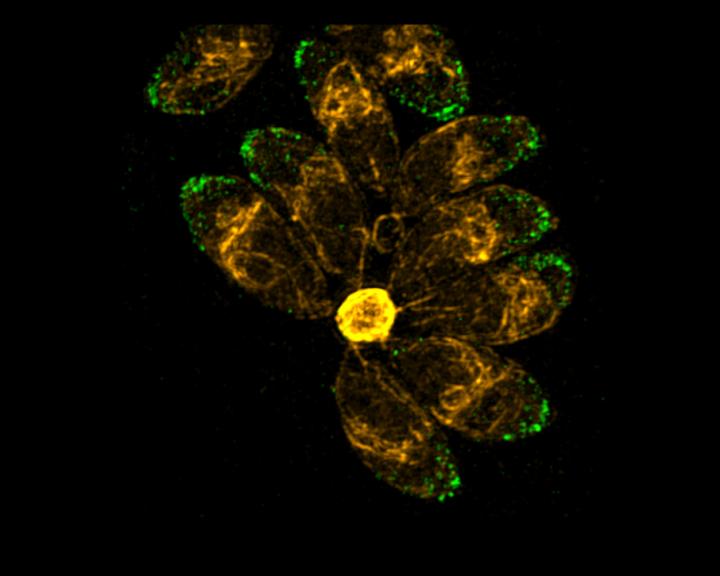
Credit: Source: Dr. Javier Periz, University of Glasgow.

Toxoplasma gondii, the unicellular causative agent of toxoplasmosis, reproduces itself in an unusual fashion by means of an internal budding process. This entails the development of two daughter cells within the cytoplasm of the mother cell. On completion of this process, the mother cell undergoes lysis, and the daughter cells are released into the infected host cell. The daughter cells continue to proliferate until the host-cell itself finally bursts. T. gondii is a globally distributed infectious agent. As a rule, the infection is innocuous. However, during pregnancy, transmission of the parasite to the fetus can severely damage the development of the latter. A group of researchers led by Markus Meissner, Professor of Experimental Parasitology at LMU in collaboration with Dr. Javier Periz at Glasgow University, has now described a phenomenon which plays an important role in asexual reproduction – during internal budding, components of a specific organelle are donated by the mother cell to the daughters. The study appears in the online journal Nature Communications.

In order to recognize, adhere to and infect host cells, T. gondii makes use of organelles called rhoptries and micronemes, which secrete a set of specialized proteins that enable the parasite to invade the target cell. Once the infection has been successfully established, the parasite divides. It had been assumed up to now that the micronemes in the daughter cells are reformed from scratch. However, by specifically labelling one of the micronemal proteins, the authors of the new study were able to follow the fate of the microneme during the cell cycle with the aid of high-resolution microscopy. The observations revealed that the components of the mother cell’s microneme are divided more or less equally between the daughter cells. In addition, micronemal proteins are newly synthesized in the daughter cell. The researchers assume that this recycling is not limited to the micronemes, but serves as a more general mechanism to enable the reassembly of organelles that are vital for propagation of the parasite.

“Furthermore, we have shown that recycled micronemes are transported from mother to daughter by the actin filaments of the cytoskeleton,” says Markus Meissner. “This is an entirely new function for actin in the parasite. Up to now, actin was thought to be involved solely in cell motility in T. gondii. When we have a better understanding of how this newly discovered function of actin is regulated, we may also be able to identify novel drug targets. This is a very interesting prospect because T. gondii is known to possess very few actin-regulating proteins.”

###

Nature Communications 2019

Media Contact
Dr. Kathrin Bilgeri
[email protected]

Original Source

https://www.en.uni-muenchen.de/news/newsarchiv/2019/meissner_micronemes.html

Related Journal Article

http://dx.doi.org/10.1038/s41467-019-12136-2

Tags: BiochemistryChemistry/Physics/Materials Sciences
Share12Tweet8Share2ShareShareShare2

Related Posts

Next-Gen Sequencing Reveals Hidden Drug Resistance in Eswatini

June 11, 2026

Gene Ancestries Trace Diverse Microbial Origins

June 11, 2026

Vibration Therapy Boosts Stroke Patients’ Balance

June 11, 2026

Unraveling MLKL’s Role in Cell Survival

June 10, 2026
Please login to join discussion

POPULAR NEWS

  • ESMO 2025: mRNA COVID Vaccines Enhance Efficacy of Cancer Immunotherapy

    324 shares
    Share 130 Tweet 81
  • Saying Goodbye to PGY-6: Pediatric Fellowship Realities

    92 shares
    Share 37 Tweet 23
  • Multi-Hospital Study Reveals Long Covid Burden Is Twice as High as Current Estimates

    90 shares
    Share 36 Tweet 22
  • Common Food Preservatives Associated with Elevated Blood Pressure and Increased Heart Disease Risk

    58 shares
    Share 23 Tweet 15

About

We bring you the latest biotechnology news from best research centers and universities around the world. Check our website.

Follow us

Recent News

SIRT7 Controls Dosage and Protects Female X

Furmonertinib and Bevacizumab Tackle Resistant Leptomeningeal Metastasis

Creating User-Focused Climate Adaptation Tools

Subscribe to Blog via Email

Enter your email address to subscribe to this blog and receive notifications of new posts by email.

Join 82 other subscribers
  • Contact Us

Bioengineer.org © Copyright 2023 All Rights Reserved.

Welcome Back!

Login to your account below

Forgotten Password?

Retrieve your password

Please enter your username or email address to reset your password.

Log In
No Result
View All Result
  • Homepages
    • Home Page 1
    • Home Page 2
  • News
  • National
  • Business
  • Health
  • Lifestyle
  • Science

Bioengineer.org © Copyright 2023 All Rights Reserved.