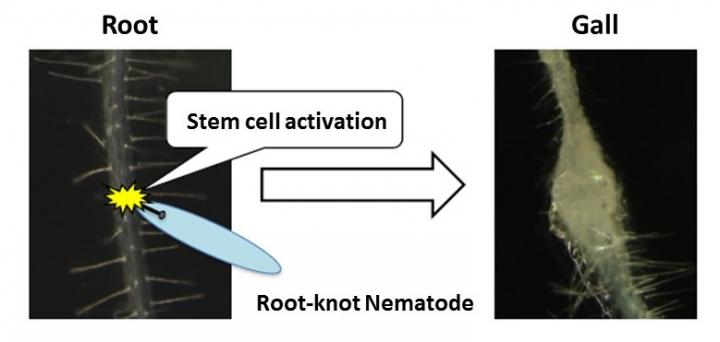
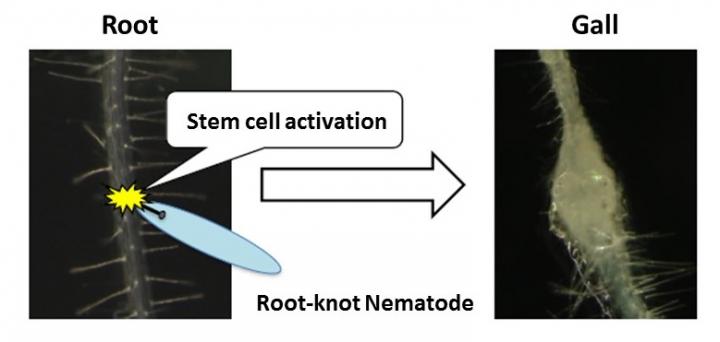
Credit: Professor Shinichiro Sawa
The plant parasitic nematode is an agricultural pest that has no fundamental countermeasures and requires the development of resistant plant varieties or pesticides. This parasitic pest creates a nest called a "gall" on the roots of agricultural crops which reduces the ability of a plant to absorb nutrition. Once this pest takes hold, a crop may die or its value may be significantly reduced. Furthermore, once infected with this troublesome pest, it is impossible to grow crops in the same field for several years. Agricultural damage caused by this nematode has recently been expanding around the world.
Researchers at Kumamoto University in Japan in collaboration with Universidad de Castilla-La Mancha in Spain analyzed the reactions of plants parasitized by plant parasitic nematodes and found that plant stem cells become activated to form galls. In other words, the researchers showed that plant parasitic nematodes are able to effectively manipulate plant stem cells to make their nests (galls) in the plant roots. In the future, this finding is expected to contribute to the reduction of nematode damage by improving crop varieties.
Background: The nematode, an insect pest.
Many microorganisms live in the soil and plants generally have no problems interacting with them. However, some microorganisms, such as plant parasitic nematodes, cause significant harm to plants. When these nematodes invade or infect a plant, a rounded nest called a gall is formed on the roots. The nematode then absorbs nutrients from the plant through the gall which allows it to grow and produce many eggs. Until now, little was known about why plants create these nematode nests after infestation.
Hypothesis: Stem cell manipulation
Researchers designed an experiment using the plant Arabidopsis thaliana that analyzed its response to being parasitized by nematodes. Although A. thaliana's roots are very small and difficult to evaluate, they succeeded in obtaining highly accurate results. They acquired a large amount of genetic data by using a next-generation sequencer and performed several statistical analyses.
As a result, the researchers found that plant stem cell function seemed to be abnormally activated by nematode infestation. Although many of the higher plants have a small amount of stem cells at the boundary between xylem and phloem cells, the activity of these stem cells is strictly controlled. However, when these stem cells start growing out of control, abnormal tissues are formed, just like cancer, and it becomes impossible for the plant to form a normal shape. In the galls, the researchers found that the activity control of the stem cells, which should be held very precisely under normal conditions, exhibited runaway conditions when infected by the parasitic worms. In other words, they thought that the nematodes manipulated the plant stem cells to build their nests.
Verification: Visual verification of the stem cells
To verify their hypothesis, researchers stained the stem cells blue and observed the plants from the beginning of nematode infection until gall creation. The blue stain showed the stem cell spreading with root growth. This was verification that the nematodes were seizing the control mechanism of the plant stem cells to make their nests.
Future: From farm to garden
This study revealed that plant parasitic nematodes can hijack the stem cells of plants. This discovery is very important to agriculture because it will enable the development of improved plant breeds after the mechanism of the stem cell appropriation is illuminated.
For example, a practical application for plant stem cells that is currently used in Japan for crops such as strawberries, asparagus, orchids, and cyclamen involves taking the stem cells from the strongest plants to culture new crops in vitro. However, the technology for inducing stem cell formation is very difficult and there are not many crops that can actually use these methods.
"Nematodes can infest a great variety of plants," said Professor Shinichiro Sawa, leader of the study at Kumamoto University. "This ability to activate the stem cells of most crops is a technology that humans do not yet possess. In the future, by studying how plant parasitic nematodes manipulate plant stem cells, we expect to be able to develop technologies that enable much more diversified plants and crops."
###
This finding was posted online in the journal Frontiers in Plant Science on 13 July 2017.
[Resource]
Yamaguchi, Y. L.; Suzuki, R.; Cabrera, J.; Nakagami, S.; Sagara, T.; Ejima, C.; Sano, R.; Aoki, Y.; Olmo, R.; Kurata, T.; Obayashi, T.; Demura, T.; Ishida, T.; Escobar, C. & Sawa, S., Root-Knot and Cyst Nematodes Activate Procambium-Associated Genes in Arabidopsis Roots, Frontiers in Plant Science, Frontiers Media SA, 2017. DOI: 10.3389/fpls.2017.01195
Media Contact
J. Sanderson, N. Fukuda
[email protected]
http://ewww.kumamoto-u.ac.jp/en/news/
Original Source
http://journal.frontiersin.org/article/10.3389/fpls.2017.01195/ http://dx.doi.org/10.3389/fpls.2017.01195