• HOME
  • NEWS
  • EXPLORE
    • CAREER
      • Companies
      • Jobs
    • EVENTS
    • iGEM
      • News
      • Team
    • PHOTOS
    • VIDEO
    • WIKI
  • BLOG
  • COMMUNITY
    • FACEBOOK
    • INSTAGRAM
    • TWITTER
Thursday, October 29, 2026
BIOENGINEER.ORG
No Result
View All Result
  • Login
  • HOME
  • NEWS
  • EXPLORE
    • CAREER
      • Companies
      • Jobs
        • Lecturer
        • PhD Studentship
        • Postdoc
        • Research Assistant
    • EVENTS
    • iGEM
      • News
      • Team
    • PHOTOS
    • VIDEO
    • WIKI
  • BLOG
  • COMMUNITY
    • FACEBOOK
    • INSTAGRAM
    • TWITTER
No Result
View All Result
Bioengineer.org
No Result
View All Result
Home NEWS Science News Health

Paramedics find frailty scale useful but tricky in prehospital care

by
October 29, 2026
in Health
Reading Time: 3 mins read
0
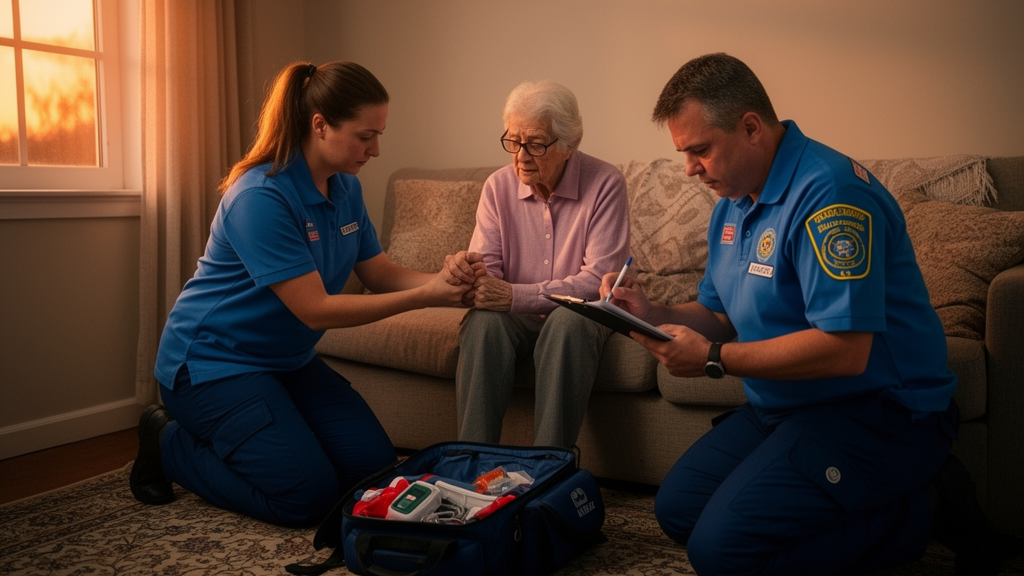
Paramedics find frailty scale useful but tricky in prehospital care

Paramedics find frailty scale useful but tricky in prehospital care

Share on FacebookShare on TwitterShare on LinkedinShare on RedditShare on Telegram

A qualitative study published in BMC Geriatrics explores how paramedics experience using the Clinical Frailty Scale (CFS) when caring for older patients in prehospital settings. The research, conducted in the North Denmark Region as part of a larger project on CFS use for patients aged 65 and older, suggests the scale is generally perceived as relevant and as a tool that can support continuity of care across healthcare sectors.

The study used a qualitative design based on semi-structured interviews, analysed with thematic analysis inspired by Braun and Clarke’s six-phase framework, and drew on hermeneutic philosophy and frailty assessment theory. During the underlying study period, 432 of 2,084 patients—21 percent—had a documented CFS score, and those scores spanned all nine categories of the scale.

Eleven paramedics took part in the individual face-to-face interviews, ten men and one woman. Their median age was 38 years, and they had a median of 11 years of experience in the prehospital setting.

Three main themes emerged from the analysis. The first concerned older patients as a complex population with multiple chronic conditions, requiring an adapted clinical mindset from crews attending them. The second addressed how CFS can be made to work within the practical realities of prehospital practice. The third described CFS as a shared language in cross-sector collaboration between ambulance services and other parts of the health system.

A recurring difficulty reported by participants was distinguishing between acute illness and frailty at the scene of an emergency. Because older patients were perceived as habitually ill, paramedics described needing to adjust their clinical assessment when frailty entered the picture, and the scale’s role in that judgement was not always straightforward.

Despite these challenges, the researchers report that CFS was considered to serve as a bridge between sectors and professional disciplines. In the study’s conclusion, the authors state that the scale was generally perceived as relevant and able to support continuity of care and create a shared language around frailty.

The findings highlight the importance of paramedics understanding both the purpose and the application of CFS, and how the assessment may contribute to patient care across sectors. The authors suggest these considerations may be relevant when supporting the use of CFS in routine prehospital practice.

As a qualitative interview study of eleven paramedics in a single Danish region, the work captures practitioner perspectives rather than measuring clinical outcomes, and the reported documentation rate of 21 percent during the study period indicates that recorded CFS scoring was not universal. The authors note the findings may inform efforts to embed frailty assessment in everyday ambulance practice.

Subject of Research: Paramedics' experiences of using the Clinical Frailty Scale with older patients in prehospital care

Article Title: Paramedics’ experiences of using the clinical frailty scale in prehospital care: a qualitative study

Article References: Ibsen, S., Sørensen, K., Lyngby, M., Rødsgaard, K., Gram, J., Riis, A., Zakariassen, E., Lindskou, T., & Søvsø, M. B. (2026). Paramedics’ experiences of using the clinical frailty scale in prehospital care: a qualitative study. BMC Geriatrics. https://doi.org/10.1186/s12877-026-08580-7

Image Credits: AI Generated

DOI: 10.1186/s12877-026-08580-7

Keywords: paramedics, Clinical Frailty Scale, prehospital care, frailty, qualitative study, older patients, emergency medical services, thematic analysis, Denmark, cross-sector collaboration, experiences, clinical

News Source: Beatrice Stafford. (October 29, 2026). Paramedics find frailty scale useful but tricky in prehospital care. Scienmag.

Tags: ClinicalClinical Frailty Scalecross-sector collaborationDenmarkemergency medical servicesexperiencesFrailtyolder patientsparamedicsprehospital carequalitative studythematic analysis
Share12Tweet7Share2ShareShareShare1

Related Posts

Poor Blood Sugar Control in Pregnancy Linked to Worse Postpartum Metabolic Health

Poor Blood Sugar Control in Pregnancy Linked to Worse Postpartum Metabolic Health

October 29, 2026
Endoscopic Microvascular Decompression Shows Possible Edge Over Microscopic Surgery

Endoscopic Microvascular Decompression Shows Possible Edge Over Microscopic Surgery

October 29, 2026

Patient-Derived Heart Cells Reveal Susceptibility to Osimertinib-Induced Cardiac Dysfunction

October 29, 2026

Single-view angiography measure of microvascular resistance linked to one-year outcomes in INOCA

October 29, 2026

POPULAR NEWS

  • Terbium-161 Shows Dose-Dependent Edge Over Lutetium-177 in Mouse Neuroendocrine Tumor Model

    Terbium-161 Shows Dose-Dependent Edge Over Lutetium-177 in Mouse Neuroendocrine Tumor Model

    29 shares
    Share 12 Tweet 7
  • Gas Drainage Lags Pressure Relief by 151.6 Metres in Deep Protective Seam Mining

    29 shares
    Share 12 Tweet 7
  • African Wild Lettuce Shows Anticancer Activity in Lab Studies, Review Finds

    29 shares
    Share 12 Tweet 7
  • SLC7A5 emerges as a central player in cancer amino acid metabolism

    29 shares
    Share 12 Tweet 7

About

We bring you the latest biotechnology news from best research centers and universities around the world. Check our website.

Follow us

Recent News

Poor Blood Sugar Control in Pregnancy Linked to Worse Postpartum Metabolic Health

Endoscopic Microvascular Decompression Shows Possible Edge Over Microscopic Surgery

Plasma Cleaner Inserted Through TEM Port Strips Hydrocarbon Contamination in Three Hours

Subscribe to Blog via Email

Enter your email address to subscribe to this blog and receive notifications of new posts by email.

Join 85 other subscribers
  • Contact Us

Bioengineer.org © Copyright 2023 All Rights Reserved.

Welcome Back!

Login to your account below

Forgotten Password?

Retrieve your password

Please enter your username or email address to reset your password.

Log In
No Result
View All Result
  • Homepages
    • Home Page 1
    • Home Page 2
  • News
  • National
  • Business
  • Health
  • Lifestyle
  • Science

Bioengineer.org © Copyright 2023 All Rights Reserved.