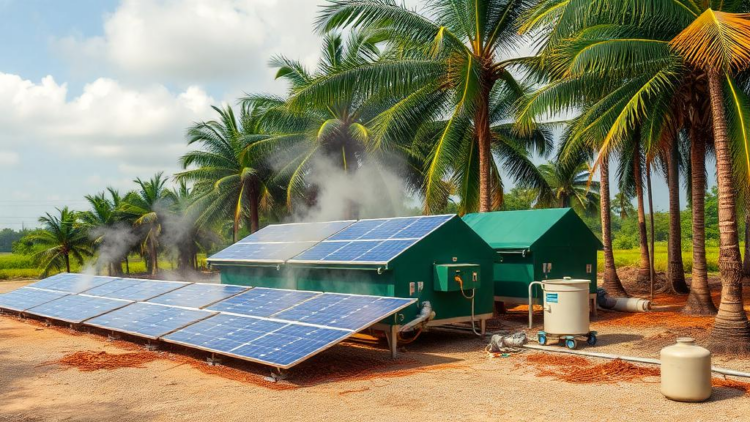
Every year, the palm oil industry discards tens of millions of tons of empty fruit bunches, the fibrous residue left behind after fresh fruit bunches are stripped of their oil-rich fruit. For every ton of fruit processed, roughly 0.23 tons of this lignocellulosic waste is generated, and across Indonesia and Malaysia, which together produce more than 40 million metric tons of crude palm oil annually, the sheer scale of the residue stream is staggering. Most of it is incinerated or left to rot, releasing greenhouse gases while squandering a valuable store of renewable carbon. Now, a team of researchers in Indonesia has demonstrated a way to squeeze two high-value photothermal materials out of this single waste stream, converting oil palm empty fruit bunches into both an acetylated lignin matrix and lignin-derived graphene quantum dots that together power solar steam generation and photothermoelectric energy harvesting.
The study, published in Results in Chemistry, centers on lignin, the second most abundant natural polymer on Earth and a major fraction of empty fruit bunches. Lignin is a dense, highly cross-linked polyphenolic macromolecule with an intrinsic capacity to absorb ultraviolet and visible light and to dissipate that energy as heat, a property known as photothermal conversion. Despite these attributes, roughly 95 percent of industrial lignin is still simply burned for low-grade heat and power. The researchers argue that this underutilization stems from lignin’s structural complexity and compositional variability, which have hindered its use in high-performance materials. Their answer is a dual valorization strategy: rather than choosing between chemical modification or nanocarbon conversion, they pursue both pathways from the same extracted lignin feedstock, building a hierarchically structured, entirely biobased photothermal platform.
The first step was extraction. Empty fruit bunches from a local palm oil mill were delignified in a rotary digester using an aqueous sodium hydroxide solution at 170 degrees Celsius under 8 atmospheres of pressure, with an active alkali charge of 19.5 weight percent and a liquor-to-solid ratio of 20 to 1. Lignin was then recovered from the concentrated black liquor by acid precipitation at pH 2.0, yielding 15.13 percent of the dry biomass weight. The recovered lignin proved remarkably pure, with a total lignin content of 95.83 percent, low ash content of 2.78 percent, and modest moisture retention, confirming that the acid precipitation recovered structurally intact lignin with minimal contamination from polysaccharides or inorganic residues.
Half of this lignin was then acetylated using glacial acetic acid and acetyl chloride at a 4 to 1 volume ratio, held at 40 degrees Celsius for two hours. The chemistry is subtle but powerful. Substituting hydroxyl groups with electron-withdrawing acetyl moieties creates donor-acceptor electronic configurations within the aromatic network, extends pi-conjugation, and weakens the hydrogen-bonding networks that normally lock lignin molecules in place. Spectroscopic evidence confirmed the transformation: the broad hydroxyl stretching band at 3376 wavenumbers vanished, a strong new ester carbonyl band appeared at 1740 wavenumbers, and pyrolysis analysis detected coniferyl alcohol diacetate, a direct marker of successful esterification of guaiacyl units. Thermogravimetric analysis showed the acetylated lignin was more thermally stable, with a higher maximum degradation temperature and far less char residue at 750 degrees Celsius, just 11.8 percent versus 26.4 percent for native lignin, a trait that avoids char interference with light absorption during thermal cycling.
The other half of the lignin took a very different path. Through oxidative depolymerization in nitric acid followed by hydrothermal carbonization at 200 degrees Celsius, the macromolecular aromatic network was cleaved into nanoscale carbon fragments that reassembled into lignin-derived graphene quantum dots, dubbed PL-GQDs, with a mass yield of 8.45 percent. These zero-dimensional carbon nanostructures averaged just 5.73 nanometers in hydrodynamic diameter, with transmission electron microscopy revealing nearly spherical particles between 2 and 5 nanometers. High-resolution imaging showed well-defined lattice fringes with an interplanar spacing of about 0.23 nanometers, matching the (100) plane of graphitic carbon. X-ray diffraction confirmed partial graphitization, with the interlayer spacing shrinking from 0.42 nanometers in the precursor lignin to 0.33 nanometers in the quantum dots, evidence of compact sp2-hybridized carbon layers forming from lignin’s aromatic rings.
The two materials were then deployed in complementary architectures. The first was a flexible photothermal film composite, built by dispersing the quantum dots and acetylated lignin into a poly(vinyl alcohol) matrix. Under simulated sunlight at one sun intensity, the neat polymer film warmed by only 6.8 degrees Celsius, but the optimized film containing 50 weight percent acetylated lignin reached a temperature rise of 15.4 degrees Celsius, hitting 42.7 degrees Celsius. Placed on a thermoelectric generator module, that film produced an open-circuit voltage of about 24.3 millivolts, compared with just 2.2 millivolts for the neat polymer and a significantly lower 12.8 millivolts for a film loaded with unmodified lignin. The apparent photothermal conversion efficiency reached 23.2 percent, a figure the authors attribute to the synergy between the acetylated lignin’s enhanced photon capture and the quantum dots’ graphitic, broadband-absorbing heat-generating domains.
The second application pushed the same chemistry into a porous solar-driven lignin aerogel designed for interfacial solar steam generation. Here the textural data tell a striking story. The aerogel combining acetylated lignin with the quantum dots achieved a specific surface area of 177.5 square meters per gram and a pore volume of 0.259 cubic centimeters per gram, more than an eightfold increase over an aerogel made with native lignin. Acetylation, by reducing the density of free hydroxyl groups, weakens the hydrogen-bond-driven aggregation that otherwise densifies and collapses the gel network, while the quantum dots act as nanoscale spacers that inhibit framework shrinkage during freeze-drying. Scanning electron microscopy revealed a hierarchical architecture of interconnected macropores and intertwined nanofibers, ideal for capillary-driven water supply and rapid evaporation.
Performance followed structure. The optimized aerogel achieved a water evaporation rate of 944.7 grams per square meter per hour under one sun, corresponding to a solar steam generation efficiency of 59.2 percent, more than a 60-fold enhancement over direct water evaporation. Over six consecutive evaporation cycles the system averaged 911.3 grams per square meter per hour with a relative standard deviation of only about 3.5 percent, demonstrating excellent reproducibility. The aerogel also sustained steam generation from saline feed solutions up to 10 weight percent sodium chloride, although salt crystals accumulated on the pore walls and cut the accessible surface area sharply, signaling that anti-scaling strategies will be needed for prolonged desalination duty. The authors also note candidly that the efficiency remains moderate compared with leading biomass evaporators, because the aerogel’s thermal conductivity rises from 0.143 to 0.477 watts per meter-kelvin when wet, allowing some heat to leak into the bulk water rather than staying confined at the evaporation interface.
The mechanistic picture ties everything together. Acetylation narrows the electronic gap between lignin’s highest occupied and lowest unoccupied molecular orbitals, from 5.58 to 5.34 electronvolts in related work, facilitating electronic excitation and non-radiative relaxation, while weakened hydrogen bonding grants molecules the freedom to dissipate absorbed photon energy as vibrational heat. The quantum dots contribute additional photon-capturing graphitic domains across the visible and near-infrared spectrum. In the film, this synergy builds thermal gradients that drive thermoelectric voltage; in the aerogel, it localizes heat at the water-air interface where it is most useful. What makes the work resonate beyond the laboratory numbers is its circular economy logic: a single agricultural waste stream, normally an environmental liability, is upgraded into two complementary functional materials for solar desalination and off-grid power generation. The researchers, funded by Indonesia’s National Research and Innovation Agency, suggest the strategy could extend the value of oil palm residues across multifunctional solar-energy harvesting technologies, turning one of the tropics’ most abundant waste problems into a feedstock for the renewable energy transition.
Subject of Research: Dual valorization of oil palm empty fruit bunch lignin into acetylated lignin and graphene quantum dots for photothermal solar energy conversion
Article Title: Dual valorization of oil palm empty fruit bunches: acetyl-modified lignin and lignin-derived graphene quantum dots for sustainable photothermal conversion
Article References: Ariyanta, H. A., Utami, K. N., Prihati, S. R., Sarwana, W., Sudirman, Rois, M. F., Priatmoko, S., Annas, D., & Holilah (2026). Dual valorization of oil palm empty fruit bunches: acetyl-modified lignin and lignin-derived graphene quantum dots for sustainable photothermal conversion. Results in Chemistry, 31, Article 103897. https://doi.org/10.1016/j.rechem.2026.103897
Image Credits: AI Generated
DOI: 10.1016/j.rechem.2026.103897
Keywords: lignin, oil palm empty fruit bunches, graphene quantum dots, photothermal conversion, solar steam generation, photothermoelectric, biomass valorization, acetylation, aerogel, circular bioeconomy, desalination, renewable energy
Cite Scienmag News
APA
MLA
Chicago
Faith Mcneil. (October 2, 2026). Palm Oil Waste Transformed Into Solar Steam Generators and Power Films. Scienmag. https://scienmag.com/palm-oil-waste-transformed-into-solar-steam-generators-and-power-films/
Faith Mcneil. “Palm Oil Waste Transformed Into Solar Steam Generators and Power Films.” Scienmag, 2 October 2026, https://scienmag.com/palm-oil-waste-transformed-into-solar-steam-generators-and-power-films/. Accessed 2 October 2026.
Faith Mcneil. “Palm Oil Waste Transformed Into Solar Steam Generators and Power Films.” Scienmag. October 2, 2026. https://scienmag.com/palm-oil-waste-transformed-into-solar-steam-generators-and-power-films/
Copy citation
Download RIS
Tags: acetylationaerogelbiomass valorizationbiomass-based photothermoelectric energycircular bioeconomyconverting empty fruit bunches into clean energydesalinationenvironmentally friendly energy solutions from lignocellulosic wastegraphene quantum dotsgreen technology for agricultural wasteligninlignin-derived graphene quantum dotsoil palm empty fruit bunchespalm oil industry waste managementpalm oil waste utilizationphotothermal conversionphotothermal materials from palm biomassphotothermoelectricrenewable carbon from palm oil residuesRenewable Energyrenewable energy from agricultural wastesolar steam generationsolar steam generators from ligninsustainable energy harvesting from palm oil residues