Credit: Fabiany Herrera & Patrick Herendeen
A discovery of well-preserved fossil plants by paleontologists from the United States, China, Japan, Russia and Mongolia has allowed researchers to identify a distant relative of the living plant Ginkgo biloba.
The find helps scientists better understand the evolution and diversity of ancient seed plants.
The fossils, from the species Umaltolepis mongoliensis, date back to the early Cretaceous Period (some 100-125 million years ago). Scientists discovered the fossils in ancient peat deposits at the Tevshiin Govi mine in the steppes of central Mongolia. Results of the research, supported by the National Science Foundation (NSF), are published in this week's issue of the journal Proceedings of the National Academy of Sciences (PNAS).
"The stems and leaves are similar to the ginkgo tree, but the seeds, and especially the structures they are born in, are unlike any other known plant, living or extinct," says scientist Patrick Herendeen of the Chicago Botanic Garden, co-author of the PNAS paper. "Finding something like this does not happen very often."
Scientists had previously uncovered fossils of U. mongoliensis, but those were in poor condition, making them difficult to study. Hundreds of better-preserved new fossils show that features of the stems and leaves are similar to those of living ginkgo.
However, the seed-bearing structures are not like those of today's ginkgo tree, Herendeen says. Ginkgo has large seeds with a fleshy outer covering, but U. mongoliensis has small, winged seeds.
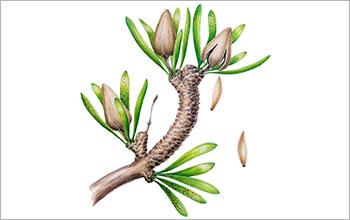
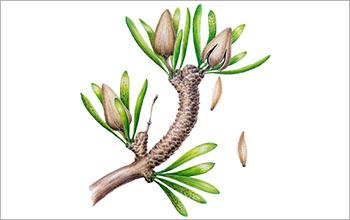
As they developed, U. mongoliensis seeds were protected inside a tough, resinous, umbrella-like outer covering, which stayed almost completely closed, opening only to release the seeds.
The key to determining how U. mongoliensis is related to other seed plants lies in understanding its strange seed-bearing capsules.
While the U. mongoliensis seeds are dissimilar to those of any other living or extinct plant, preliminary comparisons connect them with the seed-bearing structures of two groups of extinct plants that may be part of the ginkgo lineage.
These comparisons and the unique features of U. mongoliensis indicate that ginkgo is the last living member of a group of plants that was much more diverse and important in the past.
"Ginkgo biloba, primarily known today as a dietary supplement to enhance memory, also plays an important role in the understanding of seed plant evolution," says Simon Malcomber, program director in NSF's Division of Environmental Biology. "This research expands our understanding of the diversity in this enigmatic group, in addition to helping clarify relationships among seed plants more generally."
In addition, the researchers collected other fossils from the Tevshiin Govi mine, including seed plants related to modern pines, spruces, swamp cypresses and redwoods.
Also present in the ancient swamp forests of central Mongolia were a variety of extinct plants thought to be early conifers, but that have no clear living relatives.
"Knowing the diversity of plants in Cretaceous environments provides a better understanding of potential food sources for animals such as plant-eating dinosaurs," says Judy Skog, program director for paleontology in NSF's Division of Earth Sciences. "Once the diversity of plants decreases, as this paper indicates is true for the relatives of ginkgo, animal life also declines."
Scientists have long known about dinosaurs from the Cretaceous of Mongolia, but only now are the plants that supported those extinct animals coming into sharper focus.
###
Media Contact
Cheryl Dybas
[email protected]
@NSF
http://www.nsf.gov
############
Story Source: Materials provided by Scienmag