Researchers in Mexico have shown that the root-like network of the oyster mushroom, Pleurotus ostreatus, can bind a range of forestry and farm by-products into lightweight, biodegradable materials strong enough for protective packaging. The study, published in Polymer Bulletin, systematically compared five composite formulations built from wood chips of Quercus castanea, sawdust, and corn cob, and revealed how the size and architecture of the substrate particles ripple through the entire material—altering density, water behavior, surface hardness, stiffness, and strength. At a time when microplastic pollution and food-packaging waste are under intense scrutiny, the work offers a quantitative roadmap for tuning mycelium biocomposites from the bottom up, using residues that would otherwise be burned or discarded.
Mycelium-based composites are grown rather than manufactured in the conventional sense. Living fungal hyphae are inoculated onto lignocellulosic substrates, where they colonize the particles and weave them into a coherent, self-binding matrix. After the growth phase, the material is dried and heat-treated, killing the fungus and stabilizing the structure. The result is a foam-like solid that is predominantly organic, compostable, and produced at ambient temperatures, in contrast to the energy-intensive polymerization and molding processes behind expanded polystyrene. Despite a decade of enthusiasm, the field has lacked careful, statistically controlled comparisons of how substrate formulation controls performance—precisely the gap the new study set out to close.
The team, led by Diana S. Ocegueda-Vega, Nelly Flores-Ramirez, and Salomon R. Vasquez-Garcia of the Universidad Michoacana de San Nicolás de Hidalgo, together with colleagues at the Tecnológico Nacional de México in Aguascalientes, produced five P. ostreatus composites labeled S1 through S5. Formulations S1 through S4 varied the proportions and particle sizes of oak wood chips, sawdust, and corn cob, while S5 served as a 100 wt% corn-cob reference. Particle architecture proved to be a decisive variable: scanning electron microscopy showed that the geometry of the underlying particles shaped how the fungal hyphae organized, branched, and consolidated the matrix. Coarse wood chips yielded an open, loosely knit structure, whereas finer particles enabled denser hyphal packing and better mechanical integration.
That microstructural difference translated directly into bulk properties. The sawdust-based formulation, S3, achieved the highest apparent density at 178.0 kilograms per cubic meter and the highest compressive strength at 0.63 megapascals. In contrast, the coarse wood-chip formulation S1, with its more open skeleton, delivered the weakest mechanical performance. For context, these densities sit in the same low range as commercial foam packaging materials, but the strength values remain modest—confirming that current mycelium composites are best suited to low-load protective applications such as cushioning inserts, rather than structural load-bearing roles.
Moisture behavior, a long-standing Achilles heel of fungal materials, received detailed treatment. Static water contact angle measurements on the dried surfaces ranged from 107.7 to 110.7 degrees across all five formulations—values comfortably above 90 degrees that indicate hydrophobic character, likely aided by fungal hydrophobin proteins that coat aerial hyphae. Notably, these contact angles did not differ significantly between formulations, suggesting that surface wettability is largely dictated by the mycelium itself rather than the substrate. However, bulk water absorption after 24 hours told a different story: values spread from 30.6 to 46.6 percent, with statistically significant differences. Dunnett-adjusted comparisons against the corn-cob reference showed that S1 absorbed significantly less water while S3 absorbed significantly more, a finding the authors attribute to differences in pore connectivity and particle porosity.
Surface hardness, measured with a Shore D durometer, spanned 27.6 to 37.7 across the formulations. S1 and S2 fell significantly below the corn-cob reference, whereas S3 and S4 were statistically indistinguishable from it. This gradient again tracks the density trend: harder, more consolidated surfaces come from tighter particle packing and more thorough hyphal colonization. The result gives manufacturers a practical dial—adjusting particle size distribution can shift surface robustness without changing the organism or the growth protocol.
Flexural testing exposed one of the field’s persistent limitations. Three-point bending strengths ranged only from 0.07 to 0.10 megapascals, and Tukey’s all-pairwise comparison detected no statistically significant differences among the formulations. In other words, no substrate recipe in this study meaningfully improved bending resistance, which remains the weakest mechanical attribute of mycelium composites. Interestingly, S4 and S5 did post the highest mean compressive and flexural moduli, indicating that stiffness and strength respond differently to formulation—stiffness can be tuned through substrate choice even when ultimate bending strength cannot, at least not within the ranges explored here.
The statistical framework of the study deserves attention because it strengthens the practical value of the findings. Beyond one-way analysis of variance and Tukey’s honestly significant difference test for all pairwise comparisons, the authors applied Dunnett-adjusted comparisons to test each experimental formulation S1 through S4 specifically against the corn-cob reference S5. This design mirrors what an industrial formulator would actually ask: not which recipe wins overall, but whether a given blend of local residues performs as well as, or better than, a baseline single-substrate material. The answers were property-dependent—no single formulation dominated every metric, underscoring that composite design must be matched to the end-use requirements of the packaging component.
The broader significance lies in waste valorization. Quercus castanea wood residues and corn cobs are abundant, inexpensive, and locally available in many agricultural regions, including central Mexico where the research was conducted. Growing packaging from these streams couples two sustainability gains at once: it diverts lignocellulosic waste from open burning or landfilling, and it displaces petroleum-derived foams that persist for centuries and fragment into microplastics. Because mycelium composites are produced at ambient temperature and pressure and are fully biodegradable, their lifecycle emissions profile contrasts sharply with conventional expanded polystyrene, even before accounting for end-of-life benefits.
Realistic caveats remain, and the authors state them plainly. The composites are appropriate for low-load protective packaging only when shielded from direct or prolonged moisture exposure, since bulk water uptake above 30 percent would degrade cushioning performance over time in wet conditions. Mitigation strategies reported elsewhere in the literature—such as beeswax or natural oil coatings—could extend service envelopes, but were outside the scope of this study. Scaling from laboratory samples to mass production will also demand consistent control of colonization time, humidity, and sterilization. Nonetheless, by quantifying exactly how substrate composition and particle architecture govern density, moisture response, hardness, and mechanical performance, the Mexican team has converted a promising but diffuse concept into an engineerable material platform, bringing grown packaging one measurable step closer to the shipping box.
Subject of Research: Physicomechanical properties of Pleurotus ostreatus mycelium biocomposites made from agroforestry residues for sustainable packaging
Article Title: Physicomechanical properties of Pleurotus ostreatus mycelium biocomposites from agroforestry residues for sustainable packaging
Article References: Physicomechanical properties of Pleurotus ostreatus mycelium biocomposites from agroforestry residues for sustainable packaging. (n.d.). https://doi.org/10.1007/s00289-026-06683-0
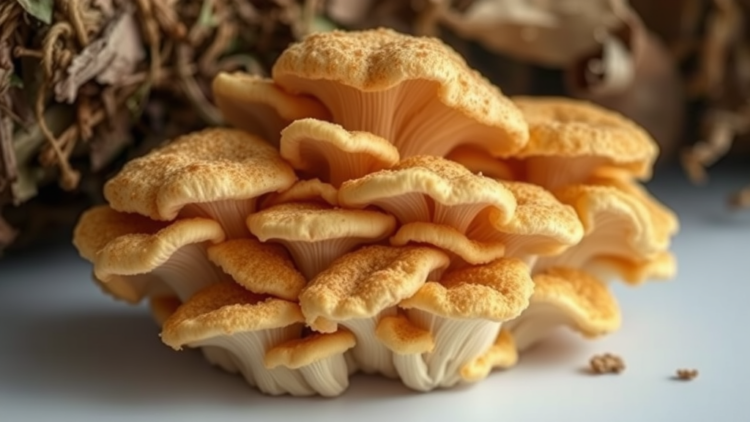
Image Credits: AI Generated
DOI: 10.1007/s00289-026-06683-0
Keywords: mycelium composites, Pleurotus ostreatus, sustainable packaging, agroforestry residues, biodegradable materials, lignocellulosic waste, water absorption, mechanical properties, biocomposites, waste valorization, circular economy, Polymer Bulletin
Cite Scienmag News
APA
MLA
Chicago
Bethany Barker. (September 12, 2026). Oyster Mushroom Mycelium Turns Forestry Waste Into Biodegradable Packaging. Scienmag. https://scienmag.com/oyster-mushroom-mycelium-turns-forestry-waste-into-biodegradable-packaging/
Bethany Barker. “Oyster Mushroom Mycelium Turns Forestry Waste Into Biodegradable Packaging.” Scienmag, 12 September 2026, https://scienmag.com/oyster-mushroom-mycelium-turns-forestry-waste-into-biodegradable-packaging/. Accessed 12 September 2026.
Bethany Barker. “Oyster Mushroom Mycelium Turns Forestry Waste Into Biodegradable Packaging.” Scienmag. September 12, 2026. https://scienmag.com/oyster-mushroom-mycelium-turns-forestry-waste-into-biodegradable-packaging/
Copy citation
Download RIS
Tags: agroforestry residuesbio-based foam for packaging applicationsbiocomposite properties influenced by substratebiocompositesbiodegradable materialsCircular economyeco-friendly protective packaging from agricultural by-productsenvironmentally friendly alternatives to polystyreneforestry waste recycling into biocompositesfungal hyphae plant residue bindinglignocellulosic substrate compositeslignocellulosic wastemechanical propertiesmicroplastic pollution reduction through mycelium materialsmycelium compositesmycelium-based biodegradable packagingoyster mushroom mycelium for sustainable materialsPleurotus ostreatusPleurotus ostreatus mushroom root networkPolymer Bulletinsustainable material production at ambient temperaturesustainable packagingwaste valorizationwater absorption