


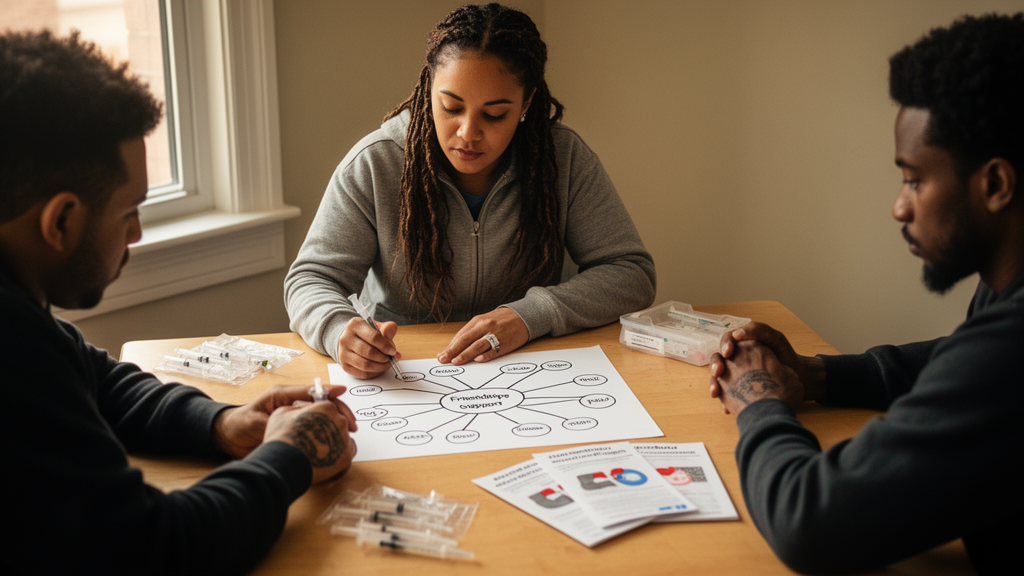
People who inject drugs often draw on the same small circle of contacts for both emotional help and drug-related activities, and a new cross-sectional study from Baltimore has now quantified exactly how much those roles overlap.
Between June 2022 and August 2023, 584 participants with a history of injection drug use completed paired network inventories, one covering social support relationships and one covering drug use relationships. The analysis, published in Harm Reduction Journal, examined characteristics at two levels: the egos who nominated their contacts, and the alters who were named, including whether each alter provided support, used drugs with the participant, or both.
The numbers reveal substantial overlap. The 266 participants with active drug use nominated 813 social support alters and 265 drug use alters, and 133 of those ties were multiplex, meaning the same person appeared in both networks. That concentration of functions in a small set of relationships is precisely the structural feature the authors argue could matter for designing network-based interventions.
Closeness ratings added a nuanced picture. Multiplex ties were perceived as less close than ties that offered only social support, with a mean perceived relationship closeness score of 4.2 compared with 4.6. Yet multiplex ties were closer than ties that involved only drug use, scoring 4.4 versus 3.2. In other words, sharing both support and drug use placed a relationship in an intermediate zone of intimacy, closer than a purely drug-focused connection but not as intimate as a purely supportive one.
The study also probed how different kinds of multiplex ties related to participants’ own drug use behaviors, using logistic regressions clustered by ego to account for the fact that each participant contributed multiple alters. Among all social support alters, being a multiplex tie rather than a simple social support tie was associated with increased odds of the participant using opioids, with an adjusted odds ratio of 2.19 and a 95 percent confidence interval of 1.24 to 3.85. The same contrast was associated with increased odds of polysubstance use, at an adjusted odds ratio of 1.97 with a confidence interval of 1.20 to 3.24.
Relationship type appeared to shape these associations in opposite directions. Multiplex sexual partners were linked to increased odds of injection drug use, with an adjusted odds ratio of 2.03 and a confidence interval of 0.93 to 4.44, an estimate that crosses unity and therefore carries statistical uncertainty. Multiplex relatives, by contrast, were associated with lowered odds of injection drug use, at an adjusted odds ratio of 0.25 with a confidence interval of 0.08 to 0.81. The authors conclude that relationship types within multiplex ties exhibited distinct interaction patterns with egos and unique associations with ego drug use behaviors.
Because the design is cross-sectional, the associations describe patterns observed at a single point in time and cannot establish whether multiplex ties drive drug use behaviors or reflect them. The sample was drawn from a single urban cohort in Baltimore, so generalization to other settings requires caution. Still, the detailed alter-level data, covering both the composition of the networks and the overlap between them, offer an unusually granular view of how support and risk are woven through the same relationships.
The practical implication the authors draw is that interventions targeting social networks should account for this multiplexity rather than treating support and drug use ties as separate channels. Leveraging the structural and functional diversity of these relationships, they argue, may optimize the development of effective network-based interventions. For harm reduction programs that already work through peer networks, the finding suggests that the same trusted contacts who provide support may also be the people present during drug use, a duality that any outreach strategy will need to navigate.
This analysis contributes a measured portrait of one such world, showing that closeness, kinship, sexual partnership and co-use intersect in patterns that simple single-network approaches would miss entirely.
Subject of Research: Overlap between social support and drug use networks among people who inject drugs in Baltimore
Article Title: Characterizing the composition and multiplexity of social support and drug use networks among people who inject drugs in Baltimore, Maryland
Article References: Wang, J., Patel, E. U., Latkin, C. A., German, D., Kirk, G. D., Mehta, S. H., Wesolowski, A., & Genberg, B. L. (2026). Characterizing the composition and multiplexity of social support and drug use networks among people who inject drugs in Baltimore, Maryland. Harm Reduction Journal. https://doi.org/10.1186/s12954-026-01560-5
Image Credits: AI Generated
DOI: 10.1186/s12954-026-01560-5
Keywords: social networks, multiplexity, injection drug use, harm reduction, Baltimore, ALIVE cohort, opioid use, polysubstance use, social support, cross-sectional study, Characterizing, composition
News Source: Glenn Wilkins. (October 29, 2026). Overlapping support and drug use ties mapped among Baltimore people who inject drugs. Scienmag.



