Researchers collaborating under the Multi-Office Accelerator Team Seed project have demonstrated that agentic artificial intelligence can streamline complex data analysis and engineering workflows across multiple particle accelerator facilities. Particle accelerators represent essential infrastructure for scientific research, yet their day-to-day operation and engineering development have long been restricted by machine complexity, fragmented operational knowledge across facilities, and the steep challenges of implementing machine learning tools beyond isolated, facility-specific setups. To overcome these limitations, the collaborative initiative was established under the United States Department of Energy Genesis Mission to build shared artificial intelligence and machine learning capabilities that can be deployed across the national laboratory complex.
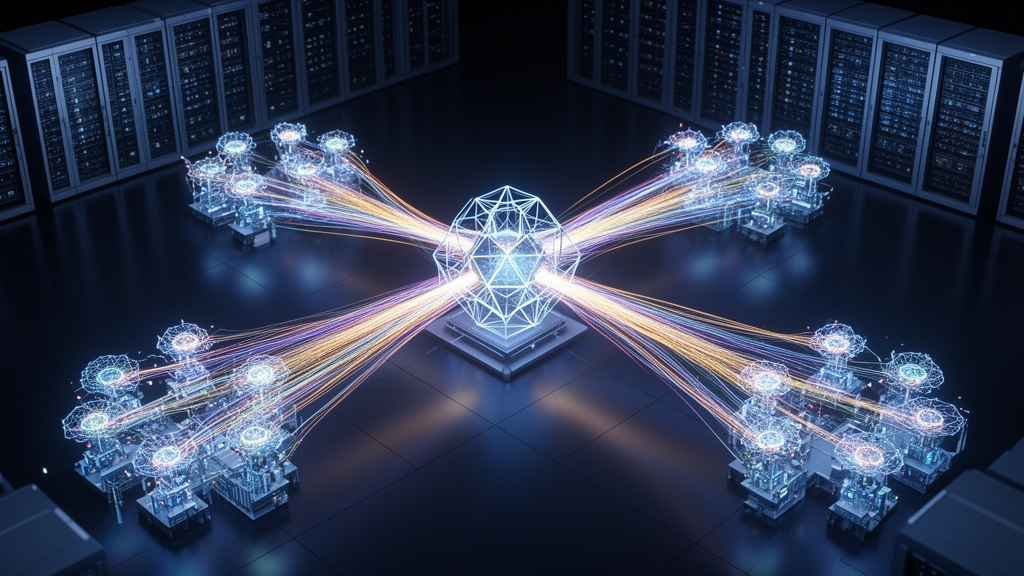
At the core of these early research results is the Osprey agentic artificial intelligence platform. The Osprey architecture functions by interfacing advanced computational reasoning models directly with operational accelerator control-system data, historical data archives, electronic logbooks, numerical simulation tools, and institution-specific operational procedures. This integrated setup allows automated systems to interact dynamically with laboratory resources that previously required continuous manual intervention and bespoke computational scripts from specialized facility staff.
Initial multi-laboratory demonstrations confirmed that natural-language-driven agents within the Osprey system can successfully carry out a wide spectrum of functional accelerator tasks. Experimental test cases across participating facilities verified that the platform can conduct archived-data analyses, execute real-time troubleshooting, support beam measurement and characterization, perform response-matrix evaluations, generate active control loops, analyze facility downtime, and directly assist in accelerator design investigations. Throughout these demonstrations, natural-language-driven agents demonstrated the ability to perform useful analyses, generate and execute task-specific code, and support accelerator troubleshooting and design studies.
The demonstrations established that agentic workflows substantially lower the practical effort and engineering time required to carry out specialized analyses and design evaluations. Traditionally, performing accelerator analyses and design studies has demanded custom scripting and expert intervention. The seed project results illustrate that agentic workflows can absorb substantial portions of that technical burden by automatically formulating and executing targeted analytic routines. Crucially, because the software constructs generic procedural pathways, operational solutions created at one laboratory can be transferred and adapted to other accelerator facilities rather than remaining confined to the site of initial development.
Beyond standalone diagnostic and operational workflows, the collaborative research team highlighted significant progress in connecting agentic software with digital twins and virtual accelerators. Unifying intelligent agents with computational replicas and established accelerator physics software creates an environment for more rigorous and accelerated exploration of machine configurations. Together, these capabilities can enable faster analysis and more systematic exploration of design and tuning spaces. This interconnected setup simultaneously improves the exploitation of historical and real-time operational metrics while facilitating the systematic integration of expert knowledge across disparate participating organizations.
According to the authors, the project marks a strategic departure from traditional deployment models in accelerator science, which have historically treated machine learning as isolated, facility-specific proofs of concept. By providing a shared operational framework where software modules, computational skills, analytical workflows, and institutional lessons can be reused across facilities, the Multi-Office Accelerator Team approach establishes the structural foundation required for sustainable artificial intelligence adoption. This collaborative architecture is designed to support the entire lifecycle of major scientific machines, ranging from routine day-to-day operations and active troubleshooting to machine commissioning, long-term facility modernization, and the design of next-generation accelerator systems.
Despite these encouraging demonstrations, the authors emphasize that the reported findings represent initial progress and that widespread deployment will depend on overcoming several crucial operational limitations. Future technical developments must focus rigorous attention on formal verification, robust safeguards governing automated interactions with control systems, end-user trust, system dependability, and the establishment of sustainable software infrastructure across laboratories. The reported early findings from the seed collaboration provide an exploratory baseline, demonstrating a practical methodology for advancing reusable, production-grade artificial intelligence infrastructure across the Department of Energy accelerator complex while outlining the technical safeguards needed for safe long-term adoption.
Subject of Research: Agentic artificial intelligence infrastructure for particle accelerator operations and design
Article Title: The Multi-Office Accelerator Team (MOAT) Seed Project
Article References: Vay, J. L., Hellert, T., Huebl, A., Lehe, R., Martino, G., Mitchell, C., Zoni, E., Edelen, A., Ratner, D., Roussel, R., Zhang, Z., Steerenberg, N., Tennant, C., Carpenter, A., Samari, J., Xu, C., Shang, H., Smith, M., Piot, P., … Ruisard, K. (2026). The Multi-Office Accelerator Team (MOAT) Seed Project. EPJ Research Infrastructures, 10(1), Article 45. https://doi.org/10.1007/s41781-026-00199-y
Image Credits: AI Generated
DOI: 10.1007/s41781-026-00199-y
Keywords: particle accelerators, agentic AI, Osprey platform, Multi-Office Accelerator Team, MOAT Seed project, Department of Energy, Genesis Mission, accelerator operations, control systems, digital twins, virtual accelerators, response-matrix analysis, downtime analysis, accelerator design, simulation tools, electronic logbooks, machine learning
News Source: Denise Maddox. (November 24, 2026). Osprey Connects Reasoning Models to Accelerator Data Across Multiple Laboratories. Scienmag.