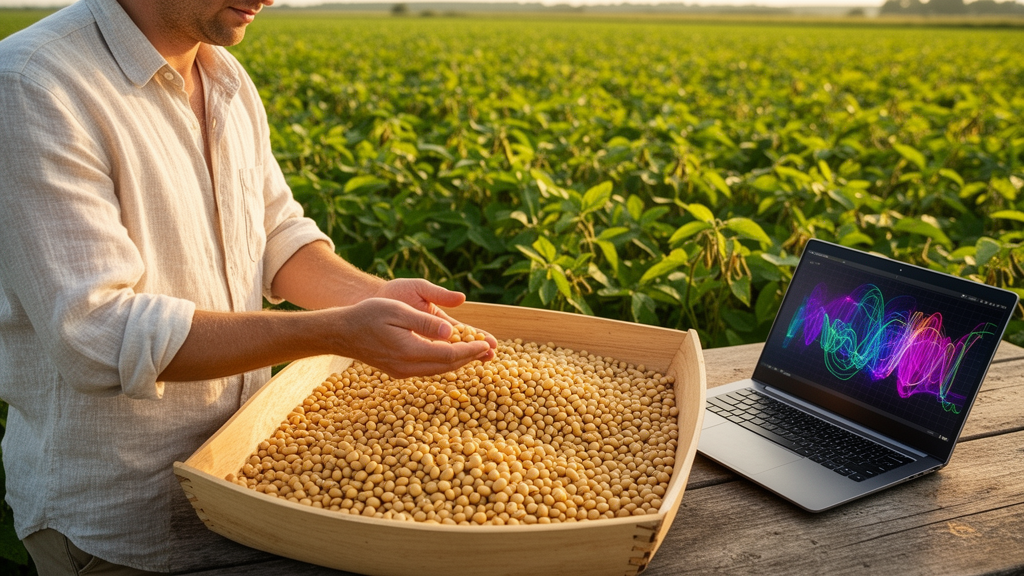
Plant scientists investigating the environmental consistency of soybean seed quality have demonstrated how supervised machine learning can be integrated with classical mixed-model stability metrics to evaluate complex breeding populations. In an extensive field evaluation conducted across three growing seasons at an experimental station in Shijiazhuang, Hebei Province, China, researchers tracked protein content, oil content, and hundred-seed weight across 695 recombinant inbred lines derived from four related biparental crosses. The multi-year study revealed substantial genetic variance alongside pronounced genotype-by-environment interactions, showing that genotype rankings across seasonal environments fluctuated significantly for all three seed traits. Rather than attempting to establish broad geographic adaptation, the investigation targeted temporal stability within a single agricultural region, demonstrating that multi-trait indices and tree-based classification algorithms can jointly identify elite recombinant lines that preserve balanced nutritional quality despite the strong physiological antagonism connecting protein and oil accumulation in soybean seeds.
The experimental plant materials comprised 695 sixth-generation recombinant inbred lines developed through single-seed descent from four distinct biparental crosses that shared a common male parent, designated HJ117. This male cultivar possessed an agronomic profile characterized by comparatively elevated seed protein and lower oil concentration. To generate broad segregating variation, HJ117 was crossed with four genetically diverse improved Chinese female cultivars originating from contrasting ecological regions: Zheng196, which produces relatively high seed oil concentrations between 18 and 21 percent; QH34, which exhibits high protein levels ranging from 40 to 52 percent; XD16, distinguished by large seed weight between 22 and 30 grams per hundred seeds; and JY101, an improved cultivar from Northeast China presenting a balanced multi-trait profile. The resulting populations—ZHJ with 220 lines, XDHJ with 183 lines, QHHJ with 170 lines, and JYHJ with 122 lines—enabled the research team to evaluate progeny performance across different maternal genetic contributions while holding the paternal genetic background partially constant.
Field trials were established during the 2019, 2021, and 2022 growing seasons under the temperate continental monsoon climate of Shijiazhuang, characterized by a mean annual temperature of 13.5 degrees Celsius and approximately 550 millimeters of annual precipitation. Agronomic records from the 2020 growing season were completely excluded from analytical consideration because pandemic-related travel and operational restrictions compromised consistent field management and observational comparability. Each trial utilized a randomized complete block design featuring three replications per season, with genotypes planted in single three-meter rows spaced half a meter apart at a target density of thirty plants per row. Sowing occurred in early June each year with harvesting conducted between late September and early October. Management practices—including pre-emergence herbicide applications, uniform supplemental irrigation delivered at critical developmental stages, and integrated pest management—were applied identically across all plots to limit extraneous environmental variation within each individual season.
Phenotypic characterization was conducted at the R8 stage of physiological maturity, defined as the point when 95 percent of pods attained mature coloration. To eliminate border effects, six representative plants were harvested from the interior portion of each row, air-dried to approximately 12 percent moisture content, and stored at 4 degrees Celsius in sealed containers. Hundred-seed weight was determined in triplicate on an analytical balance with a precision of 0.01 grams, using intact, undamaged seeds randomly sampled from each harvest. Protein and oil concentrations were quantified using Fourier-transform near-infrared reflectance spectroscopy calibrated against official reference chemistry, including Kjeldahl nitrogen determination using a 6.25 conversion factor and Soxhlet petroleum-ether oil extraction. The spectral calibrations were constructed from 150 reference samples spanning 35 to 55 percent protein and 10 to 22 percent oil, achieving coefficients of determination exceeding 0.98 and root mean square errors of prediction below 0.5 percent.
Analysis of variance components revealed broad phenotypic diversity and substantial quantitative inheritance across all three evaluated traits. Seed protein content varied across the panel from 21.08 percent to 58.17 percent, with population means extending from 45.01 percent in the JYHJ population to 46.00 percent in ZHJ. Oil content spanned 8.31 percent to 24.84 percent, while hundred-seed weight exhibited the widest relative range, shifting from 9.40 to 32.86 grams per hundred seeds. Linear mixed-effects models estimated through restricted maximum likelihood showed that genetic variance contributed an average of 21.7 percent of total phenotypic variance for protein, 25.6 percent for oil, and 42.0 percent for seed weight. Genotype-by-environment interaction variance accounted for 18.2 to 40.1 percent of total variance across trait-population combinations. Broad-sense heritability on an entry-mean basis ranged from 0.488 to 0.702 for protein, 0.511 to 0.734 for oil, and 0.754 to 0.832 for seed weight, confirming strong genetic control alongside meaningful environmental sensitivity.
Pairwise phenotypic correlations among genotype means demonstrated a powerful, statistically significant inverse relationship between seed protein and oil content across all four biparental populations. Correlation coefficients between the two storage reserves ranged from negative 0.735 to negative 0.888, with a panel-wide average of negative 0.820, reflecting internal resource competition during seed filling. Conversely, hundred-seed weight displayed largely independent relationships with both compositional traits; the correlation between seed weight and protein averaged negative 0.058, while the correlation between seed weight and oil averaged 0.133. This compositional independence creates an agronomic opportunity to select lines combining increased seed size with targeted protein or oil concentrations. Furthermore, extensive transgressive segregation appeared across all crosses, with approximately 30 percent of recombinant inbred lines displaying phenotypic values exceeding the upper or lower limits established by their parental cultivars for protein, oil, and hundred-seed weight, demonstrating the release of novel recombinant genetic variation.
To assess temporal environmental stability for individual traits, the investigators calculated the weighted average of absolute scores from best linear unbiased predictions, known as the WAASB index, which measures genotype contributions to interaction effects. Lower WAASB values designate lines exhibiting lower interaction sensitivity and more consistent performance across seasonal environments. For hundred-seed weight, WAASB values ranged from 0.0081 to 0.8347; for protein content, scores spanned 0.0051 to 0.8893; and for oil content, values varied between 0.0016 and 0.5271. When averaging WAASB scores across all three traits, line QHHJ-13 emerged as the most temporally stable genotype in the entire panel with a composite score of 0.0262, closely followed by JYHJ-12 at 0.0410 and ZHJ-24 at 0.0444. These trait-specific evaluations confirmed that environmental sensitivity varies by trait, but identified specific recombinant lines capable of maintaining stability across multiple seed characteristics simultaneously.
Because practical soybean cultivar improvement requires the simultaneous optimization of multiple agronomic attributes rather than isolated traits, the researchers deployed the multi-trait stability index, or MTSI, which calculates the Euclidean distance between each genotype and an idealized multi-trait ideotype within a factor-analytic space. Applying a 15 percent selection intensity identified 105 superior genotypes possessing MTSI values ranging from 3.3271 to the threshold value of 4.4566. Representation of selected lines varied sharply among the biparental crosses: the QHHJ population supplied 28.8 percent of its evaluated lines into the selected cohort, followed by XDHJ at 18.6 percent and ZHJ at 9.1 percent, whereas no lines from the JYHJ population met the threshold. The highest-ranked genotype under the multi-trait index was QHHJ-150, exhibiting an MTSI value of 3.3271 along with mean values of 28.74 grams hundred-seed weight, 47.82 percent protein, and 17.90 percent oil, followed closely by sibling lines QHHJ-130 and QHHJ-175.
To reconcile trait-specific stability with composite ideotype proximity, the research team synthesized rankings by calculating the arithmetic mean of each genotype’s rank positions from both the WAASB and MTSI frameworks. Under this dual criterion, line XDHJ-127 achieved the top combined ranking, placing seventh in mean WAASB stability and sixteenth in MTSI performance, yielding an average rank of 11.5 alongside a mean hundred-seed weight of 24.18 grams, 45.48 percent protein, and 18.65 percent oil. Sibling line XDHJ-50 ranked second overall with an average rank of 22, followed by XDHJ-90 with an average rank of 30, ZHJ-101 with an average rank of 31.5, and QHHJ-139, which also averaged 31.5. This integrated selection protocol ensured that prioritized candidates were not merely high-yielding under favorable seasonal conditions or static performers under stress, but successfully paired temporal consistency with multi-trait compositional excellence.
Complementary multivariate profiling through Ward’s hierarchical clustering of nine standardized stability and performance variables resolved the 695 recombinant lines into two broad phenotypic clusters, displaying an average silhouette width of 0.1714. Cluster 2 was distinguished by higher mean stability indices of 0.16 and lower overall coefficients of variation averaging 6.76 percent, whereas Cluster 1 exhibited lower stability indices averaging 0.12 and higher variability averaging 9.09 percent. Crucially, recombinant lines from all four biparental families were distributed widely across both clusters rather than segregating according to parental pedigree. A weak, statistically significant positive correlation of 0.257 was observed between overall performance and stability indices across the population, demonstrating that higher trait performance is not inherently coupled to elevated environmental instability under the experimental conditions evaluated.
To explore automated classification, the investigators implemented a machine learning pipeline evaluating Random Forest, Support Vector Machine, and Extreme Gradient Boosting algorithms trained on 28 engineered phenotypic descriptors. Genotypes were partitioned into four relative stability quartiles based on their overall coefficient of variation across traits. The Random Forest classifier, trained on 75 percent of the dataset and evaluated on a held-out test subset of 172 lines, achieved a test accuracy of 86.05 percent and a Cohen’s kappa coefficient of 0.814, although training accuracy reached 100 percent with an out-of-bag error rate of 20.44 percent. Analysis of Gini impurity reduction revealed that temporal dispersion metrics dominated predictive importance; the coefficient of variation for hundred-seed weight ranked as the single most influential predictor with a Gini score of 53.82, followed by the coefficient of variation for oil content at 32.12 and the standard deviation of oil content at 31.07.
The authors explicitly emphasized that the findings reflect three growing seasons at a single experimental research farm and cannot be interpreted as demonstration of broad geographic adaptation or general climate resilience. Because the investigation relied entirely on phenotypic evaluations without corresponding molecular markers, quantitative trait loci mapping, or genomic prediction, the physiological and genetic mechanisms governing the superior multi-trait stability of candidates like XDHJ-127 and QHHJ-150 remain unresolved. The research team concluded that supervised machine learning provides a valuable, data-driven layer for classifying stability profiles that effectively complements formal mixed-model selection indices. However, commercial deployment or parent selection will require extensive multi-location trials across contrasting agroecological zones alongside targeted genomic dissection to verify whether these recombinant lines retain their balanced seed-quality performance across diverse production environments.
Subject of Research: Phenotypic stability and multi-trait evaluation of soybean seed quality using mixed models and machine learning
Article Title: Leveraging multi-year trials and supervised machine learning to dissect phenotypic stability of seed quality traits in related soybean biparental populations
Article References: Liu, Z., Lamlom, S. F., Hong, H., yang, Q., Feng, Y., Yan, L., Ren, H., & QIU, L.-J. (2026). Leveraging multi-year trials and supervised machine learning to dissect phenotypic stability of seed quality traits in related soybean biparental populations. Artificial Intelligence in Agriculture. https://doi.org/10.1016/j.aiia.2026.11.008
Image Credits: AI Generated
DOI: 10.1016/j.aiia.2026.11.008
Keywords: soybean breeding, Glycine max, seed quality, phenotypic stability, recombinant inbred lines, protein content, oil content, 100-seed weight, genotype-by-environment interaction, WAASB index, multi-trait stability index, random forest, supervised machine learning, broad-sense heritability, transgressive segregation, hierarchical clustering, multi-environment trials
News Source: Alan Morgan. (November 24, 2026). Machine Learning and Multi-Year Field Trials Clarify Soybean Seed Quality Stability. Scienmag.