Researchers have built a patient-derived organ-on-a-chip platform that reproduced chemotherapy sensitivity profiles from surgically removed colorectal tumors and, in a small retrospective comparison, matched the treatments patients actually received. The study, published in Bioengineering & Translational Medicine, describes models grown from 14 patients with locally advanced colorectal cancer and a microfluidic device that kept tumor organoids alive long enough to test standard drug regimens within days.
The team, based at the First Affiliated Hospital of Zhengzhou University, enrolled patients with stage III colorectal cancer who had not yet received any cancer treatment. Surgeons collected tumor tissue during resection, and the researchers minced and enzymatically digested the samples into single cells before growing them as three-dimensional organoids. Cultures took hold in 13 of the 14 cases, a 92.9 percent success rate the authors note is consistent with earlier organoid studies. Immunohistochemistry confirmed that the organoids retained key markers from the original tumors, including CDX2, E-cadherin and Ki-67.
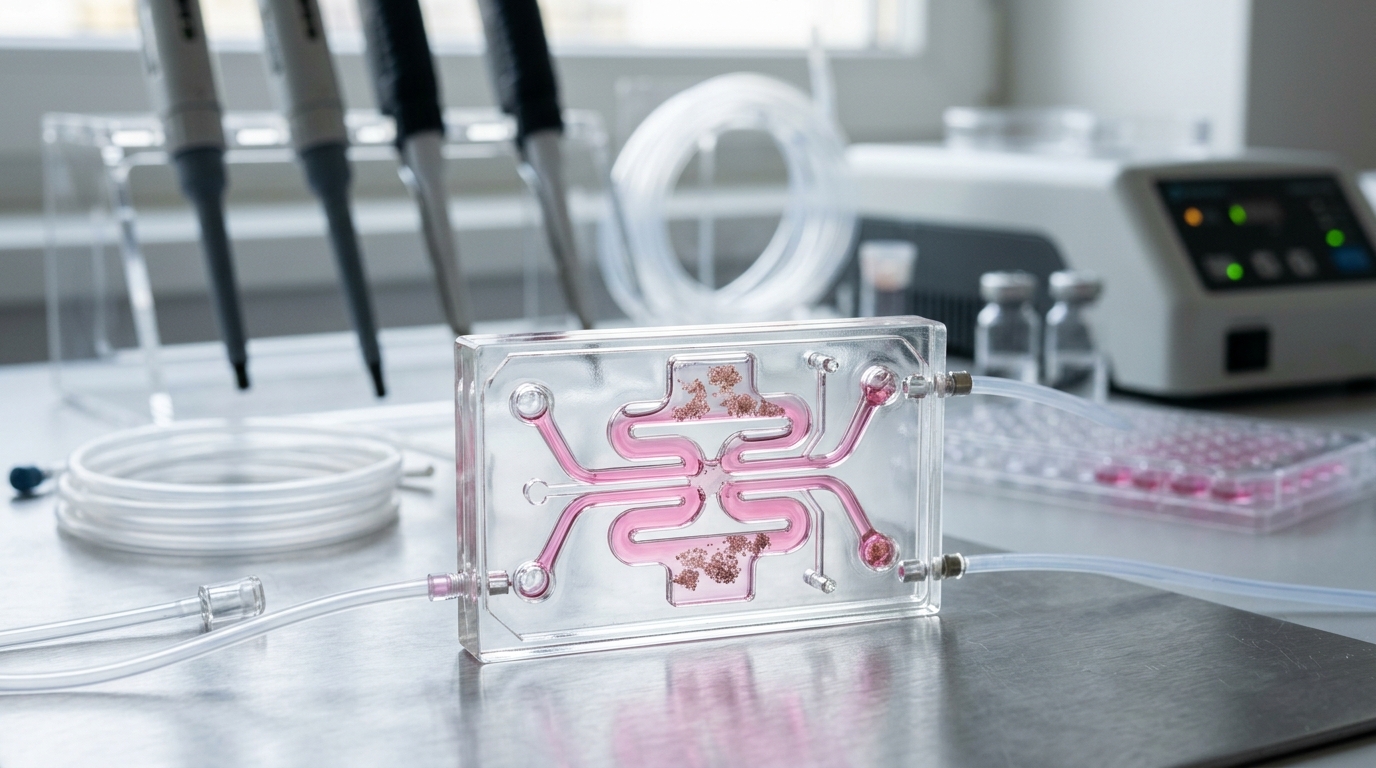
Those organoid cells were then loaded into a thermoplastic microfluidic device called OC-Plex, which contains eight independent chips, each with two fluidic channels. Cells mixed with Matrigel were seeded into a gel channel, medium flowed through the device on a shaker, and bright-field imaging tracked organoid growth over time. Within the chip, organoids reached a diameter of roughly 200 micrometers and remained viable for at least nine days, with quantitative measurements showing a time-dependent increase in size. In extended cultures, the models kept expanding to a maximal diameter of about 800 micrometers after 27 days of continuous growth, and immunofluorescence confirmed sustained expression of the colorectal cancer markers CDX2 and Ki-67 inside the chip environment.
Quantifying drug response cheaply and reliably is a persistent bottleneck in functional precision oncology, so the group also built an automated imaging pipeline. Organoids were cultured in the chips for four days, exposed to drugs for four days in the validation experiments, and then stained with Hoechst and propidium iodide to label live and dead cells. High-content imaging captured bright-field and fluorescent images, and segmentation masks distinguished living from dying cells so that viability could be calculated from the stained area. When the imaging-based viability measurements were compared against a parallel CellTiter-Glo ATP assay, the two methods correlated strongly, with a Pearson correlation coefficient of 0.8216.
To test the workflow, the researchers profiled organoids from a representative patient against two regimens: 5-fluorouracil combined with oxaliplatin, and irinotecan hydrochloride. Each was tested at six concentrations ranging from 0.01 to 200 micromolar. Dose-response curves showed markedly higher sensitivity to irinotecan hydrochloride than to the 5-fluorouracil plus oxaliplatin combination, reflected in lower IC50 and area-under-the-curve values, and the differential response was confirmed by both imaging-based and ATP-based analyses.
Because rapid turnaround matters for personalized treatment decisions, the team also optimized how long the drugs needed to stay on the cells. Using a FOLFOX-mimic regimen of 5-fluorouracil plus oxaliplatin, they assessed viability at three, four and six days after treatment began. A dose-dependent reduction in viability appeared at every time point, and the response profiles at day three already matched those seen at days four and six. On that basis, the researchers selected a three-day treatment window for all subsequent experiments, arguing that the early separation of drug response curves supports clinically feasible turnaround times.
The platform was then used to profile tumor-derived organoids from eight of the 13 patients whose cultures had been established. Live-dead imaging revealed clear heterogeneity between patients. Six patients showed greater sensitivity to the FOLFOX mimic, while the remaining two responded more strongly to a FOLFIRI mimic of 5-fluorouracil plus irinotecan. The same patterns appeared across independent readouts, in both the automated imaging-based viability analysis and the conventional ATP assay, suggesting the stratification was not an artifact of a single measurement method.
A retrospective look at the clinical records offered an early, preliminary signal of predictive value. Among the patients who received FOLFOX or mFOLFOX6 as their clinical treatment, three showed concordant sensitivity to the FOLFOX mimic in the chip models. The two patients whose chips favored FOLFIRI had nonetheless been treated clinically with FOLFOX, and both remained progression-free at the current follow-up, which the authors emphasize is short at seven months. They caution that complete tumor resection or the limited follow-up time could explain the discrepancy, and that longer follow-up is ongoing. If recurrence were to occur, they suggest, FOLFIRI might represent an alternative regimen for those patients.
The study’s authors frame the work as a step toward clinical use of organ-on-a-chip technology in drug-testing based precision oncology, and they situate it against the limitations of existing models. Conventional two-dimensional cell lines and animal xenografts often fail to capture the three-dimensional architecture, cellular diversity and dynamic tumor microenvironment of human cancers, contributing to poor clinical translatability and high drug attrition. Patient-derived organoids preserve genetic and phenotypic features of the tumor of origin and have shown clinical utility in predicting responses across tumor types, but they typically lack immune cells, fibroblasts and vasculature, and do not reproduce physiological cues such as nutrient gradients and fluid flow. They are also limited by high costs, variable success rates and a lack of standardization. The thermoplastic OC-Plex device, the authors argue, improves scalability and reduces cost compared with many PDMS-based chips, lowering a barrier to clinical adoption.
Significant limitations remain. Only eight patients were profiled, the tumor microenvironment in the chips is simplified and lacks immune and stromal components, and the clinical correlation is retrospective with short follow-up. The authors note that current genomic biomarkers fail to predict chemotherapy benefit in more than 40 percent of locally advanced colorectal cancer cases, which motivates functional approaches, but they state that prospective validation in multi-center trials correlating chip predictions with RECIST response criteria will be essential before clinical adoption. Future work, they write, should incorporate autologous immune cells to evaluate immunotherapies and expand testing to targeted agents. Colorectal cancer remains the third most common cancer and the second leading cause of cancer-related death worldwide, and outcomes in locally advanced or metastatic disease remain heterogeneous despite combination regimens such as FOLFOX and FOLFIRI. Whether chip-based sensitivity testing can genuinely guide first-line therapy selection, and spare patients the toxicity of ineffective regimens, will depend on those larger prospective studies.
Subject of Research: A patient-derived organ-on-a-chip platform for profiling chemotherapy sensitivity in locally advanced colorectal cancer
Article Title: A patient‐derived organ‐on‐a‐chip platform for predicting chemotherapy response in locally advanced colorectal cancer
Article References: Zhou, H., Gu, X., Chang, W., Zhou, L., Cao, R., Wang, X., Deng, L., Xiao, S., Ye, S., Qian, X., Xie, Z., Li, S., Xie, X., & Bai, H. (2026). A patient‐derived organ‐on‐a‐chip platform for predicting chemotherapy response in locally advanced colorectal cancer. Bioengineering & Translational Medicine, Article e70190. https://doi.org/10.1002/btm2.70190
Image Credits: AI Generated
DOI: 10.1002/btm2.70190
Keywords: organ-on-a-chip, colorectal cancer, patient-derived organoids, chemotherapy response, precision oncology, microfluidics, FOLFOX, FOLFIRI, drug sensitivity testing, tumor microenvironment, high-content imaging, locally advanced cancer
News Source: Nathaniel Bowman. (November 5, 2026). Organ-on-a-chip platform predicts chemotherapy response in colorectal cancer patients. Scienmag.