• HOME
  • NEWS
  • EXPLORE
    • CAREER
      • Companies
      • Jobs
    • EVENTS
    • iGEM
      • News
      • Team
    • PHOTOS
    • VIDEO
    • WIKI
  • BLOG
  • COMMUNITY
    • FACEBOOK
    • INSTAGRAM
    • TWITTER
Thursday, January 15, 2026
BIOENGINEER.ORG
No Result
View All Result
  • Login
  • HOME
  • NEWS
  • EXPLORE
    • CAREER
      • Companies
      • Jobs
        • Lecturer
        • PhD Studentship
        • Postdoc
        • Research Assistant
    • EVENTS
    • iGEM
      • News
      • Team
    • PHOTOS
    • VIDEO
    • WIKI
  • BLOG
  • COMMUNITY
    • FACEBOOK
    • INSTAGRAM
    • TWITTER
  • HOME
  • NEWS
  • EXPLORE
    • CAREER
      • Companies
      • Jobs
        • Lecturer
        • PhD Studentship
        • Postdoc
        • Research Assistant
    • EVENTS
    • iGEM
      • News
      • Team
    • PHOTOS
    • VIDEO
    • WIKI
  • BLOG
  • COMMUNITY
    • FACEBOOK
    • INSTAGRAM
    • TWITTER
No Result
View All Result
Bioengineer.org
No Result
View All Result
Home Headlines

Orexin as a potential drug for treating septic shock

Bioengineer.org by Bioengineer.org
January 25, 2018
in Headlines, Health, Science News
Reading Time: 2 mins read
0
Share on FacebookShare on TwitterShare on LinkedinShare on RedditShare on Telegram
IMAGE

Credit: University of Tsukuba

Sepsis is a life-threatening condition due to excessive immune responses to infection that damages the patient's own tissues and organs. In septic shock, the severest stage of sepsis, the blood pressure drops to a dangerously low level, often leading to multiple organ failure and death. To date, there is no effective therapy yet available for septic shock. Recent findings by Japanese scientists may be a breakthrough in developing a silver bullet for the treatment of septic shock.

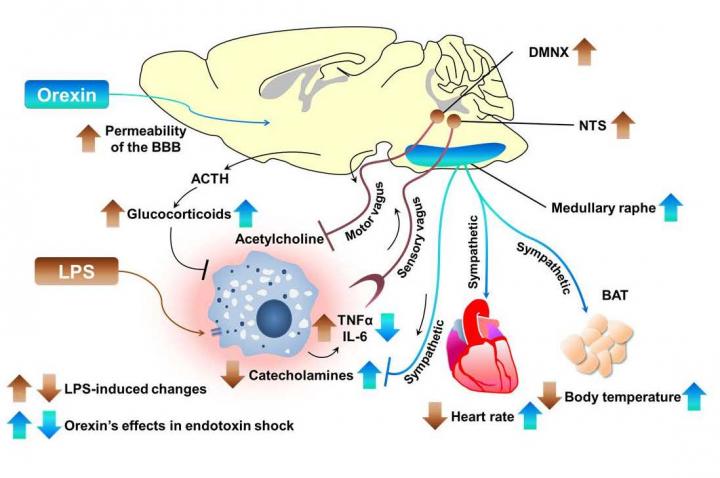
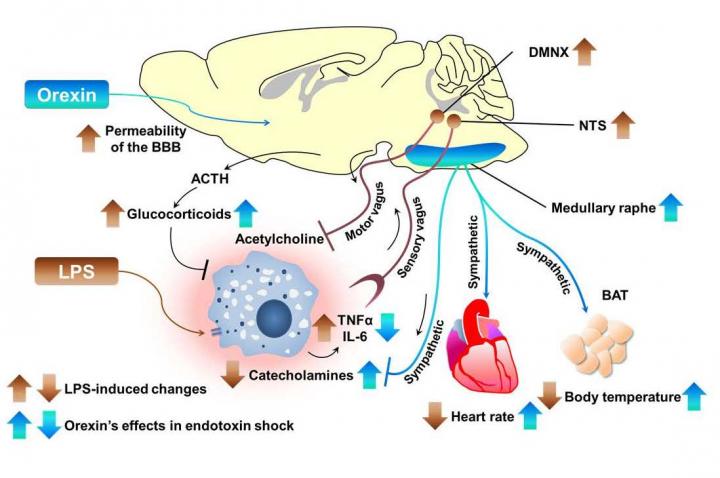
The research team led by Yasuhiro Ogawa, Yoko Irukayama-Tomobe and Masashi Yanagisawa of the International Institute for Integrative Sleep Medicine (WPI-IIIS), University of Tsukuba, found that subcutaneous injection of the neuropeptide orexin can markedly improve survival rate of mice suffering from endotoxin shock (sepsis model mice). Orexin, discovered by Yanagisawa and his colleagues in 1998, plays a critical role in controlling sleep/wakefulness, and is also known to alter heart rate and body temperature in rats, suggesting that it may potentially be a therapeutic agent for circulatory shock. However, the clinical application of orexin is technically difficult because it works in the brain, and delivery of orexin to the brain is hampered by the blood-brain barrier (BBB), an interface that selectively transports essential molecules to the brain and separates the brain from the circulatory system in order to protect the central nervous system (CNS) from hazardous substances.

"We exploited the leakiness of the BBB, a hallmark pathophysiology of the systemic inflammatory syndrome, in order to deliver orexin into the CNS," Irukayama-Tomobe says. The researchers confirmed that peripherally injected orexin can enter the brain because of the enhanced BBB permeability caused by septic shock, which subsequently helps mice to survive and recover from septic shock by restoring body temperature and increasing the heart rate. They further found that orexin is likely to regulate immune responses through multiple signaling pathways in the brain.

Future studies include elucidation of the precise mechanism through which CNS orexin regulates the responses of the immune system. They are validating the effect of peripherally administered orexin in primates with septic shock, aiming at clinical applications in the future.

###

Media Contact

Masataka Sasabe
[email protected]
81-298-535-857

Share12Tweet8Share2ShareShareShare2

Related Posts

blank

Teachers’ Digital Skills in AI’s Evolving Landscape

January 15, 2026
Gregory Valentine Discusses ECI in Biocommentary

Gregory Valentine Discusses ECI in Biocommentary

January 15, 2026

Birth Defects Linked to Prenatal Oil Well Exposure

January 15, 2026

MicroRNAs in Cancer: AI-Driven Translational Insights

January 15, 2026
Please login to join discussion

POPULAR NEWS

  • Enhancing Spiritual Care Education in Nursing Programs

    155 shares
    Share 62 Tweet 39
  • PTSD, Depression, Anxiety in Childhood Cancer Survivors, Parents

    147 shares
    Share 59 Tweet 37
  • Robotic Ureteral Reconstruction: A Novel Approach

    76 shares
    Share 30 Tweet 19
  • Study Reveals Lipid Accumulation in ME/CFS Cells

    53 shares
    Share 21 Tweet 13

About

We bring you the latest biotechnology news from best research centers and universities around the world. Check our website.

Follow us

Recent News

Teachers’ Digital Skills in AI’s Evolving Landscape

Gregory Valentine Discusses ECI in Biocommentary

Birth Defects Linked to Prenatal Oil Well Exposure

Subscribe to Blog via Email

Enter your email address to subscribe to this blog and receive notifications of new posts by email.

Join 71 other subscribers
  • Contact Us

Bioengineer.org © Copyright 2023 All Rights Reserved.

Welcome Back!

Login to your account below

Forgotten Password?

Retrieve your password

Please enter your username or email address to reset your password.

Log In
No Result
View All Result
  • Homepages
    • Home Page 1
    • Home Page 2
  • News
  • National
  • Business
  • Health
  • Lifestyle
  • Science

Bioengineer.org © Copyright 2023 All Rights Reserved.