

• HOME
  • NEWS
  • EXPLORE
    • CAREER
      • Companies
      • Jobs
    • EVENTS
    • iGEM
      • News
      • Team
    • PHOTOS
    • VIDEO
    • WIKI
  • BLOG
  • COMMUNITY
    • FACEBOOK
    • INSTAGRAM
    • TWITTER
Wednesday, May 6, 2026
BIOENGINEER.ORG
No Result
View All Result
  • Login
  • HOME
  • NEWS
  • EXPLORE
    • CAREER
      • Companies
      • Jobs
        • Lecturer
        • PhD Studentship
        • Postdoc
        • Research Assistant
    • EVENTS
    • iGEM
      • News
      • Team
    • PHOTOS
    • VIDEO
    • WIKI
  • BLOG
  • COMMUNITY
    • FACEBOOK
    • INSTAGRAM
    • TWITTER
  • HOME
  • NEWS
  • EXPLORE
    • CAREER
      • Companies
      • Jobs
        • Lecturer
        • PhD Studentship
        • Postdoc
        • Research Assistant
    • EVENTS
    • iGEM
      • News
      • Team
    • PHOTOS
    • VIDEO
    • WIKI
  • BLOG
  • COMMUNITY
    • FACEBOOK
    • INSTAGRAM
    • TWITTER
No Result
View All Result
Bioengineer.org
No Result
View All Result
Home NEWS Science News Biology

Oregon State University research finds evidence to suggest Pacific whiting skin has anti-aging properties that prevent wrinkles

Bioengineer by Bioengineer
June 21, 2022
in Biology
Reading Time: 2 mins read
0
Pacific whiting
Share on FacebookShare on TwitterShare on LinkedinShare on RedditShare on Telegram

CORVALLIS, Ore. – The gelatin in the skin of Pacific whiting, an abundant fish on the Pacific Coast of North America, may help prevent skin wrinkling caused by ultraviolet radiation, a new Oregon State University study found.
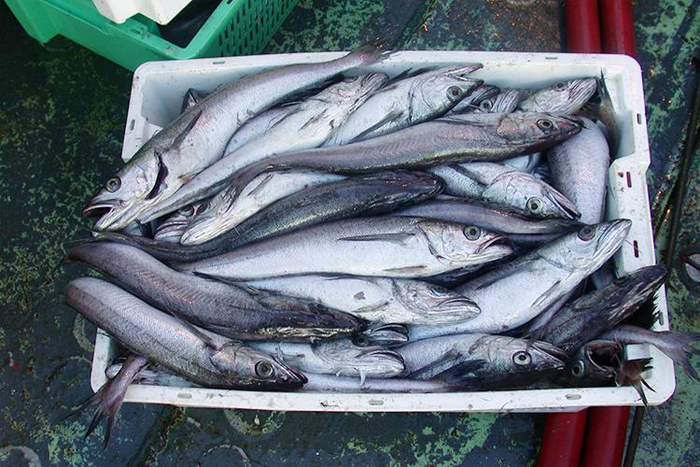
Pacific whiting

Credit: Vanessa Tuttle, NOAA Fisheries

CORVALLIS, Ore. – The gelatin in the skin of Pacific whiting, an abundant fish on the Pacific Coast of North America, may help prevent skin wrinkling caused by ultraviolet radiation, a new Oregon State University study found.

Pacific whiting is caught in large volumes in the United States but consumers have little familiarity with the mild, white meat fish also known as hake. It is popular in Europe, though, where it is the eighth most consumed species. In the U.S., the 10 most-consumed species account for 77% of total per capita seafood consumption and Pacific whiting is not among the top 10.

By studying Pacific whiting. Jung Kwon, an assistant professor at Oregon State’s Seafood Research & Education Center in Astoria, Oregon, is looking to change that and alleviate pressure on stocks of those 10 species, which include salmon and tuna.

She studies marine organisms and their potential to improve human health and is particularly interested in the benefits from parts of marine organisms such as fish skin, which many U.S. consumers choose to discard rather than eat.

“Fish skins are an abundant resource that we already know have valuable nutritional properties,” Kwon said. “But we wanted to find out what additional potential value might be found in something traditionally considered a byproduct.”

In a paper recently published in the journal Marine Drugs, Kwon and a team of researchers looked at molecular pathways that contribute on a cellular level to the wrinkling of skin. That wrinkling is promoted by chronic exposure to ultraviolet light, which breaks down collagen in the skin.

The researchers extracted gelatin from Pacific whiting fish and then looked at what impact it had on anti-oxidant and inflammatory responses and pathways known to degrade collagen and promote synthesis of collagen.

They found that the Pacific whiting skin:

  • Reactivated to a certain level the collagen synthesis pathway that had been suppressed by UV radiation.
  • Prevented activation to a certain level of the collagen degradation pathway that had been accelerated by UV radiation.
  • Promoted additional anti-oxidant activity. Antioxidants are substances that can prevent or slow damage to cells.
  • Promoted additional anti-inflammatory effects. 

Kwon cautioned that these are initial results obtained in her lab through a human cell model system. Further research is needed using animal models.

“We saw some potential with a positive response in the cell model system,” she said. “This gives us good evidence to take those next steps.”

Co-authors of the paper are Elaine Ballinger of Oregon State and Seok Hee Han and Se-Young Choung of Kyung Hee University in South Korea.

The research was funded by Pacific Seafood, a harvester, processer, and distributor of seafood.


Journal

Marine Drugs

Share15Tweet10Share3ShareShareShare2

Related Posts

How River DNA Simultaneously Tracks Fish, Frogs, Fungi, and Human Feces — Biology

How River DNA Simultaneously Tracks Fish, Frogs, Fungi, and Human Feces

May 6, 2026
High School Teacher Citizen Scientist Tracks Five Years of Black Skimmer Migration, Reveals Farthest Breeding Dispersal in Eastern US — Biology

High School Teacher Citizen Scientist Tracks Five Years of Black Skimmer Migration, Reveals Farthest Breeding Dispersal in Eastern US

May 6, 2026

Transition Metals Boost Arabidopsis Root Immunity via NLR

May 6, 2026

New Study Links Advanced Lung Cancer Inflammation Index to Stroke Recovery Post-Thrombolysis

May 6, 2026

POPULAR NEWS

  • Research Indicates Potential Connection Between Prenatal Medication Exposure and Elevated Autism Risk

    836 shares
    Share 334 Tweet 209
  • New Study Reveals Plants Can Detect the Sound of Rain

    723 shares
    Share 289 Tweet 181
  • Scientists Investigate Possible Connection Between COVID-19 and Increased Lung Cancer Risk

    68 shares
    Share 27 Tweet 17
  • Salmonella Haem Blocks Macrophages, Boosts Infection

    61 shares
    Share 24 Tweet 15

About

We bring you the latest biotechnology news from best research centers and universities around the world. Check our website.

Follow us

Recent News

How River DNA Simultaneously Tracks Fish, Frogs, Fungi, and Human Feces

Language Plasticity in Anaesthetized Human Hippocampus

ERASur Colorectal Cancer Trial Achieves Key Milestone with One-Third Patient Enrollment

Subscribe to Blog via Email

Enter your email address to subscribe to this blog and receive notifications of new posts by email.

Join 82 other subscribers
  • Contact Us

Bioengineer.org © Copyright 2023 All Rights Reserved.

Welcome Back!

Login to your account below

Forgotten Password?

Retrieve your password

Please enter your username or email address to reset your password.

Log In
No Result
View All Result
  • Homepages
    • Home Page 1
    • Home Page 2
  • News
  • National
  • Business
  • Health
  • Lifestyle
  • Science

Bioengineer.org © Copyright 2023 All Rights Reserved.