The field of energy conversion is witnessing transformative advancements, especially pertaining to cathode catalysts like single-atom catalysts (SACs). These catalysts are pivotal for enhancing the efficiency of metal-air batteries and fuel cells, which are integral to the green energy revolution. A recent study spearheaded by Professor We Zhang at the School of Materials Science and Engineering has unveiled significant breakthroughs in this area, particularly focusing on antimony-based SACs, namely, SbAC-NC-x catalysts.
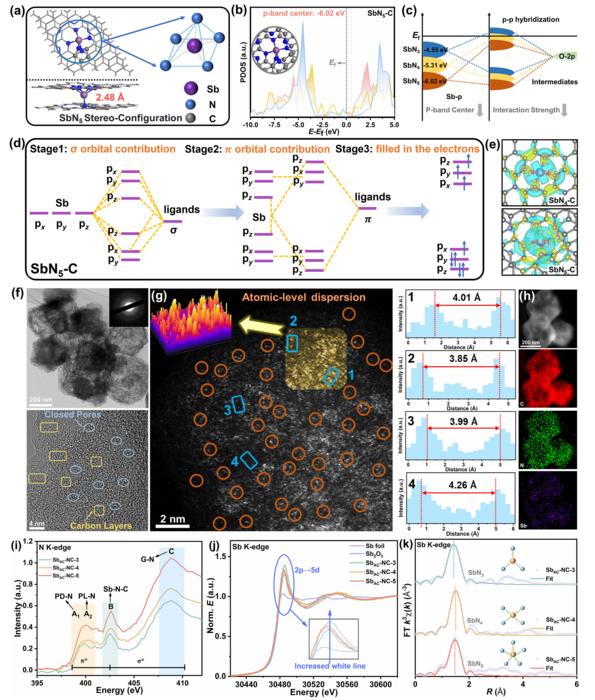
Key to this innovation is the understanding that the local coordination environment around the Sb centers can be engineered to enhance stability and activity. In the study, various degrees of NH4Cl gas-phase etching allowed the researchers to tailor the first coordination shell of the Sb atoms. Remarkably, they found that the encapsulated SbN5 stereoconfiguration, as identified through comprehensive theoretical predictions and structural analyses, exhibited an unprecedented half-wave potential (E1/2) of 0.908 V in an alkaline medium.
This extraordinary potential signifies a leap forward in the durability and efficiency of cathode materials. After undergoing accelerated durability tests, the catalyst maintained its performance relatively well, showing only a minor decrease of 11 mV in E1/2 after an extreme 150,000 cycles. This stability is significant as it indicates minimal degradation over extensive use, a common challenge for many conventional catalysts.
The underlying mechanism that allows for such stability revolves around the orbital stabilization effect associated with the SbN5 arrangement. Through a combination of in-situ experimentation and theoretical modeling, the researchers elucidated that this unique configuration actively mitigates the steric hindrance experienced by OH intermediates at the Sb sites. By preventing negative interactions between Sb centers and reaction intermediates, the catalyst effectively promotes the activation of the OH state, which is crucial for accelerating the formation of the *OOH species, a vital precursor in the ORR pathway.
Delving deeper into the characterizations, the research also made effective use of transmission electron microscopy (TEM) for imaging the catalyst’s morphology and gauging its crystallinity through high-resolution transmission electron microscopy (HRTEM) techniques. The images produced from these methods, along with high-angle annular dark field scanning transmission electron microscopy (HAADF-STEM) statistical analyses, revealed not only the structural integrity of the Sb sites but also the well-defined distances between Sb atoms, vital for efficient electron transfer processes.
To further validate their findings, the research team employed X-ray absorption spectroscopy techniques. By investigating the Sb K-edge, they were able to glean insights into electronic structures and the dynamics of charge distribution within their synthesized catalysts. This multi-faceted approach underscores the rigorous methodology that supports their theoretical predictions.
The implications of this research extend far beyond just theoretical advancements. With the global shift towards cleaner energy solutions, the demand for efficient electrochemical devices is escalating. Metal-air batteries and fuel cells have great potential for various applications ranging from portable electronics to electric vehicles and even grid-scale energy storage. Thus, catalysts that demonstrate both high activity and enhanced stability will play a critical role in meeting these energy demands.
Moreover, the successful development of SbAC-NC-x opens new avenues for the exploration of other elemental combinations and configurations that could similarly improve electrocatalytic performance. Future research might focus on extending these concepts to other non-transition metals or optimizing the coordination environments even further, thus broadening the scope of SACs in energy applications.
In conclusion, the journey initiated by Professor Zhang and his team signifies a pivotal moment in the landscape of energy catalysis. By adeptly manipulating the local coordination environment of Sb atoms within their single-atom catalysts, they have demonstrated a promising method to optimize both performance and durability. This pioneering research not only contributes significantly to the existing literature but also sets a foundation for future studies aimed at revolutionizing energy conversion technologies.
Subject of Research: Antimony-based single-atom catalysts and their application in enhancing the efficiency of metal-air batteries and fuel cells.
Article Title: Orbital Stabilisation Effect in Sb-based Single-Atom Catalyst Enhances Electrochemical Activity
News Publication Date: October 2023
Web References: Science Bulletin
References: None provided in the original text.
Image Credits: ©Science China Press
Keywords
Single-atom catalysts, antimony, electrochemical performance, oxygen reduction reaction, durability, metal-air batteries, energy conversion, coordination engineering, electrocatalysis.
Tags: Antimony-based catalystsCoordination engineeringDurability enhancementElectrocatalysisElectrochemical performanceFuel cellsGreen energy revolutionMetal-air batteriesOrbital stabilization effectOxygen reduction reaction (ORR)SbN5 stereoconfigurationSingle-atom catalysts