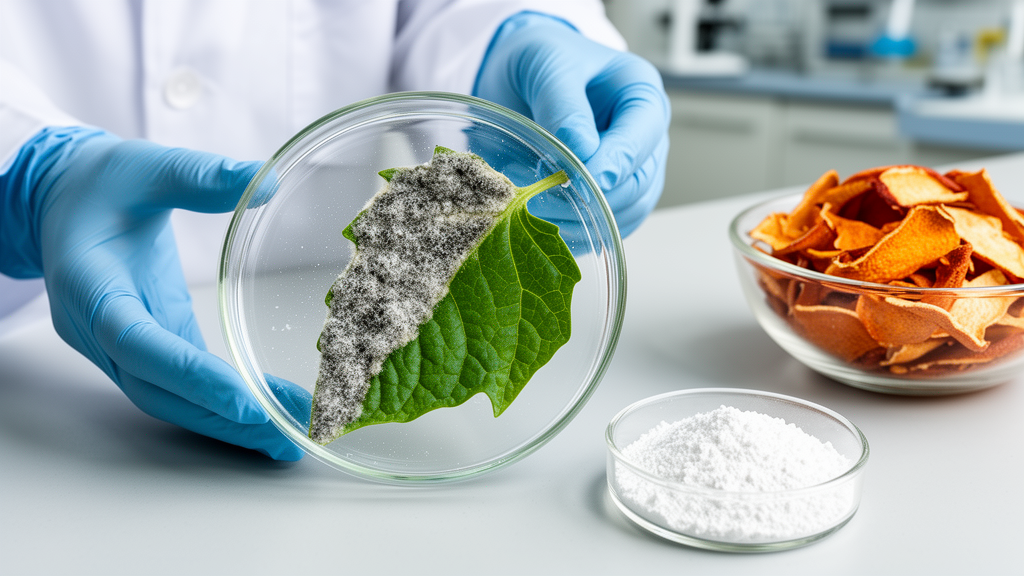
Orange peels, the discarded byproduct of one of the world’s largest fruit industries, have become the unlikely starting point for a new weapon against crop-destroying fungi. In a study published in Frontiers in Fungal Biology, researchers at Vellore Institute of Technology in Tamil Nadu, India, transformed lanthanum nitrate into crystalline lanthanum oxide nanoparticles using nothing more than an aqueous extract of Citrus sinensis peel waste, then showed that the resulting particles can completely halt the growth of Alternaria solani, the fungus behind tomato early blight, at concentrations as low as 5 milligrams per milliliter. The work offers a rare head-to-head benchmark of a green-synthesized rare-earth oxide against a commercial fungicide, and it arrives amid mounting concern that fungal pathogens inflict more than 220 billion dollars in annual losses while synthetic fungicides accumulate residues in food chains and drive resistance.
The choice of lanthanum oxide is deliberate and somewhat contrarian. Silver and copper nanoparticles have dominated agricultural antimicrobial research because they kill microbes through ion release and reactive oxygen species generation, but they carry documented drawbacks: high production cost, phytotoxicity at elevated concentrations, and concerns over bioaccumulation in soil microbiota and aquatic organisms. Zinc oxide and copper oxide nanoparticles offer lower cost but raise similar dose-dependent toxicity worries, while titanium dioxide nanoparticles depend on ultraviolet activation that field conditions cannot guarantee. Lanthanum oxide, a rare-earth oxide that has received comparatively little attention as a direct biocontrol agent, combines high chemical stability with a wide bandgap suited to sustained oxidative activity, and comparative studies suggest lanthanum-based compounds generally show lower cytotoxicity and reduced bioaccumulation than their silver or copper counterparts at equivalent antimicrobial concentrations. The authors note, however, that the environmental fate and long-term ecotoxicological impact of lanthanum oxide nanoparticles at agricultural scales remain active areas of investigation that have not been fully characterized for green-synthesized formulations.
The synthesis itself reads like a chemistry lesson in valorized waste. Orange peels collected from a campus canteen were chopped, dried at 40 degrees Celsius, and ground into powder, then steeped in distilled water at 60 degrees Celsius for 15 minutes to release the peel’s rich phytochemical cargo. The filtered extract was combined with a 0.1 molar lanthanum nitrate solution and stirred for three hours at 50 degrees Celsius while the pH was raised to 10 with sodium hydroxide. The dark yellow solution progressively paled as electron-donating polyphenols and hydroxyl-rich phenolic compounds reduced lanthanum(III) ions, and centrifugation yielded a tan pellet corresponding to a lanthanum hydroxide intermediate. Drying at 70 degrees Celsius shifted the material to bright yellow, and a final calcination at 700 degrees Celsius for three hours converted the intermediate into a white powder, the characteristic appearance of pure lanthanum oxide. The entire colorimetric sequence tracks the expected reaction pathway from metal salt to hydroxide intermediate to crystalline oxide, with plant polyphenols serving as natural reducing and capping agents in place of hazardous chemicals such as sodium borohydride or hydrazine.
Characterization confirmed that the plant-mediated route produced a highly crystalline, phase-pure material. Powder X-ray diffraction displayed sharp, well-defined Bragg peaks at 2-theta values of 26.1, 29.9, 39.5, and 48.7 degrees, matching the (100), (101), (102), and (110) reflection planes of cubic lanthanum oxide and aligning with the ICDD reference standard JCPDS No. 00-050-0193. The authors point out that achieving comparable crystallinity through some chemical routes would require harsher conditions, suggesting plant polyphenols broadly support efficient crystalline oxide formation. Ultraviolet-visible spectroscopy revealed a strong absorption peak at approximately 360 nanometers, consistent with literature values for lanthanum oxide nanoparticles synthesized by other green routes, alongside a broad shoulder between 290 and 320 nanometers most plausibly attributed to residual flavonoids from the orange peel extract. Minimal absorbance across the visible region confirmed the wide-bandgap semiconductor behavior typical of the oxide, meaning any photocatalytic response would occur predominantly under ultraviolet excitation.
Field-emission scanning electron microscopy revealed an irregular, flake-like to quasi-spherical morphology rather than the uniform spheres reported in prior green syntheses using other plant extracts, a heterogeneity the researchers attribute to differences in extraction solvent, extract concentration, and synthesis pH that shape nucleation and growth kinetics. The particles aggregated appreciably into clusters, a consequence of the high surface energy of nanoscale materials and the presence of residual phytochemical components acting as stabilizing interfaces between adjacent particles without fully preventing agglomeration. Energy-dispersive X-ray spectroscopy confirmed the elemental composition as 47.4 weight percent lanthanum, 35.9 weight percent oxygen, and 16.7 weight percent carbon, with no peaks corresponding to any other elements, indicating the sample was free of extraneous contamination. The substantial carbon content, together with the deviation of the measured lanthanum-to-oxygen ratio from the theoretical stoichiometric value for pure lanthanum oxide, provides direct quantitative evidence for a retained organic surface layer, a common observation in green-synthesized nanoparticles that reflects both the inherent limitations of EDX for quantifying light elements and the diluting effect of the bio-capping coating on the inorganic signal.
Fourier-transform infrared spectroscopy told a similar story of partial organic retention. The orange peel extract spectrum displayed bands characteristic of its phytochemical constituents: hydroxyl stretching at 3740 and 3336 reciprocal centimeters from free and hydrogen-bonded phenolic and polysaccharide groups, aliphatic C-H stretching at 2924, carbonyl C=O stretching at 1735, aromatic C=C stretching at 1604 characteristic of flavonoid and polyphenolic structures, and C-O-containing linkages at 1245 and 1018. The nanoparticle spectrum showed a markedly simplified profile consistent with thermal decomposition of most organic constituents during calcination, yet it retained O-H bands at 3740 and 3440, residual C-O-related bands at 1380 and 1070, and, most notably, three new absorption bands at 890, 620, and 460 reciprocal centimeters, all attributed to lanthanum-oxygen stretching vibrations. The persistence of the 3740 band in both spectra suggests this specific hydroxyl environment survives thermal treatment largely intact, and the combined FTIR and EDX evidence supports a bio-hybrid nanostructure model in which an inorganic oxide core retains a residual organic surface coating of plant-derived secondary metabolites.
Antifungal testing using the poisoned food technique produced the study’s most striking results. Nanoparticle suspensions at 1, 5, and 15 milligrams per milliliter were incorporated into potato dextrose agar, and 5-millimeter mycelial discs from 7-day-old cultures of Alternaria solani and Colletotrichum capsici were placed at the center of each plate, with three replicates per treatment and colony diameter measured at 24-hour intervals for 7 days. Against A. solani, the tomato early blight pathogen, the nanoparticles achieved complete suppression of mycelial growth at both 5 and 15 milligrams per milliliter, exactly matching the performance of the commercial SAAF fungicide (carbendazim 12 percent plus mancozeb 63 percent) at 5 milligrams per milliliter. Even at the lowest concentration of 1 milligram per milliliter, the particles restricted mycelial expansion by 24.4 percent. Against C. capsici, the chili anthracnose pathogen, inhibition rose stepwise from 9.9 percent at 1 milligram per milliliter to 61.5 percent at 5 and a substantial 86.8 percent at 15, though only the commercial fungicide achieved complete growth restriction. One-way analysis of variance confirmed the overall treatment effects were statistically highly significant for both pathogens.
The kinetic dimension may prove as important as the final efficacy. Against A. solani, the nanoparticles at 15 milligrams per milliliter achieved complete inhibition two days earlier than the commercial fungicide at 5 milligrams per milliliter, on day 2 rather than day 4. While both treatments ultimately reached 100 percent inhibition, the authors argue that more rapid early-stage growth arrest during the critical infection window is expected to limit disease severity and associated yield loss under field conditions. Equally notable was the complete suppression of sporulation observed across all lanthanum oxide-treated plates for both pathogens, an effect that extends beyond simple growth restriction, since spore production is central to secondary disease spread in field conditions. The pathogen-specific difference in susceptibility is most plausibly explained by fungal cell wall architecture: A. solani possesses relatively thin, loosely organized cell walls composed primarily of glucans and chitin with minimal melanization, permitting greater nanoparticle penetration and exposure to reactive oxygen species, whereas Colletotrichum species bear thicker, more heavily melanized cell walls, and melanin is a recognized scavenger of reactive oxygen species that would reduce the bioavailability of nanoparticle-induced oxidative stress at the cell surface and confer partial resistance.
The retained phytochemical layer may itself contribute an independent antifungal component alongside the oxidative and cell-wall-disruptive mechanisms attributed to the inorganic core. Recent work has shown that Citrus limon and Citrus sinensis peel extracts alone suppress potato rot-causing fungal pathogens through their phytochemical content, supporting the rationale that the surface-bound organic layer identified by FTIR and EDX in this study may act in parallel with the oxide’s own bioactivity. This dual-mechanism perspective, in which the antifungal effect derives from both the inorganic oxide core and the retained organic phytoconstituents, is not explicitly addressed in comparable prior green-synthesis lanthanum oxide studies and distinguishes the present work, which the authors describe as the first to synthesize lanthanum oxide nanoparticles specifically from orange peel extract and to test them against these two economically important pathogens.
The findings position peel-derived lanthanum oxide nanoparticles as a promising eco-friendly biocontrol candidate, particularly for managing early blight, while acknowledging that further optimization, whether through higher application concentrations, extended exposure times, or combination with complementary antifungal agents, may be required to achieve comparable efficacy against more resistant pathogens such as C. capsici. The researchers also emphasize that evaluation against a broader collection of phytopathogenic fungi representing different taxonomic groups and host crops will be necessary to establish the generality and spectrum of the observed activity, and that dedicated investigation of environmental fate and ecotoxicological impact at agricultural application scales must precede any large-scale field deployment. Still, by converting an abundant agricultural waste stream, with global orange production exceeding 50 million metric tons annually, into a functional antifungal nanomaterial with a comparatively favorable toxicological profile, the study contributes both a practical waste-to-value pathway and new pathogen-specific efficacy data to the emerging field of rare-earth-oxide green nanotechnology in agriculture.
Subject of Research: Biogenic synthesis and characterization of lanthanum oxide nanoparticles using citrus sinensis peel waste for antifungal applications in crop protection
Article Title: Biogenic synthesis and characterization of lanthanum oxide nanoparticles using citrus sinensis peel waste for antifungal applications in crop protection
Article References: Ramesh, S., Khyathi, A., Mandapati, H. S., S., V., Kumar, V., & Parthasarathi, T. (2026). Biogenic synthesis and characterization of lanthanum oxide nanoparticles using citrus sinensis peel waste for antifungal applications in crop protection. Frontiers in Fungal Biology, 7, Article 1925291. https://doi.org/10.3389/ffunb.2026.1925291
Image Credits: AI Generated
DOI: 10.3389/ffunb.2026.1925291
Keywords: Biogenic, synthesis, characterization, lanthanum, oxide, nanoparticles, citrus, sinensis, peel, waste, antifungal, applications
News Source: Roger Howard. (October 17, 2026). Orange peel waste yields lanthanum oxide nanoparticles that stop tomato fungus. Scienmag.