Mineral processing researchers investigating placer gold beneficiation have established empirical models that optimize the enrichment performance of laboratory-scale centrifugal concentration. Working with low-grade alluvial deposits, the investigators applied response surface methodology combined with a three-level, three-factor Box-Behnken experimental design to evaluate how solid concentration, centrifugal force, and fluidization water flow rate govern metallurgical outcomes in a Knelson concentrator. The experimental trials demonstrated that careful manipulation of these operating variables enables substantial upgrading of raw placer material, elevating a feed grade of 0.2 parts per million of gold to concentrated products reaching up to 2.69 parts per million. Through rigorous statistical evaluation, the research team identified quadratic relationships that link concentrator operational inputs to both concentrate grade and extraction yield, confirming that fluidization dynamics and centrifugal acceleration play decisive roles in separating precious metal grains from dense mineral matrices.
Gravity separation represents an essential beneficiation strategy for placer gold deposits because of the profound physical contrast in specific gravity between native gold particles and surrounding gangue minerals. Natural gold typically possesses a specific gravity spanning from 15.0 to 19.3 grams per cubic centimeter, whereas typical host rock minerals display specific gravities ranging between 2.6 and 5.8 grams per cubic centimeter. Exploiting this density difference requires comprehensive liberation through crushing and grinding before separation can occur, ensuring valuable metal particles detach cleanly from non-valuable host materials rather than remaining locked in composite grains. While conventional gravity devices such as sluices, jigs, spirals, and shaking tables have long processed coarse free gold, centrifugal gravity concentrators represent an advanced development capable of treating broader particle size distributions.
The experimental investigation utilized a bulk sample of 250 kilograms of placer gold ore retrieved from the western region of Manisa, Turkey. Given the low-grade nature of alluvial gold deposits, representative sample preparation remains fundamental to generating reproducible metallurgical data across successive processing tests. The research team processed the initial material using a vibratory sample divider equipped with eight collection jars, systematically preparing uniform sub-samples of exactly one kilogram each. Prior to conducting detailed microscopic and mineralogical characterization, the placer ore underwent separation using a low-intensity magnetic separator to isolate magnetic constituents from non-magnetic minerals. This preparatory magnetic segregation proved necessary because the Turkish placer ore contained substantial quantities of iron-bearing species, including magnetite, hematite, and specularite. Removing the strongly magnetic fraction clarified the optical field, allowing researchers to evaluate the textural and mineralogical properties of the remaining non-magnetic mineral phases with elevated precision.
Microscopic examinations conducted with a Nikon Eclipse 6400POL polarizing microscope revealed detailed mineralogical characteristics across the separated sample fractions. The magnetic portion consisted predominantly of iron oxides alongside almandine-type garnets that displayed characteristic red and pink coloration under optical inspection. Magnetite occurred in well-formed crystalline structures exhibiting cubic geometry, accompanied by specularite, a metamorphic variety of hematite recognizable by distinct leafing patterns and metallic luster. Dark brown and black tourmaline crystals presented as elongated, prismatic, transparent structures within the mineral assembly. In contrast, the non-magnetic fraction comprised primarily quartz and feldspar group minerals, specifically orthoclase and plagioclase, accompanied by typical red rutile grains, hexagonal zircon crystals, muscovite-type mica, pyrite, and limonitized iron oxides. Crucially, the non-magnetic material contained native gold occurring as small, yellow, flaky particles, whose delicate morphology influenced their hydrodynamic response inside wet processing equipment.
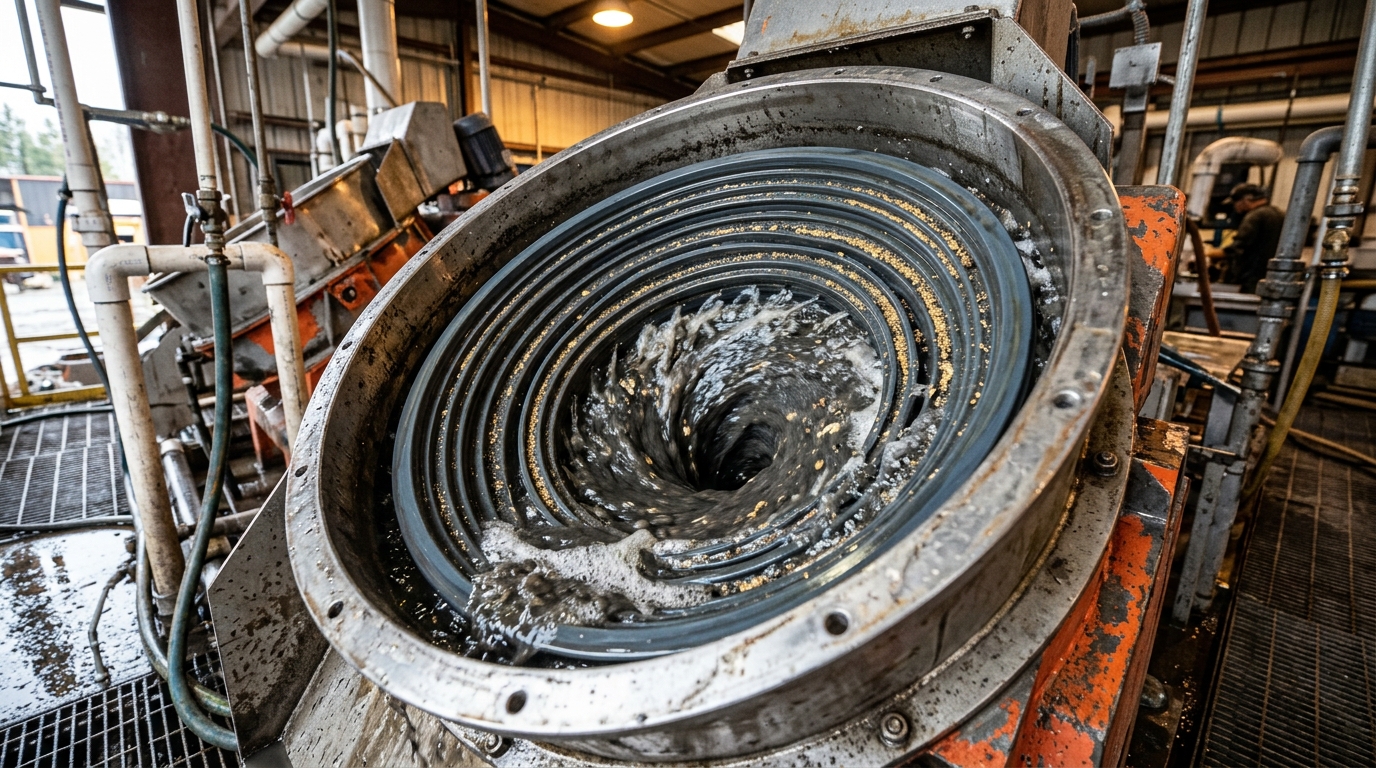
Separation testing took place using a laboratory-scale KC-MD3 batch-type Knelson concentrator manufactured by FLSmidth USA Incorporated. This specialized unit features a three-inch diameter truncated-cone separation bowl that rotates to generate high centrifugal fields, achieving a rated dry throughput of 45 kilograms per hour and a volumetric slurry handling capacity of 8 liters per minute. The internal concentrate retention capacity of the inner ribbed bowl ranges from 80 to 150 grams depending on prevailing fluidization conditions and heavy mineral characteristics. To maximize gold recovery in accordance with established field standards, the feed material was prepared to pass a minus one-millimeter wet sieve sizing threshold.
The test protocol evaluated three key operational parameters across three distinct intensity levels using the Box-Behnken experimental design matrix, comprising fifteen individual tests including three central replicate points. Solid concentration of the feed slurry was tested at 10, 15, and 20 weight percent; centrifugal acceleration was adjusted to 60, 90, and 120 times normal gravitational acceleration; and fluidization water flow rate was regulated via a centrifugal pump at 4, 6, and 8 liters per minute. Following each concentration trial, the retained concentrate and discharged tailings were dried, weighed to calculate mass pull, and ground below 100 micrometers in a ring mill. Gold concentrations were determined using aqua regia digestion with hydrochloric and nitric acids, followed by organic solvent extraction using methyl isobutyl ketone to isolate gold from interfering iron ions before measurement on an atomic absorption spectrometer.
Statistical evaluation using Design Expert 13 software generated second-order polynomial regression models that described gold grade and gold recovery as empirical functions of coded concentrator parameters. Both mathematical equations exhibited robust predictive accuracy, yielding coefficients of multiple determination of 0.996 for concentrate grade and 0.998 for gold recovery, indicating that the selected operating variables accounted for nearly all observed response variations. Adequate precision values reached 37.073 for the grade model and 60.560 for recovery, well above the baseline threshold of four required for reliable signal distinction. Analysis of variance verified that both models achieved high statistical significance, with model F-values of 142.72 for grade and 443.98 for recovery alongside probability values below 0.05. Furthermore, lack-of-fit tests yielded values of 0.7214 and 0.5668, confirming the absence of significant model error and demonstrating normal residual distributions.
The calculated regression equations and effect-size analyses revealed contrasting parameter behaviors across the separation mechanisms. Fluidization water flow rate exerted the dominant negative influence on both responses, exhibiting eta-squared effect sizes of 0.240 for grade and 0.247 for recovery, with excessive water washing gold grains out of the concentrate retaining rings. Centrifugal force demonstrated a moderate negative influence on concentrate grade with an eta-squared value of 0.107, while exerting a pronounced positive linear influence on recovery with a model coefficient of positive 4.28 and an eta-squared value of 0.070. Feed solid concentration showed a minor positive influence on concentrate grade with an eta-squared of 0.028 and a negligible effect on total gold recovery.
Response surface three-dimensional diagrams highlighted intricate parameter interactions and physical separation phenomena within the rotating conical bowl. Furthermore, microscopic analysis of panning concentrates from Knelson tailings confirmed the escape of delicate, flaky gold flakes. The experimental tests produced gold grades ranging between 1.58 and 2.69 parts per million and gold recovery rates spanning between 45.72 percent and 82.19 percent across the diverse parameter combinations.
Multi-objective response optimization identified operating parameter settings that simultaneously maximize gold enrichment and extraction yield. Model optimization targeted peak performance at intermediate operating points, which was subsequently verified through a physical confirmation experiment. This validation run achieved an experimental gold grade of 2.65 grams per metric ton and a recovery rate of 79.38 percent, falling squarely within predicted ninety-five percent statistical confidence intervals. The researchers concluded that while laboratory-scale Knelson units achieve high enrichment ratios from low-grade alluvial deposits, scaling these processes to industrial processing facilities requires careful hydrodynamic calibration.
Subject of Research: Placer gold ore enrichment through centrifugal Knelson concentrator parameter optimization
Article Title: Enrichment of placer gold ore through Knelson concentrator optimization
Article References: Çerik, Ç., Şen, G. A., & Şen, S. (2024). Enrichment of placer gold ore through Knelson concentrator optimization. Gold Bulletin, 57(3-4), 107-118. https://doi.org/10.1007/s13404-024-00352-8
Image Credits: AI Generated
DOI: 10.1007/s13404-024-00352-8
Keywords: Knelson concentrator, placer gold ore, centrifugal gravity separation, response surface methodology, Box-Behnken design, gold recovery, mineral processing, Manisa Turkey, Enrichment, placer, gold, Knelson
News Source: Denise Maddox. (November 7, 2026). Optimizing Knelson Concentrators Maximizes Placer Gold Recovery and Processing Efficiency. Scienmag.