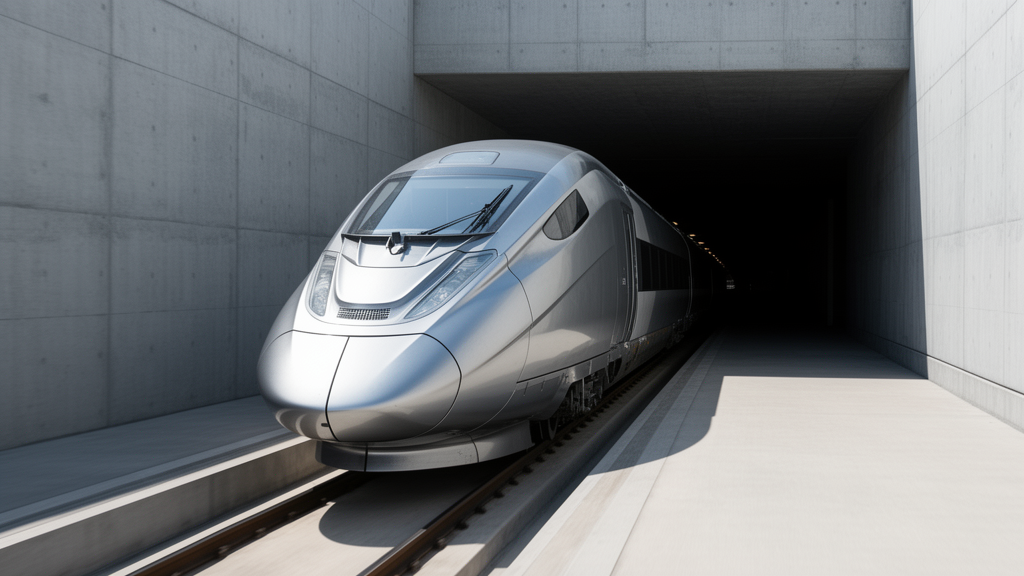
In a study published in the peer-reviewed journal Railway Engineering Science, researchers Beomsu Kim, Hyeokbin Kwon, and Junsun Ahn revealed that a multi-objective optimization scheme coupled with evolutionary algorithms successfully developed nose configurations that simultaneously outperform the current commercial KTX-Cheongryong baseline across all primary operational regimes. By parameterizing the train front with mathematical Bézier curves across localized structural section boxes and generating high-throughput compressible fluid dynamics datasets, the team established a Pareto-optimal design envelope. Their primary compromise configuration accomplished an 8.9 percent reduction in total trainset aerodynamic drag—governed by an extraordinary 22.9 percent decrease in tail car drag—while concurrently decreasing an entrance pressure wave proxy by 4.3 percent and suppressing crosswind-induced rolling moments by 3.6 percent under severe lateral winds, all while strictly adhering to international trackside safety margins.
The engineering challenge addressed by the research team stems from South Korea’s evolving railway infrastructure and the impending retirement of its original high-speed rolling stock. Having accumulated extensive operational fatigue, these original trainsets are approaching their mandated thirty-year design lifetime, requiring retirement around 2034. In preparation, national transportation planners have laid out infrastructure upgrades and rolling stock specifications targeting operating speeds exceeding 370 kilometers per hour. At sustained velocities reaching 400 kilometers per hour, aerodynamic forces escalate aggressively, as aerodynamic drag scales with the square of velocity while the explosive micro-pressure wave phenomena radiating from tunnel exits scale approximately with the cube of speed. Compounding the design challenge, geographical and meteorological conditions along South Korean corridors frequently subject trains to strong crosswinds, which dramatically alter near-body flow separation and threaten crosswind running safety.
Historically, aerodynamic optimizations for high-speed rail have operated in programmatic isolation, addressing singular flight regimes without accounting for counterproductive physical trade-offs. Tailoring a nose profile exclusively for open-air drag reduction often elongates and sharpens the forebody, which can alter cross-sectional area variation rates during high-speed tunnel entry and generate steep compression waves that propagate downstream as disruptive exit sonic booms. Conversely, designs optimized solely to diffuse tunnel micro-pressure waves frequently exhibit blunted contours that induce boundary layer separation and elevate surface drag when running in the open air. Furthermore, asymmetrical lateral loading caused by ambient crosswinds requires careful management of leeward pressure distributions to prevent vehicle overturning. Overcoming these entrenched design conflicts required the researchers to devise an automated, multi-objective computational methodology capable of exploring high-dimensional geometric spaces while maintaining realistic passenger cabin dimensions, structural clearance envelopes, and equipment housing mandates.
To establish a realistic optimization space, the investigators modeled the external geometry of the cutting-edge KTX-Cheongryong train, representing its nose surface through thirty-two spatial control and contact points governing cubic, quadratic, and linear Bézier curves. Rather than allowing unrestrained shape alterations that would violate railway operational constraints, the authors implemented a five-tier section box methodology. These modular boxes localized deformations to designated functional regions: Box 1 preserved roof clearance; Box 2 secured driver cab volume; Box 3 controlled the windshield curvature and driver sightline regulations; Box 4 maintained coupler machinery dimensions; and Box 5 guarded mandatory underbody bogie clearances. This parameterization maintained strict compliance with South Korean domestic loading gauges as well as international crashworthiness and sightline standards. High-fidelity verification against three-dimensional models of South Korea’s KTX, KTX-Sancheon, and experimental HEMU-430X confirmed that the simplified Bézier framework preserved baseline volumetric profiles within a negligible absolute error margin of 2.42 percent.
Evaluating hundreds of iterative geometric designs under realistic conditions necessitated a robust numerical simulation framework. The researchers employed OpenFOAM v2212 to solve three-dimensional compressible, steady Reynolds-averaged Navier-Stokes equations combined with an energy equation and an ideal gas state equation. Turbulent boundary layer effects and adverse pressure gradients were captured using the shear stress transport k-omega turbulence model, chosen for its proven accuracy in tracking separated boundary layers and shear zones around high-speed rail surfaces. Simulations utilized a standardized four-car train model spanning an overall length of 101.9 meters, with head and tail cars measuring 26.65 meters each and intermediate cars spanning 24.3 meters, maintaining a standardized height of 3.7 meters and a cross-sectional area of 10.9 square meters. For normal open-air runs, computational efficiency was doubled by deploying a symmetric half-domain containing approximately 4 million Cartesian-dominant cells, while crosswind scenarios employed full-domain grids containing roughly 8 million cells.
To eliminate the prohibitive computational expense of running unsteady, dynamic moving-mesh simulations of tunnel entry for hundreds of design candidates, the researchers adopted a validated stationary analytical proxy known as the wall-normal velocity integral theory. By projecting the steady open-air velocity field onto an imaginary tunnel boundary matching the 110.6-square-meter bore of the Gyeongbu rail tunnels, the team computed the maximum circumferential normal velocity integral. Prior aerodynamic theory demonstrated that this metric correlates directly with the initial compression wave gradient generated during actual portal entry. In parallel, crosswind vulnerability was quantified under a conservative lateral wind velocity of 40 meters per second blowing perpendicular to a train traveling at 400 kilometers per hour, yielding an effective aerodynamic yaw angle of approximately 20 degrees. The leeward rail rolling moment coefficient served as the comparative index for overturning vulnerability, while the trackside pressure variation was constrained to remain below a strict non-dimensional coefficient threshold equivalent to 700 Pascals at 250 kilometers per hour.
Building the optimization dataset began with optimal Latin hypercube sampling, which generated an initial exploratory population of 500 nose geometries within a twenty-five percent coordinate displacement boundary. After eliminating four cases that suffered numerical convergence failures, the team introduced forty-eight supplementary design candidates selected from preliminary multi-objective optimization runs, expanding the search envelope up to maximum local displacements of 72.56 percent. The resulting database of 544 fully resolved fluid dynamic simulations provided the foundational training and validation data for machine learning surrogate modeling. The team constructed non-parametric Gaussian process regression models utilizing Matérn 3/2 covariance kernels to interpolate the nonlinear relationships connecting the Bézier control coordinates to the target aerodynamic metrics. An independent, randomly sampled ten-percent holdout test set of fifty-four designs confirmed superior predictive reliability, yielding coefficients of determination of 0.8466 for tail car drag, 0.9967 for the tunnel wave proxy, and 0.9040 for the trackside pressure constraint.
Before executing the optimization search, the researchers conducted rigorous statistical correlation and global sensitivity assessments to expose the fundamental interactions among competing aerodynamic targets. Spearman rank correlation coefficients paired with conflict ratio calculations confirmed that tail car drag acts as an almost perfect surrogate for total train drag, exhibiting a correlation coefficient of 0.9951. To uncover the physical drivers of these trade-offs, the team performed a variance-based Sobol sensitivity analysis utilizing 8,192 scrambled quasi-Monte Carlo sample points. The total-order Sobol indices revealed that tail car drag and tunnel pressure waves are overwhelmingly governed by the lateral and vertical coordinates of the driver cab and windshield transition zones, whereas crosswind overturning moments depend on a far broader spatial distribution encompassing the nose tip, lower front skirt, and rooflines.
Armed with the validated surrogate models, the investigators deployed the non-dominated sorting genetic algorithm II across 5,000 convergence generations, utilizing a ten percent offspring generation rate and fifty percent crossover and mutation probabilities. The evolutionary search yielded a highly diverse Pareto front comprising 475 non-dominated geometric solutions, remarkably demonstrating that every single Pareto design dominated the baseline KTX-Cheongryong geometry across all three target objectives while meeting the regulatory trackside pressure limit. However, these single-target optima inflicted severe performance penalties on unoptimized metrics, confirming that single-focus optimization creates unacceptable operational compromises.
The centerpiece of the study emerged from the multi-objective Pareto front: a balanced compromise configuration that captured the majority of single-objective gains while suppressing cross-regime degradation. Direct computational fluid dynamic re-evaluation confirmed that this representative design achieved a 22.90 percent reduction in tail car drag, which translated directly into an 8.86 percent curtailment of total trainset running resistance. Simultaneously, the compromise nose decreased the tunnel micro-pressure wave proxy by 4.28 percent and reduced the leeward rail rolling moment coefficient by 3.62 percent, all while maintaining a trackside pressure variation coefficient of 0.2318, comfortably within the mandated 0.237 safety ceiling.
In-depth flow-field analyses illuminated the precise fluid physical mechanisms responsible for the superior multi-objective performance. Under open-air conditions, the optimized tail car geometry substantially weakened boundary layer separation along the trailing cabin roof and side shoulders, transforming abrupt pressure drops into a gradual, stable pressure recovery region along the non-dimensional nose length and cutting peak cumulative pressure drag accumulation by more than 41 percent. In the tunnel simulation domain, the refined lateral curvature around the cab transition suppressed the spanwise expansion of high-speed slipstream sheets, shrinking the spatial footprint of intense wall-normal velocities on the imaginary tunnel perimeter down to 75 percent of the baseline area. Under severe crosswinds, the re-sculpted windshield profile modulated roof and shoulder separation vortices, shifting leeward suction cores downward and driving the effective moment arm inward by 9.07 percent, thereby substantially attenuating the mechanical overturning leverage exerted on the trainbody.
While the study demonstrates a significant advance in surrogate-assisted aerodynamic design, the authors acknowledged important methodological boundaries that define avenues for subsequent investigation. Because the large-scale sample generation relied on steady-state Reynolds-averaged Navier-Stokes equations, instantaneous turbulent wake vortex shedding and transient aeroacoustic phenomena were not resolved in time. Furthermore, the train geometry utilized simplified underbody fairings that excluded detailed rotating wheelsets, suspension brackets, and bogie cavities to isolate the aerodynamic influence of the outer nose shell.
Subject of Research: Aerodynamic multi-objective nose shape optimization for 400 km/h high-speed trains across open-air, crosswind, and tunnel environments
Article Title: Surrogate-based multi-objective nose shape optimization for 400 km/h-class high-speed trains under open-air, crosswind, and tunnel operations
Article References: Kim, B., Kwon, H., & Ahn, J. (2026). Surrogate-based multi-objective nose shape optimization for 400 km/h-class high-speed trains under open-air, crosswind, and tunnel operations. Railway Engineering Science. https://doi.org/10.1007/s40534-026-00449-0
Image Credits: AI Generated
DOI: 10.1007/s40534-026-00449-0
Keywords: High-speed trains, Aerodynamic optimization, Surrogate modeling, Gaussian process regression, NSGA-II, KTX-Cheongryong, Micro-pressure waves, Crosswind stability, Tail car drag, Computational fluid dynamics, Reynolds-averaged Navier-Stokes, Railway engineering, OpenFOAM, Bézier curves, Sobol sensitivity analysis, Trackside pressure variation, Tunnel aerodynamics
News Source: Denise Maddox. (November 23, 2026). Optimized Nose Shape Cuts High-Speed Train Drag and Tunnel Waves. Scienmag.