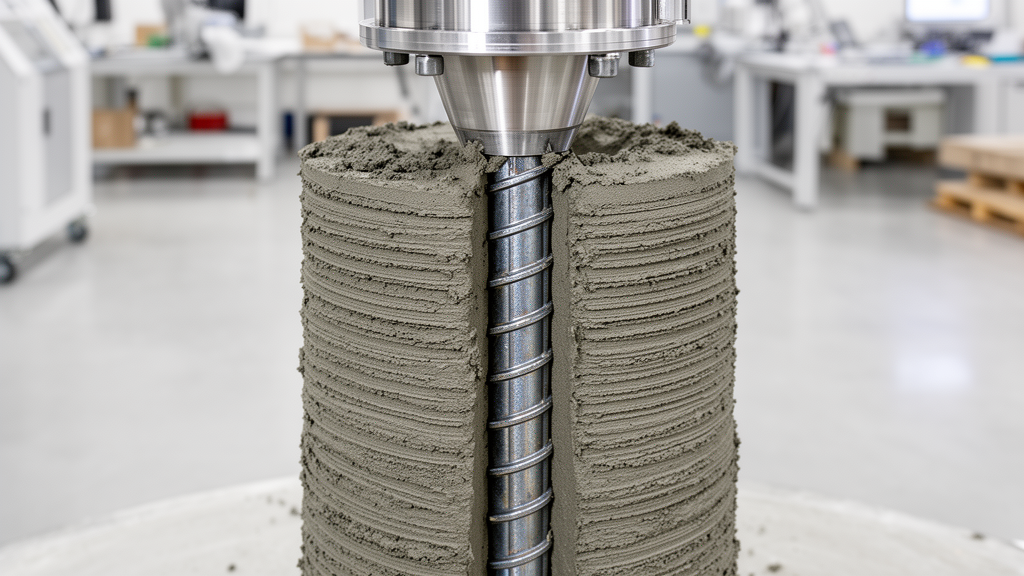
An interpretable machine learning model utilizing the Extreme Gradient Boosting algorithm and optimized with a Bayesian Tree Parzen Estimator achieved a testing mean absolute error of 1.46 megapascals and a root mean square error of 1.7 megapascals in predicting reinforcement bond strength for three-dimensional concrete printing. According to the research investigation, the resulting Bayesian Tree Parzen Estimator Extreme Gradient Boosting model marginally outperformed an alternative model developed using Taguchi optimization techniques. The performance metrics were validated through k-fold cross-validation across a comprehensive dataset of 607 experimental pull-out test results gathered from published literature, confirming stable generalization capabilities for the computational framework.
The authors established that the reliable prediction of reinforcement bond strength in three-dimensional concrete printing represents a critical operational challenge for the field. This difficulty arises because printed concrete components are subject to material anisotropy, geometric variability, and complex interfacial mechanisms that govern internal stress transfer. Conventional experimental approaches designed to evaluate these interfacial bonding properties are inherently resource intensive. Furthermore, the researchers observed that prior predictive studies in the published literature remained notably limited in their optimization rigor, their mechanical validation, and their interpretability.
To directly address the limitations found in existing literature, the study introduced an integrated and interpretable machine learning framework built upon the Extreme Gradient Boosting algorithm. The investigative team implemented two distinct optimization methodologies to tune the algorithmic framework, specifically utilizing the Bayesian Tree Parzen Estimator alongside Taguchi optimization techniques. For model training and subsequent validation, the researchers assembled a comprehensive experimental database compiling 607 pull-out test measurements retrieved from previously published studies. The application of k-fold cross-validation established that the trained models maintained stable generalization performance across the compiled test database.
In addition to statistical evaluation on the historical database, the researchers conducted mechanical validation on unseen data configurations using finite element modeling. This phase of the investigation demonstrated that the trained Extreme Gradient Boosting models achieved superior predictive accuracy when compared directly to nonlinear finite element simulations. The accompanying finite element analysis successfully reproduced the rib-induced stress transfer mechanisms that develop within the composite material during pull-out, capturing peak concrete stresses that reached 38.58 megapascals at the moment of pull-out and confirming the mechanical consistency of the modeled behavior.
These interpretability assessments determined that reinforcement diameter and embedment length serve as the primary governing parameters that determine bond strength in reinforced three-dimensional concrete printing.
The authors concluded that the integrated framework establishes a computationally efficient and mechanically consistent tool for reinforcement bond strength prediction in reinforced three-dimensional concrete printing. By combining Extreme Gradient Boosting with Bayesian optimization, mechanical verification through finite element analysis, and parameter interpretability, the study delivers an analytical system intended to support the practical implementation of reinforced three-dimensional concrete printing while overcoming the resource-intensive requirements associated with conventional experimental testing methods.
Subject of Research: Machine learning prediction of reinforcement bond strength in three-dimensional printed concrete
Article Title: Determining reinforcement bond strength in 3D printed concrete using machine learning with bayesian optimisation and numerical modelling
Article References: Iqbal, I., Inqiad, W. B., Kasim, T., Besklubova, S., Halim, I., & Rahman, M. (2026). Determining reinforcement bond strength in 3D printed concrete using machine learning with bayesian optimisation and numerical modelling. Discover Materials. https://doi.org/10.1007/s43939-026-00952-5
Image Credits: AI Generated
DOI: 10.1007/s43939-026-00952-5
Keywords: 3D concrete printing, reinforcement bond strength, Extreme Gradient Boosting, Bayesian optimisation, Tree Parzen Estimator, Taguchi optimisation, pull-out tests, finite element modelling, material anisotropy, interfacial stress transfer, embedment length, reinforcement diameter, nonlinear finite element simulations, k-fold cross-validation, concrete bond strength, structural concrete
News Source: Teresa Odom. (November 11, 2026). Optimized Machine Learning Accurately Predicts Reinforcement Bond Strength in 3D-Printed Concrete. Scienmag.