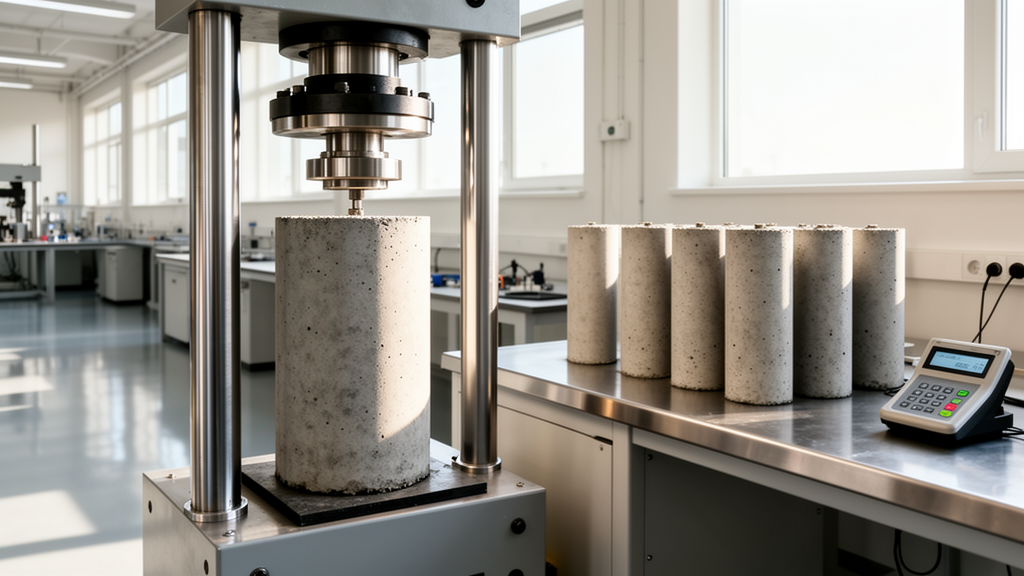
The study evaluated different ensemble regressors, specifically the extra trees regressor (ETR) and extreme gradient boosting regressor (XGBR), optimized by a variety of metaheuristic algorithms, including the Lyrebird optimization algorithm (LOA), human evolutionary optimization algorithm (HEOA), particle swarm optimization (PSO), and genetic algorithm (GA). By adopting a rigorous, leakage-free train-validation-test evaluation framework across five different random data seeds, the researchers identified that the XGBR+PSO model achieved the highest predictive performance, with an R2 value of 0.9486 ± 0.0182 and a root mean squared error (RMSE) of 3.7756 ± 0.6602 MPa.
Concrete compressive strength remains a cornerstone property for determining the functional reliability and constructability of structures. Traditionally, assessing this strength requires lengthy and economically taxing laboratory procedures, which can hinder immediate decision-making in active construction sites. Machine learning techniques have emerged as a high-potential solution to streamline quality control and mix design by utilizing available historical data on concrete mixture parameters—such as the amount of cement, fly ash, water, and various aggregates—and curing age to predict performance.
To evaluate these predictive capabilities, the research team utilized the widely recognized UCI Concrete Compressive Strength dataset, which encompasses 1030 laboratory-tested mixtures. The dataset provides quantitative data on eight input variables: cement, blast furnace slag, fly ash, water, superplasticizer, coarse aggregate, fine aggregate, and curing age.
The methodological framework for this study was designed to prioritize predictive reliability and robustness by implementing a strictly controlled repeated holdout validation protocol. The data were partitioned into training, validation, and testing sets at a ratio of 70:15:15. Importantly, the training set was used to fit the models, the validation set was utilized to guide the optimizer in hyperparameter selection, and the independent test set was exclusively reserved for final performance evaluation. This partitioning procedure was repeated five times with different random seeds—1, 7, 21, 42, and 100—to ensure that the reported metrics were not dependent on a single arbitrary data split. This leakage-free paradigm helps address concerns regarding experimental validity that have appeared in previous studies that relied on single-split or potentially contaminated validation methodologies.
The experimental results demonstrated that models based on the extreme gradient boosting regressor (XGBR) generally outperformed the extra trees regressor (ETR) based models across all metrics. Following the optimization of hyperparameters, the XGBR+PSO model provided the most accurate predictions. Among the newer metaheuristic approaches investigated, the XGBR+HEOA model proved highly effective, achieving an R2 of 0.9483 ± 0.0174 and an RMSE of 3.7928 ± 0.6860 MPa. The study confirms that the integration of metaheuristic optimization can indeed increase the accuracy of baseline machine learning models, but the degree of improvement remains intrinsically linked to the synergy between the chosen optimizer and the base learner employed.
When comparing the two base learners, the research revealed a clear disparity in their response to optimization. All optimized versions of the XGBR model achieved predictive performance metrics superior to the baseline XGBR model. Conversely, the ETR model did not consistently benefit from metaheuristic optimization. For instance, while ETR+HEOA showed a marginal improvement over the baseline, the ETR+LOA model actually exhibited worse performance. This suggests that the successful application of metaheuristics is not automatic and depends heavily on the specific hyperparameters and the structural characteristics of the base learner, emphasizing that the selection process must be carefully validated rather than assumed to be universally beneficial.
To complement the predictive modeling, the researchers performed a sensitivity analysis using one-way ANOVA to identify which input variables exert the strongest influence on the compressive strength of the concrete. Although all eight input variables showed statistical significance at the p < 0.05 level, the magnitude of their effect, as measured by the eta-squared coefficient, varied considerably. Age and cement content were identified as the most influential factors, showing the highest effect sizes. Superplasticizer dosage and water content followed in importance, while fly ash and aggregate-related variables had a comparatively minor impact.
Residual error analysis provided further qualitative validation of the models’ stability. For the XGBR-based models, the residual distributions were tightly concentrated around the zero-error line, particularly for the optimized variants. This indicates a high level of concordance between measured laboratory results and the predicted strength values. The ETR models, however, displayed a wider residual spread and occasional large outliers, especially for medium- to high-strength mixtures. While the optimized XGBR models display great potential, the presence of these deviations highlights that these models currently function best as decision support tools rather than as flawless substitutes for standard experimental verifications.
Despite the high predictive accuracy achieved, the study acknowledges several limitations inherent in the dataset and current modeling approaches. The UCI repository dataset lacks specific details on environmental factors such as curing temperature and humidity, which are known to significantly impact the ultimate strength of concrete. Furthermore, the dataset does not provide record-level information on specimen geometry, loading rates, or the specific standardized tests used, such as ASTM C39 or EN 12390-3. These missing pieces of metadata limit the ability of the models to account for all variables involved in real-world concrete performance, suggesting that future studies should aim to integrate more comprehensive field-collected data.
The study also compared its findings with recent academic literature, noting that the reported performance metrics for optimized XGBR models are competitive with or superior to other sophisticated models, such as those employing explainable boosting machines. The results further reinforce the broader trend in materials science research: AI-driven ensemble learning models, when optimized with appropriate metaheuristic algorithms, are becoming increasingly effective at navigating the complex, non-linear relationships characteristic of cement-based materials. As the field advances, integrating fundamental physics and chemistry with these high-performing machine learning tools may be the next step toward achieving even more realistic and robust predictive systems for the construction industry.
Ultimately, these findings reinforce the value of high-precision computational modeling in the design and quality control of modern concrete structures. By demonstrating that metaheuristic optimization, when correctly controlled, provides quantifiable improvements in accuracy, the study offers a clear direction for further research into machine learning for material engineering. However, the researchers emphasize that experimental validation remains indispensable, particularly for projects where structural safety is the highest priority. Moving forward, the development of models that explicitly include humidity and temperature as inputs could further enhance the applicability of these tools in diverse, real-world construction environments.
The optimization framework maintained uniform computational settings, utilizing a population size of 20 candidate hyperparameter vectors over 200 iterations to minimize validation root mean squared error. Search spaces were tailored to each model class. For the extreme gradient boosting regressor, algorithms tuned the number of estimators, maximum tree depth, learning rate, subsample ratio, and feature subsampling rate per tree. Conversely, the learning rate was omitted from the extra trees regressor because it averages randomized unpruned trees rather than boosting sequential residuals. Under the human evolutionary optimization algorithm, candidate vectors evolved through crossover between parent solutions followed by Gaussian mutation, using a 0.20 mutation probability and perturbation standard deviation equal to 10 percent of the parameter search range.
Detailed evaluations revealed substantial differences between baseline benchmarks and optimized configurations across the independent testing sets. Unoptimized baseline models recorded test R2 values of 0.9391 with an RMSE of 4.1169 MPa for gradient boosting, compared to 0.9281 and 4.4689 MPa for the extra trees regressor. Separate five-fold cross-validation confirmed this baseline hierarchy, yielding an average cross-validated R2 of 0.9326 for gradient boosting against 0.9243 for extra trees. Beyond the top-ranked model, pairing gradient boosting with the Lyrebird optimization algorithm achieved an R2 of 0.9478 and an RMSE of 3.8179 MPa. Conversely, applying the Lyrebird optimizer to the extra trees regressor reduced performance below its baseline, yielding an R2 of 0.9193 and an RMSE of 4.7436 MPa.
Statistical examination of the underlying benchmark data highlighted structural variations across the 1030 laboratory mixtures. Concrete compressive strength ranged from 2.33 to 82.60 MPa, while curing age spanned 1 to 365 days. Pairwise linear assessments showed that cement content exhibited the strongest positive correlation with strength, followed by superplasticizer dosage at 0.37, whereas water content displayed a moderate negative correlation of negative 0.29. Analysis of variance demonstrated that curing age exerted the largest effect size with an eta squared of 0.3307, followed by cement at 0.2528, superplasticizer at 0.1834, and water at 0.1539, whereas fly ash recorded the lowest effect size at 0.0156.
Subject of Research: Comparison and optimization of machine learning models for concrete compressive strength prediction.
Article Title: Prediction of Concrete Compressive Strength Using Ensemble Machine Learning Models Optimized by Lyrebird Optimization Algorithm and Human Evolutionary Optimization Algorithm
Article References: Luan, C., Zhang, X., Zhou, S., Guo, R., Ding, Y., & Zhao, X. (2026). Prediction of Concrete Compressive Strength Using Ensemble Machine Learning Models Optimized by Lyrebird Optimization Algorithm and Human Evolutionary Optimization Algorithm. International Journal of Concrete Structures and Materials, 20(1), Article 98. https://doi.org/10.1186/s40069-026-00973-7
Image Credits: AI Generated
DOI: 10.1186/s40069-026-00973-7
Keywords: machine learning, concrete, compressive strength, XGBoost, Extra Trees, metaheuristic optimization, Lyrebird algorithm, HEOA, PSO, genetic algorithm, structural engineering, predictive modeling, UCI dataset, data-driven construction, statistical analysis, sensitivity analysis, ANOVA, ensemble learning
News Source: Denise Maddox. (November 18, 2026). Optimized Gradient Boosting Models Predict Concrete Compressive Strength with High Accuracy. Scienmag.