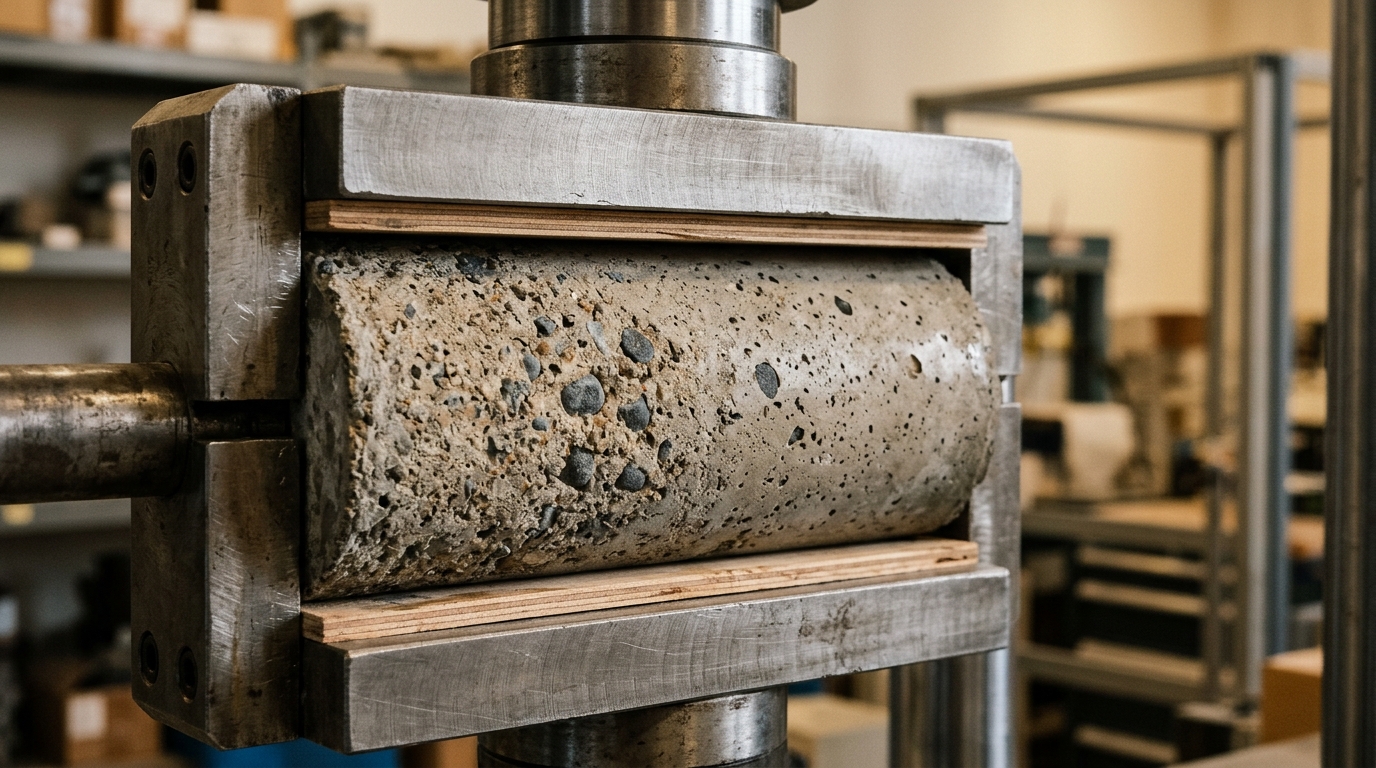
Researchers have developed an explainable machine-learning framework using optimized Gaussian process regression to predict the splitting tensile strength of concrete incorporating supplementary cementitious materials. The study focused on materials commonly utilized to lower reliance on conventional Portland cement by modeling tensile performance directly from mixture proportions.
The analysis evaluated a dataset of 395 valid concrete mixtures compiled from a global supplementary cementitious materials database. Eight specific mixture components were selected as model predictors: cement, water, coarse aggregate, fine aggregate, fly ash, silica fume, ground granulated blast-furnace slag, and superplasticizer.
To evaluate predictor relevance across the dataset, the researchers applied maximum relevance minimum redundancy, F-test, RReliefF, and Random Forest feature importance methods. A wide selection of regression algorithms was subsequently tested in the MATLAB Regression Learner environment using five-fold cross-validation, where Rational Quadratic Gaussian Process Regression demonstrated the best baseline performance.
The baseline Rational Quadratic model recorded a root mean square error of 0.51 MPa, a mean absolute error of 0.34 MPa, a mean absolute percentage error of 10.02 percent, and a coefficient of determination of 0.85. Investigators then explored model optimization using Bayesian optimization, random search, and grid search techniques. While all three optimization methods yielded comparable predictive accuracy, Bayesian optimization was selected for the final architecture because it required the shortest training time.
The resulting Bayesian-optimized Gaussian process regression model attained a root mean square error of 0.41898 MPa, a mean squared error of 0.17554 MPa², a mean absolute error of 0.29095 MPa, a mean absolute percentage error of 8.9 percent, and a coefficient of determination of 0.89. Compared with the baseline model, these metrics reflected a 17.85 percent decrease in root mean square error and a 32.48 percent decrease in mean squared error.
Model interpretability was assessed through partial dependence plots and SHAP analysis, which identified water and cement as the dominant predictors of tensile strength. Within the model predictions, higher water content was generally associated with lower splitting tensile strength, whereas higher cement content was associated with higher strength. The authors noted that the predictive performance of this data-driven framework is bounded by the specific range of mixtures represented in the analyzed dataset.
Subject of Research: Machine learning prediction of concrete splitting tensile strength
Article Title: Explainable machine learning for predicting the splitting tensile strength of SCM-blended concrete using optimized Gaussian process regression
Article References: Alnaqbi, A., Salim, A. M., Al-Zu’bi, M., Elnaml, I., Alotaibi, A., & Youssef, A. M. (2026). Explainable machine learning for predicting the splitting tensile strength of SCM-blended concrete using optimized Gaussian process regression. Discover Materials. https://doi.org/10.1007/s43939-026-01074-8
Image Credits: AI Generated
DOI: 10.1007/s43939-026-01074-8
Keywords: machine learning, Gaussian process regression, concrete strength, supplementary cementitious materials, splitting tensile strength, Bayesian optimization, explainable artificial intelligence, SHAP analysis, Explainable, machine, learning, predicting
News Source: Blake Davidson. (November 6, 2026). Optimized Gaussian Process Regression Predicts Splitting Tensile Strength of Blended Concrete. Scienmag.