


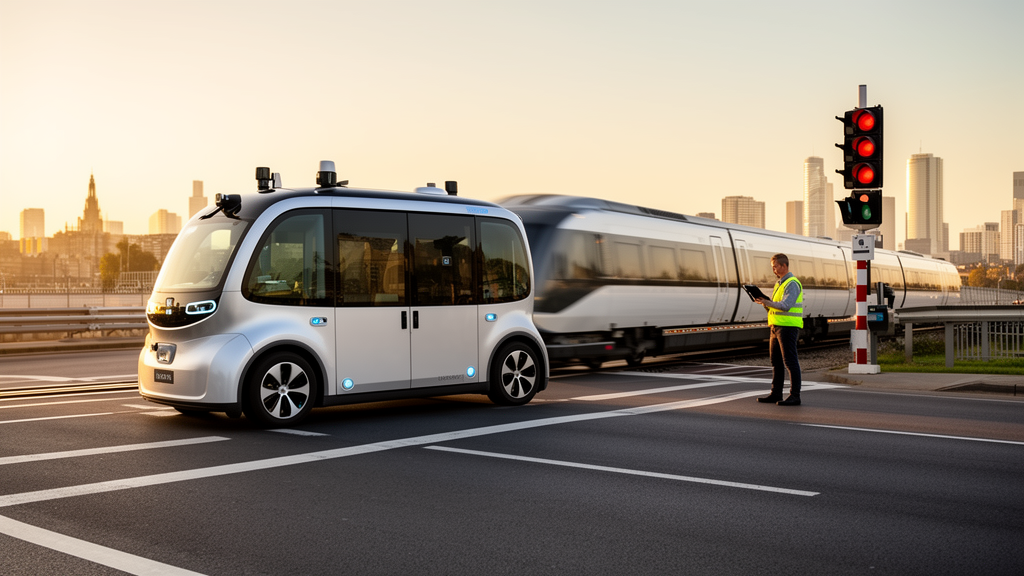
Level crossings have always obeyed a simple and unforgiving rule: the train wins. That rule exists for good reason, because a conventional train travelling at 90 km/h needs roughly 800 metres to come to a stop, so road traffic must always yield. But a new study argues that this rigid hierarchy breaks down when the rail vehicle in question is not a heavy locomotive at all, but a lightweight autonomous shuttle that can brake in a fraction of that distance and arrives whenever passengers request a ride rather than according to a fixed timetable. The research, published in European Transport Research Review, presents an optimization framework that dynamically decides which mode gets the crossing at any given moment, and its simulations show that both rail and road users can come out ahead.
The vehicle at the heart of the work is the Ferromobile, an autonomous public transport service designed to run on existing railways, including disused rural lines in France that the project aims to reactivate. Unlike a conventional train, a Ferromobile is comparable in size and mass to a Peugeot Expert van, travels at up to 90 km/h on the tracks, and has a stopping distance ten times shorter than a conventional train. It can operate either on fixed schedules or as demand-responsive transport, in which vehicles are dispatched in response to passenger requests. That flexibility is the whole point of the service, but it also creates a traffic management problem that traditional railway signalling was never designed to solve.
When arrivals are irregular, systematically granting rail absolute priority becomes costly and even dangerous. Successive or closely spaced shuttle crossings can keep a level crossing closed for extended or repeated periods, producing road congestion and unsafe driver behaviour as motorists grow impatient with barriers that seem to fall without warning. The authors therefore propose redefining priority rules between rail and road traffic, something conventional railway practice forbids. Because the shuttle’s short braking distance and limited mass make conditional priority physically feasible, the question becomes how to allocate crossing slots in real time so that rail delays stay small while road disruption is minimized.
The proposed framework works over a moving time window. As a shuttle approaches a crossing, it passes through a perception zone where the system detects it, then an activation zone where all shuttles detected simultaneously broadcast their identity, position, speed and current delay to a local controller, and finally an application zone where they adjust speed to hit their assigned crossing times. The controller computes a safe desired access time for each vehicle, enforcing a minimum safety gap of two seconds between successive shuttle passages to prevent collisions, and constrains speeds between defined maxima and minima to avoid derailment. Each shuttle’s delay is capped at a maximum authorized value of 15 seconds, beyond which no additional delay may be imposed.
The objective function blends two competing goals with a weighting coefficient: minimizing the total absolute delay of the perceived shuttles, and minimizing the total time lost by road vehicles during the evaluation period. To model the road term, the authors developed two formulations. The first, called the Complete Queue Clearance Model (CQCM), assumes the road queue is empty at the start of each red phase, which keeps the mathematics convex and yields a mixed-integer quadratic program that standard solvers handle efficiently. The second, the Partial Queue Clearance Model (PQCM), drops that simplifying assumption and tracks realistic queue dynamics at the beginning and end of each signal cycle, splitting the congestion cost into red and green components plus a final dissipation term the authors call a ghost phase. That realism comes at a price: bilinear terms between decision variables make the problem a non-convex mixed-integer quadratic program that is harder to solve.
Both models were implemented on the Pyomo modeling platform and solved with the Gurobi academic solver, then tested in simulation against two baselines: a mono-phase configuration representing traditional absolute rail priority, and a grouping heuristic that clusters shuttles into phases using their actual detected times. Simulations covered fleets of 5, 10 and 15 shuttles, with four random initial conditions per scenario in which shuttle speeds, positions and delays at entry were randomized, and no fixed interval was imposed between arrivals, consistent with demand-responsive operation. The same datasets were fed to every model to keep the comparison fair.
The results show a clear division of labour between the two formulations. CQCM achieved lower total absolute shuttle delays as fleet size grew: for 10 and 15 shuttles it produced mean delays of 72.924 plus or minus 3.909 seconds and 100.343 plus or minus 42.415 seconds, against 79.952 plus or minus 25.103 seconds and 110.663 plus or minus 41.632 seconds for PQCM. With only five shuttles the two models were comparable, and PQCM actually posted a slightly lower mean delay of 36.579 seconds versus 38.780 seconds, though with greater variability across seeds. The authors attribute CQCM’s rail advantage to the absence of explicit road queue constraints, which effectively gives rail more weight. In the largest configurations, CQCM reduced shuttle delays by up to 766 seconds relative to the baselines.
On the road side, the picture reverses. Both optimization models significantly reduced road waiting times compared with the two baselines, and PQCM consistently outperformed CQCM on traffic metrics. The additional road waiting time savings of PQCM over CQCM, relative to the absolute-priority reference, amounted to 2.448 seconds, 27.366 seconds and 7.193 seconds for the 5, 10 and 15 shuttle scenarios respectively, with similar margins over the grouping heuristic. PQCM also produced lower cumulative congestion areas, an aggregate measure of queue volume over time. In one representative ten-shuttle scenario, the CQCM solution allowed the road queue to reach about 24 vehicles by the end of a red phase, whereas PQCM’s intermediate green phases held the queue to roughly 12 vehicles, illustrating how partial releases of road traffic curb queue growth and speed dissipation.
Computational performance supports real-time use. On an ordinary laptop with an Intel Core i5-8250U processor and 16 GB of RAM, both models solved in a fraction of a second even in the most complex cases, with execution times remaining low as the number of shuttles increased. The authors also calibrated the priority weighting coefficient rather than fixing it arbitrarily. Running simulations across demand levels from 0.1 to 0.5 vehicles per second and fleet sizes of 5, 10 and 15, they identified the optimal weight at each operating point and fitted third-degree polynomials that let the weighting update automatically as traffic demand changes. Notably, all three fitted curves fell within a narrow band from 0.914 to 0.981, consistently favouring rail. The authors caution that these high values partly reflect the different numerical scales of the two objective terms, and that a different normalization method, such as min-max instead of the percentile-based approach used, could shift the calibrated range.
The study remains a simulation exercise, and the authors are explicit about its limits. The framework should next be validated through microscopic simulation and field experiments on pilot lines to confirm assumptions about vehicle dynamics and communication latency, an additional control stage could translate the optimized time slots into physically realistic shuttle trajectories, and extending the evaluation to a corridor of successive level crossings would reveal cumulative effects on commercial travel times. Still, the core message stands on the evidence presented: when the rail vehicle can stop like a van rather than a freight train, and arrives on demand rather than on schedule, a jointly optimized, conditional allocation of crossing priority can beat both absolute rail priority and simple grouping heuristics, reducing shuttle delays and road waiting times at the same time.
Subject of Research: Optimization of level crossing traffic management for on-demand autonomous light rail shuttles
Article Title: Level crossing traffic management for an innovative on-demand public transport rail system
Article References: Brahim, R., Laharotte, P.-A., Touzout, F., Bon, P., Collart-Dutilleul, S., & Faouzi, N.-E. E. (2026). Level crossing traffic management for an innovative on-demand public transport rail system. European Transport Research Review, 18(1), Article 89. https://doi.org/10.1186/s12544-026-00847-9
Image Credits: AI Generated
DOI: 10.1186/s12544-026-00847-9
Keywords: level crossings, Ferromobile, demand-responsive transport, autonomous rail shuttles, traffic optimization, mixed-integer quadratic programming, rail-road priority, queue dynamics, Pyomo, rural railways, V2X communication, traffic simulation
News Source: Denise Maddox. (October 29, 2026). Optimization Model Rebalances Rail and Road Priority at Level Crossings for On-Demand Autonomous Shuttles. Scienmag.



