WASHINGTON, February 7, 2023 – A group of researchers recently modeled the transmission of COVID-19 within an isolation room at the Royal Brompton Hospital in London, U.K. Their goal was to explore the optimal room layout to reduce the risk of infection for health care staff.
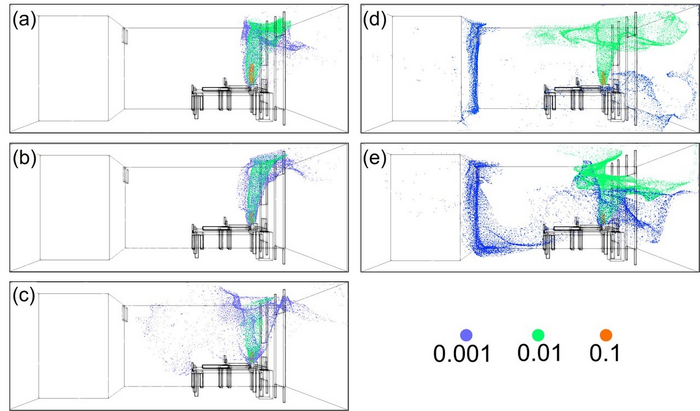
Credit: Xiaofei Wu, Hisham Abubakar-Waziri, Fangxin Fang, Claire Dilliway, Pin Wu, Jinxi Li, Runming Yao, Pankaj Bhavsar, Prashant Kumar, Christopher C. Pain, and Kian Fan Chung
WASHINGTON, February 7, 2023 – A group of researchers recently modeled the transmission of COVID-19 within an isolation room at the Royal Brompton Hospital in London, U.K. Their goal was to explore the optimal room layout to reduce the risk of infection for health care staff.
To accomplish this, they used an adaptive mesh finite-element computational fluid dynamics model to simulate 3D spatial distribution of the virus within the room — based on data collected from the room during a COVID-19 patient’s stay.
In Physics of Fluids, from AIP Publishing, Wu et al. share their findings and guidance for isolation rooms. Their work centers on the location of the room’s air extractor (air outlet) and filtration rates, the location of the patient’s bed, and the health and safety of the hospital staff working within the area.
“We modeled the virus transport and spreading processes and considered the effect of the temperature and humidity on the virus decay,” said Fangxin Fang, of Imperial College London. “We also modeled fluid and turbulence dynamics in our study, and explored the spatial distribution of virus, velocity field, and humidity under different air exchange rates and extractor locations.”
They discovered that the area of highest risk of infection is above a patient’s bed at a height of 0.7 to 2 meters, where the highest concentration of COVID-19 virus is found. After the virus is expelled from a patient’s mouth, it gets driven vertically by buoyancy and wind forces within the room.
Based on the group’s findings, the optimal layout for an isolation room to minimize infection risk is to use a ceiling extractor with an air exchange rate of 10 air changes per hour. The study focused on an isolation room within a hospital and its numerical results are limited due to the omission of droplet evaporation and particle matters, the researchers point out.
Now, the group plans to include evaporation and particle processes in models of a standard hospital patient room, intensive care unit, and waiting room.
“Further work will also focus on artificial intelligence-based surrogate modeling for rapid simulations, uncertainty analysis, and optimal control of ventilation systems as well as efficient energy use,” said Fang.
###
The article “Modeling for understanding of Coronavirus Disease-2019 (COVID-19) spread and design of an isolation room in a hospital” is authored by Xiaofei Wu, Hisham Abubakar-Waziri, Fangxin Fang, Claire Dilliway, Pin Wu, Jinxi Li, Runming Yao, Pankaj Bhavsar, Prashant Kumar, Christopher C. Pain, and Kian Fan Chung. It will appear in Physics of Fluids on Feb. 7, 2023 (DOI: 10.1063/5.0135247). After that date, it can be accessed at https://aip.scitation.org/doi/10.1063/5.0135247.
ABOUT THE JOURNAL
Physics of Fluids is devoted to the publication of original theoretical, computational, and experimental contributions to the dynamics of gases, liquids, and complex fluids. See https://aip.scitation.org/journal/phf.
###
Journal
Physics of Fluids
DOI
10.1063/5.0135247
Article Title
Modeling for understanding of Coronavirus Disease-2019 (COVID-19) spread and design of an isolation room in a hospital
Article Publication Date
7-Feb-2023