• HOME
  • NEWS
  • EXPLORE
    • CAREER
      • Companies
      • Jobs
    • EVENTS
    • iGEM
      • News
      • Team
    • PHOTOS
    • VIDEO
    • WIKI
  • BLOG
  • COMMUNITY
    • FACEBOOK
    • INSTAGRAM
    • TWITTER
Saturday, August 22, 2026
BIOENGINEER.ORG
No Result
View All Result
  • Login
  • HOME
  • NEWS
  • EXPLORE
    • CAREER
      • Companies
      • Jobs
        • Lecturer
        • PhD Studentship
        • Postdoc
        • Research Assistant
    • EVENTS
    • iGEM
      • News
      • Team
    • PHOTOS
    • VIDEO
    • WIKI
  • BLOG
  • COMMUNITY
    • FACEBOOK
    • INSTAGRAM
    • TWITTER
  • HOME
  • NEWS
  • EXPLORE
    • CAREER
      • Companies
      • Jobs
        • Lecturer
        • PhD Studentship
        • Postdoc
        • Research Assistant
    • EVENTS
    • iGEM
      • News
      • Team
    • PHOTOS
    • VIDEO
    • WIKI
  • BLOG
  • COMMUNITY
    • FACEBOOK
    • INSTAGRAM
    • TWITTER
No Result
View All Result
Bioengineer.org
No Result
View All Result
Home NEWS Science News Chemistry

Optical security: Tunable-resonator upconverted emission color printing

Bioengineer by Bioengineer
May 13, 2019
in Chemistry
Reading Time: 2 mins read
0
IMAGE
Share on FacebookShare on TwitterShare on LinkedinShare on RedditShare on Telegram

IMAGE

Credit: SUTD

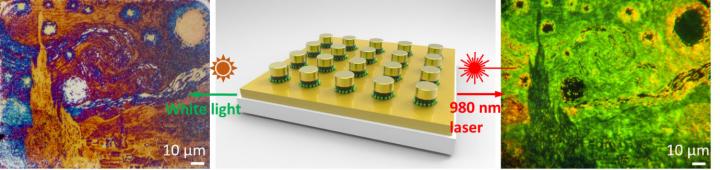
Viewing bank notes under ultraviolet or infra-red light is a common check for counterfeits. Doing so causes invisible inks to glow visibly and is one of the most tried and tested tricks in optical document security. Microprint is another technique used as an anti-counterfeiting tool. As the name suggests, microprints hide information on documents because they are too small for the eye to see. However, microprints and invisible inks often only exhibit a single color and are separate elements. Scientists from the Singapore University of Technology and Design (SUTD) have recently reported a plasmonic upconversion optical security device, which displays an ultrahigh resolution color print under white light while revealing different upconversion luminescent information under infrared illumination. The presented optical security devices have potential applications in deterring counterfeiting of important documents and packages of high-value medicines.

Principal researcher, SUTD Associate Professor Joel Yang, calls it “TRUE color printing”, where “TRUE” stands for “Tunable-Resonator Upconverted Emission”. A monolayer of upconversion nanophosphors (NaGdF4:Yb) were self-assembled within a 15 nm gap between aluminum disks and a continuous aluminum film. The strong electromagnetic fields confined within the metal-insulator-metal gap increases the brightness and of the nanophosphor emitters by two orders of magnitude. Interestingly, in this TRUE color printing, a range of luminescent colors were achieved with one type of upconversion nanophosphors under a single excitation source. Usually, doping with different lanthanide elements or employing multiple excitation lasers are required to achieve multiple luminescent colors. Instead, the interaction between these nanophosphors and their local environment causes them to shine with different colors.

Current optical security devices are mostly one dimensional and only display a set of encrypted information. While in TRUE color printing, both amplitude of the white light and upconversion luminescence are simultaneously employed to encode the information. It is recently well known that different sizes of plasmonic resonators reflect different colors under white light. Meanwhile, they will activate different energy transfer channels of upconversion nanophosphors under laser excitation, emitting different luminescent colors. Therefore, the white light colors and luminescent colors were both employed to design the optical security devices, which display a colored butterfly while revealing a luminescent butterfly. To increase the level of secrecy, upconversion emitters are precisely incorporated in specific positions, while leaving other places non-luminescent. A visible colorful butterfly was displayed under white light while a football and some English letters “UCNP” was recovered with laser illumination. The different display information under white light and laser source make TRUE color printing widely applicable in anti-counterfeiting such as passport, banknotes, and ID cards.

###

This study was recently published on Advanced Materials and was selected as the inside cover.

Media Contact
Melissa Koh
[email protected]

Related Journal Article

http://dx.doi.org/10.1002/adma.201807900

Tags: Chemistry/Physics/Materials SciencesElectrical Engineering/ElectronicsMaterialsOpticsResearch/DevelopmentTechnology/Engineering/Computer Science
Share14Tweet8Share2ShareShareShare2

Related Posts

Scientists uncover design rules for high-performance thermoelectric materials

Scientists uncover design rules for high-performance thermoelectric materials

August 22, 2026
Bringing Optical Fibre Materials to Photonic Chips

Bringing Optical Fibre Materials to Photonic Chips

August 22, 2026

Nanoscience and Liquid Crystals Unite in Functional Hybrids With Transformative Applications

August 22, 2026

Designing Better Biomedical Hydrogels Through Molecular Building Blocks and Hierarchical Structures

August 22, 2026
Please login to join discussion

POPULAR NEWS

  • Real-world study examines psychotic complications of subcutaneous foslevodopa/foscarbidopa infusions in 198 patients

    29 shares
    Share 12 Tweet 7
  • Blood-flow signals from liver vessels direct region-specific liver function through Wnt pathways

    29 shares
    Share 12 Tweet 7
  • Ge/SiGe Quantum-Well Photodetectors Integrated with SiN Waveguides on 200-mm Silicon Wafers

    29 shares
    Share 12 Tweet 7
  • Consensus Roadmap Guides Clinical Trials for Rare Childhood CNS Tumors

    29 shares
    Share 12 Tweet 7

About

We bring you the latest biotechnology news from best research centers and universities around the world. Check our website.

Follow us

Recent News

Real-world study examines psychotic complications of subcutaneous foslevodopa/foscarbidopa infusions in 198 patients

Blood-flow signals from liver vessels direct region-specific liver function through Wnt pathways

Ge/SiGe Quantum-Well Photodetectors Integrated with SiN Waveguides on 200-mm Silicon Wafers

Subscribe to Blog via Email

Success! An email was just sent to confirm your subscription. Please find the email now and click 'Confirm' to start subscribing.

Join 85 other subscribers
  • Contact Us

Bioengineer.org © Copyright 2023 All Rights Reserved.

Welcome Back!

Login to your account below

Forgotten Password?

Retrieve your password

Please enter your username or email address to reset your password.

Log In
No Result
View All Result
  • Homepages
    • Home Page 1
    • Home Page 2
  • News
  • National
  • Business
  • Health
  • Lifestyle
  • Science

Bioengineer.org © Copyright 2023 All Rights Reserved.