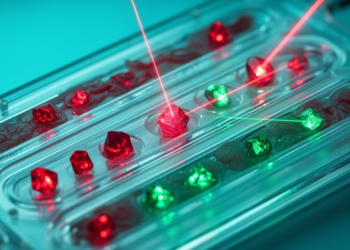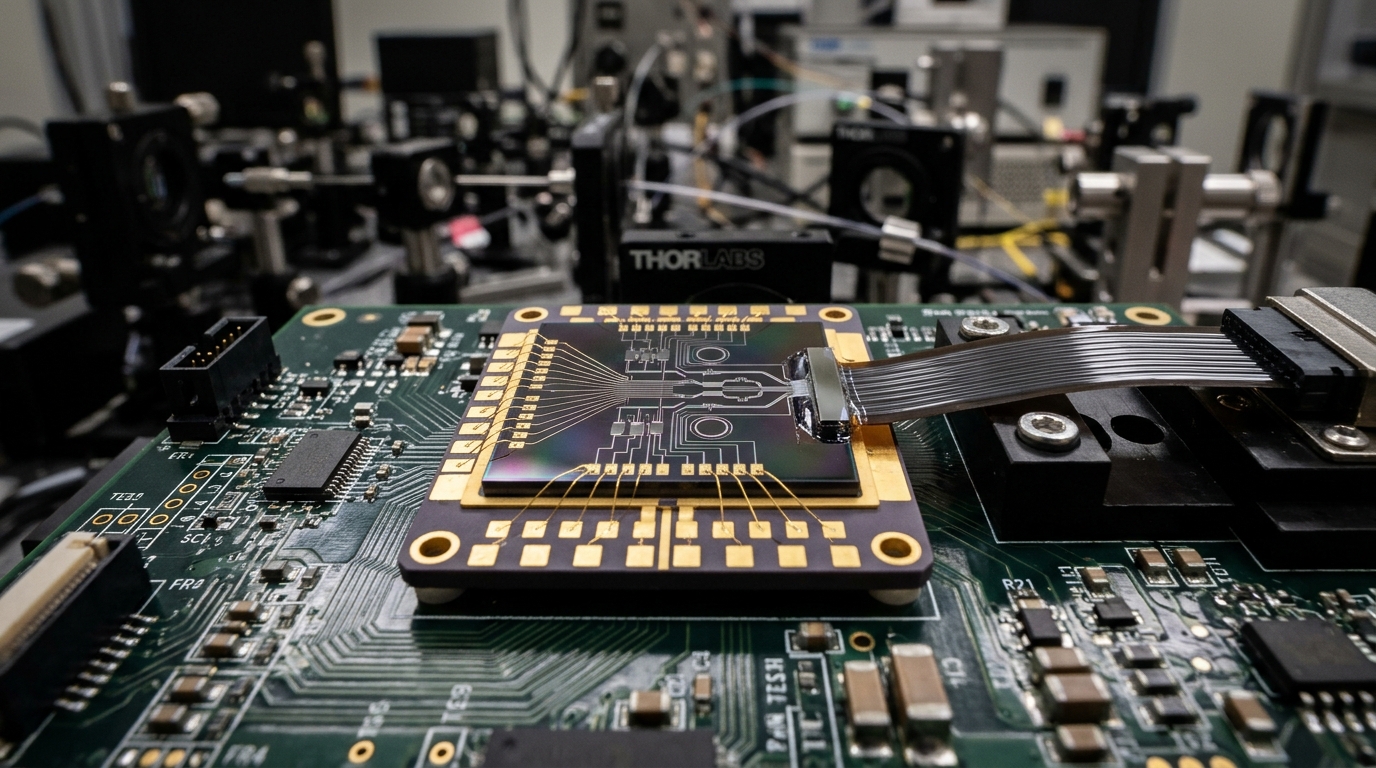
An experimental all-optical biomimetic spike encoder built on optically injected Fabry–Perot laser neurons has been demonstrated by researchers from Fudan University and Zhangjiang Laboratory. The experimental study, reported in Opto-Electronic Science, establishes an optical approach to convert real-world analog sensory signals directly into optical spike sequences suitable for photonic neuromorphic hardware. By coupling optical injection dynamics with Fabry–Perot lasers, the research group introduced an amplitude-to-rate encoding architecture capable of generating high-speed optical spike trains.
The system addresses longstanding operational hurdles that have constrained photonic spiking neural networks from transitioning beyond laboratory demonstrations. Brain-inspired spiking neural networks process information through discrete spike pulses to achieve low latency and energy efficiency relative to conventional artificial neural networks, but converting continuous real-world analog inputs into reliable optical spikes has remained difficult. Existing electrical spike generators are limited to low spike rates that cannot sustain high-throughput neuromorphic processing, while earlier optical spike devices predominantly produce binary outputs lacking a stable linear mapping between input signal intensity and spike firing frequency.
To overcome the limitations of binary-output optical spiking schemes, the researchers developed a setup that generates a steady monotonic correlation between incoming signal strength and spike firing rate. In this architecture, higher input optical intensity directly produces a higher spike firing rate. By adjusting injection power, laser frequency detuning, and the bias current of the Fabry–Perot laser, the team demonstrated amplitude-to-rate encoding operating at spike rates exceeding 2.0 GHz, while maintaining an encoding precision of approximately 5 bits.
Energy efficiency and physical compatibility were central features of the experimental platform. Each generated optical spike consumed 0.5 pJ of energy, outperforming many existing electrical and optical pulse-generation solutions. Furthermore, the encoder was designed to operate within the 1,550 nm telecommunication band, enabling direct integration and interoperability with existing optical fiber communication infrastructure rather than requiring specialized or incompatible optical pathways.
When evaluated in computational tasks, the encoder achieved a 94.1% classification accuracy for handwritten digit recognition on the MNIST benchmark dataset when paired with digital spiking neural networks. The encoder demonstrated capability beyond static visual images by successfully converting continuous audio and physiological waveforms into ordered optical spike trains. To evaluate multiplexing and scalability, the team constructed an architecture supporting time-division and wavelength-division multiplexing schemes.
The transmission stability of the optical spikes was confirmed over physical communication distances, maintaining robust encoding performance following transmission across 10 km of single-mode optical fiber. Proof-of-concept diagnostic evaluations included chest X-ray screening, electrocardiogram arrhythmia identification, and heart-sound classification. By uncovering the underlying laser dynamical mechanisms governing amplitude-to-rate encoding in optically injected Fabry–Perot lasers, the study establishes a direct path for interfacing photonic spike encoders with established fiber networks for low-power neuromorphic communication and intelligent healthcare applications.
The research addresses an ongoing gap in neuromorphic engineering, where previous optical spiking devices rarely functioned alongside deployed fiber-optic communication infrastructure or demonstrated end-to-end processing across practical signals. By converting diverse inputs originating from communication, multimedia, and biomedicine into ordered optical spike sequences, the experimental framework validates an integrated approach to connecting photonic hardware with intelligent signal processing.
The investigation was conducted by researchers with extensive experience in advanced optical communication and transmission systems. Professor Nan Chi of Fudan University, who earned her bachelor’s and doctoral degrees in electrical engineering from Beijing University of Posts and Telecommunications, contributed expertise developed over more than 25 years of research and 300 publications in optical fiber communication, coherent optical transmission, visible light communication, and optical switching. She is also a recipient of the National Science Fund for Distinguished Young Scholars.
The peer-reviewed paper was published in Volume 5 of Opto-Electronic Science on October 19, 2026, and made available online on October 21, 2026. In the publication, the authors declared no competing financial interests.
Subject of Research: All-optical biomimetic spike encoding for photonic neuromorphic computing
Article Title: Ultrafast all‑optical biomimetic encoder unlocks neuromorphic computing over fiber networks
Article References: Ultrafast all‑optical biomimetic encoder unlocks neuromorphic computing over fiber networks. Original publication (Bibliographic details unavailable.)
Image Credits: AI Generated
DOI: Not provided
Keywords: photonic neuromorphic computing, spiking neural networks, Fabry-Perot lasers, optical biomimetic encoder, fiber-optic networks, amplitude-to-rate encoding, optical computing, biomedical diagnostics, Ultrafast, optical, biomimetic, encoder
News Source: Denise Maddox. (November 13, 2026). Optical Biomimetic Encoder Advances Neuromorphic Computing Over Standard Fiber Networks. Scienmag.