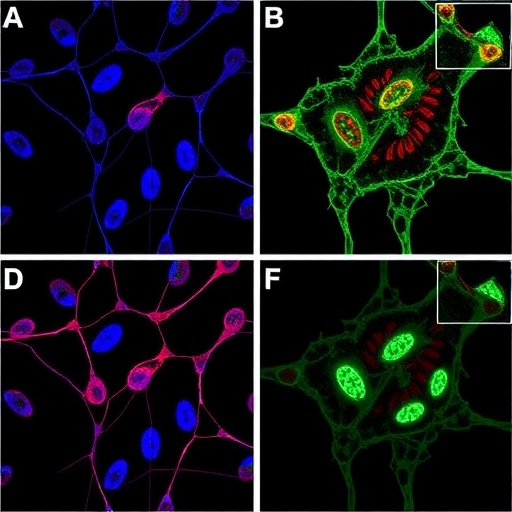
Cancer cells may rely on opportunism, as well as chemical signalling, to spread through the body, according to new findings by mathematicians at the University of Birmingham.
Cancer spreads by sending cells out from the primary tumour to travel through the vascular or lymphatic system to colonise other organs in a process called metastasis. During this process the cancer cells need to cross layers of endothelial cell – the cells that line blood or lymphatic vessels.
It has been thought that the cancer cells chemically signal to the endothelial cells making them open up gaps through which the cancer can migrate, but a team of researchers in Birmingham have suggested an alternative, or complementary, process may also be at work.
Working with partners at the Massachusetts Institute of Technology, the University of Zaragoza, and others, the team built a detailed mathematical model of the endothelial cells’ behaviour to show how and where openings in the endothelial layer appear, and how long they remain open for.
Their results, published in PLOS Computational Biology, showed how the physical forces within the cells’ structure continually push and pull the cells in different directions, sometimes causing the bonds between them to rupture, leaving temporary gaps.
Researchers then tested this model on cell cultures of endothelial monolayers with cancer cells, and observed how the cancer cells were able to capitalise on this endothelial movement and migrate through the gaps.
“The gaps in the endothelium open and close spontaneously – whether cancer cells are present or not,” explains lead researcher, Dr Fabian Spill, Lecturer in Applied Mathematics at the University of Birmingham.
“They are caused by an interplay between mechanics and chemistry exerting different forces on the cells. Much work has already been done to characterise the chemistry of the endothelium – our work complements this research, focusing on the mechanical forces at work in these processes.”
Interestingly, the researchers also found that openings were most likely to appear at the junctions of three or more cells, as opposed to two-cell borders. Cancer cells that had landed on borders between two cells were able to migrate towards these tricellular junctions, where they leaked through. This indicates that the cancer cells are able not only to signal to the endothelium to chemically open new gaps, they can also employ an opportunistic wait-and-see approach. This enables them to take advantage of the spontaneous formation of gaps in the endothelium.
In this study, the team focused on the vascular system. Future work will examine the lymphatic system or different types of endothelial cells, and will also focus in more detail on other contributing factors to endothelial gap dynamics, such as blood flow and the 3D structure of blood vessels, all of which will affect the ability of cancer cells to transmigrate.
###
Notes for editors:
* Spill et al (2019. “Balance of Mechanical Forces Drives Endothelial Gap Formation and May Facilitate Cancer and Immune-Cell Extravasation”. PLOS Computational Biology. https:/
* The University of Birmingham is ranked amongst the world’s top 100 institutions, its work brings people from across the world to Birmingham, including researchers and teachers and more than 6,500 international students from over 150 countries.
Media Contact
Beck Lockwood
[email protected]