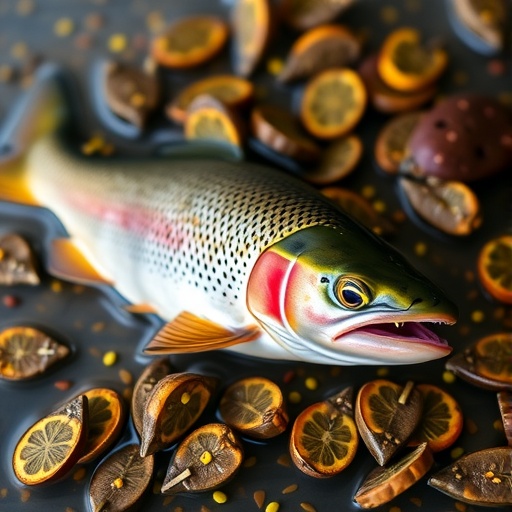
As the global demand for sustainable aquaculture intensifies, the industry is undergoing a significant transformation. Traditional reliance on fishmeal and fish oil is increasingly viewed as ecologically unsustainable, prompting a shift toward plant-based feeds. However, this transition has introduced a complex challenge: many fish species exhibit reduced feed intake and stunted growth when reared on entirely plant-based diets. A groundbreaking study focusing on rainbow trout unravels some of the underlying neurobiological mechanisms driving this phenomenon, shedding new light on how fish perceive and respond to their diets at the molecular level.
Researchers have long sought to understand why fish fed exclusively plant-based diets often fail to thrive, despite the nutritional adequacy of these feeds. The study, conducted by Jérôme Roy and colleagues, took a comprehensive approach by examining the temporal dynamics of feeding behavior and brain chemistry in trout. From first feeding onward, the experimental design involved two groups of trout: one receiving a conventional diet rich in fishmeal and fish oil, the other fed a completely plant-based formula. Growth metrics, feeding patterns, and neurochemical profiles were assessed at critical intervals—five days, one month, and eight months—to capture both immediate and long-term impacts.
Initial findings revealed that trout consuming the plant-based diet consistently displayed lower body weights across all time points, highlighting a persistent growth deficit. At five days post-initiation, these fish weighed approximately 8% less than their conventionally fed counterparts. This disparity widened over time, reaching 17% at one month and escalating to a striking 33% after eight months—229 grams compared to 344 grams in fish meal-fed trout. Interestingly, feed efficiency metrics remained comparable between groups, implying that the diminished growth was primarily attributable to reduced feed intake rather than altered metabolic utilization of nutrients.
Delving deeper, the team explored the neurochemical pathways implicated in reward processing and feeding motivation, with a particular emphasis on the brain’s opioid system. The opioid system is instrumental in mediating hedonic responses—the pleasurable sensations associated with eating—which are critical for driving food intake and regulating appetite. By employing gene expression analyses and neurotransmitter activity assays, the researchers tracked how components of this system responded to the different diets over time.
After just five days on the plant-based diet, only a single opioid receptor gene, oprk1, showed a significant diet-dependent modulation shortly post-feeding. This subtle early response suggested that immediate hedonic signaling was largely unaffected. However, by the one-month mark, a pronounced shift emerged: trout on the plant-based diet exhibited increased serotonin turnover, a neurotransmitter closely linked to mood and appetite regulation. Concurrently, alterations appeared in the expression of pdyn, an opioid precursor gene, indicating an evolving adaptive response within the opioid circuitry.
The most profound changes manifested after eight months of continuous exposure to the plant-based diet. Multiple genes tied to the opioid system within the telencephalon—a brain region analogous to the mammalian cortex and associated with reward valuation—were significantly dysregulated. These long-term molecular shifts correlated with the sustained reduction in feeding and growth, underscoring a delayed but substantive engagement of the brain’s reward pathways under nutritional stress imposed by a non-traditional diet.
Jérôme Roy, the study’s senior author, reflects on these results, noting that while growth and intake deficits are evident from the outset, the opioid system’s marked response is temporally delayed. This latency implies that the brain initially tolerates dietary change but subsequently activates hedonic regulatory mechanisms that may diminish the palatability and desirability of plant-based feed. Such insights challenge the simplistic notion that nutritional composition alone dictates fish growth and underscore the nuanced interplay between diet and neurobiology.
Lead author Elisabeth Plagnes-Juan emphasizes the practical implications of these findings for aquaculture. Enhancing the palatability of fish-free feeds is crucial not only for optimizing growth but also for reducing feed waste and environmental impact. By monitoring opioid-related biomarkers, producers may gain novel tools to evaluate and refine feed formulations, ensuring that alternative feeds are not only nutritionally sufficient but also neurobiologically appealing to cultured fish.
This research also contributes to a broader understanding of how animals integrate sensory, nutritional, and reward signals to regulate feeding behavior over time. The delayed engagement of opioid pathways in response to sustained diet composition shifts may represent an evolutionary conserved mechanism that balances the need for diverse nutrient sources against the hedonic costs associated with unfamiliar foods.
Moreover, these discoveries point toward innovative strategies for feed development in the aquaculture sector. Incorporating components that modulate opioid signaling or enhance serotonergic activity could potentially mitigate the negative effects of plant-only diets on feed acceptance. This approach opens new avenues for interdisciplinary collaboration, blending nutritional science, neurobiology, and fish physiology to advance sustainable aquaculture.
From an ecological standpoint, transitioning to plant-based aquafeeds is essential for conserving marine resources and reducing the carbon footprint of fish farming. Yet, as this study reveals, such shifts are accompanied by complex biological trade-offs. Understanding the neurobiological underpinnings behind feeding behavior will empower the industry to develop more effective feeds that align environmental sustainability with fish welfare and production efficiency.
Ultimately, this research underscores the importance of considering the sensory and hedonic dimensions of animal nutrition. As aquaculture continues to evolve, integrating neurobiological insights into feed formulation will be pivotal for overcoming current limitations and achieving sustainable, high-performance fish farming.
In conclusion, the temporal alterations observed in the opioid system of rainbow trout fed plant-based diets expose a delayed neurochemical feedback mechanism influencing feeding behavior and growth. These findings illuminate the sophisticated neural pathways governing dietary acceptance and highlight potential targets for enhancing the palatability of alternative aquafeeds. By bridging nutrition and neuroscience, this study provides a compelling blueprint for future research and practical innovation in aquaculture nutrition.
Subject of Research: Animals
Article Title: Temporal hedonic regulation of feeding behavior in rainbow trout: a role for the opioid system under plant-based diets from first feeding onward
Image Credits: Jérôme Roy, et al
Keywords: Aquaculture, Biochemistry, Nutrition
Tags: ecological sustainability in fish farmingeffects of plant-based feed on troutfeed intake challenges in fishfeeding behavior and brain chemistryfishmeal alternatives in aquaculturegrowth metrics in farmed troutneurobiological mechanisms in troutopiate system in fishplant-based diets for aquacultureresearch on aquaculture nutritionsustainable aquaculture practicestrout diet and health